Uganda’s GMO biosafety bill ensuring ‘no dangers’ likely to pass after embrace of president’s proposed changes

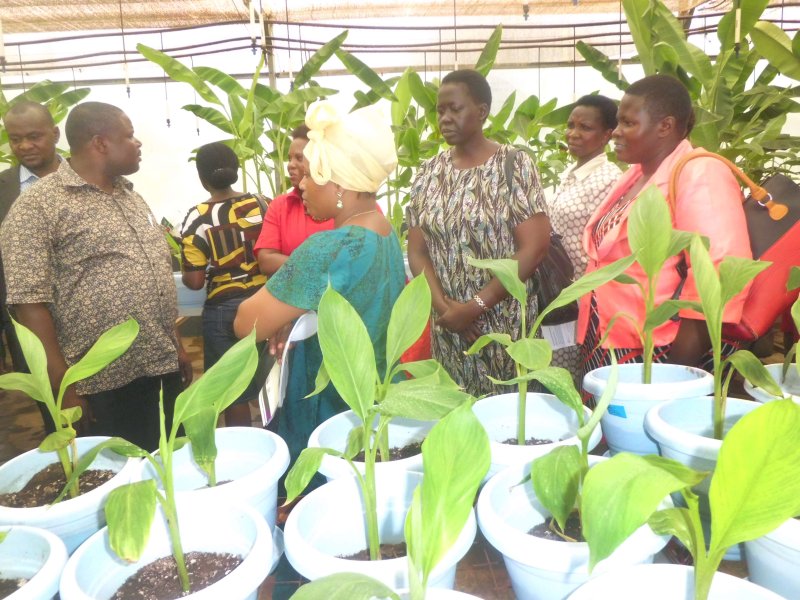
GM Banana greenhouse
A section of Uganda's legislators in a field tour of GM plants in green houses at the Nataional Research Laboratories Kawanda- Uganda.

Legislators on the Parliamentary Committee on Science, Technology and Innovation have changed their positions on the GMO Bill and considered proposals suggested by President Museveni …. This comes after the President declined to sign the Bill into law in December 2017 ….

[T]he committee has accepted …. the Presidentโ€™s recommendations …. Regarding the name of the Bill for instance, the MPs report that โ€œthe committee …. found it necessary to align the title to the contents of the Bill.โ€ The proposed name contained in a draft Bill is โ€œThe Genetic Engineering and Biosafety Act, 2018.โ€

The committee also provided for the containment of confined field trials in green houses to prevent genetically modified seeds and related materials from being randomly mixed with indigenous ones. The new Bill also prohibits human cloning from genetic engineering.

However, whereas the President advised that the use of poisonous and dangerous bacteria as inputs in genetic engineering must never be allowed, the committee emphasized that โ€œthis may not be avoided [but] safety measures have been provided for in the Bill to ensure that there is no danger to plants, humans, the environment and animals.โ€

If the new changes are adopted by Parliament, the President will have one more chance to sign the Bill into law and should he still decline, then Parliament will simply convene and pass it into law.

Read full, original article: MPs accept Museveniโ€™s proposals on GMO Bill

{{ reviewsTotal }}{{ options.labels.singularReviewCountLabel }}
{{ reviewsTotal }}{{ options.labels.pluralReviewCountLabel }}
{{ options.labels.newReviewButton }}
{{ userData.canReview.message }}

Related Articles

Infographic: Global regulatory and health research agencies on whether glyphosate causes cancer

Infographic: Global regulatory and health research agencies on whether glyphosate causes cancer

Does glyphosateโ€”the world's most heavily-used herbicideโ€”pose serious harm to humans? Is it carcinogenic? Those issues are of both legal and ...

Most Popular

ChatGPT-Image-Apr-20-2026-11_17_18-AM-2
10,000 scientists gone: Trumpโ€™s cuts create an unprecedented brain drain
Screenshot-2026-04-22-at-4.10.32-PM
Viewpoint โ€” โ€˜Completely unethicalโ€™: RFK, Jr.โ€™s medical ignorance deprives melanoma cancer-sufferers of a life-saving therapy
ChatGPT-Image-Apr-22-2026-04_31_20-PM
โ€˜Irresponsible decisionโ€™? On mandatory military flu shots, Hegseth chooses โ€˜freedomโ€™ over health
ChatGPT-Image-Apr-20-2026-12_28_36-PM
Vaccine skepticism is a growing global problem
Screenshot-2026-04-15-at-1.22.58-PM
Anti-biotechnology activists smear hybrid wheat breakthrough that could surge yields in poorer countries
ChatGPT-Image-Apr-17-2026-03_30_52-PM
Food labels, decoded: What they really mean
ChatGPT-Image-Mar-2-2026-03_22_54-PM
Why โ€˜support supplementsโ€™ for GLP-1 users are mostly a waste of money
images
The never-ending GMO debate: Pros and cons
ChatGPT-Image-Mar-11-2026-11_58_46-AM
The Trump administration has run out more than 4,000 National Institutes of Health employees. Here are the consequences
Screenshot-2026-04-22-at-1.14.34-PM
Latest fevered, right-wing conspiracy: Fox, New York Post, and kooky GOP legislators push โ€˜Dead Scientistsโ€™ scare
Screenshot-2026-04-12-135256
Bixonimania: The fake disease scam that AI swallowed whole
glp menu logo outlined

Get news on human & agricultural genetics and biotechnology delivered to your inbox.