Farming may go high-tech, but unless seeds keep pace, all improvements will be cosmetic. Or that’s what scientists at research institutes think. “Till the government allows farmers to adopt genetically modified (GM) crops, there is little chance of an agricultural transformation that we are talking about,” says P. Ananda Kumar, director of the Indian Institute of Rice Research.
But isn’t GM bad? … Kumar sees little benefit in the endless debate. “After all,” he says in a matter-of-fact way, “it is already working in 28 countries covering 185 million hectares and 15 crops.”
…
Modified seeds for brinjal [eggplant] and mustard have been argued about for years now. “It is time that the Indian government or the political leadership heed the advice of its own scientists than some vested interests using scare-mongering tactics in the media,” says Kumar caustically. Elsewhere, K.K. Narayanan, founder and chairman of Kottaram Agro-Foods, gets agitated when I ask about Bt brinjal [eggplant]. These technologies, which can add Rs 60,000 crore every growing season, are left “sitting on the shelf”, he says. Bhagirath Choudhary, founder director of New Delhi-based South Asia Biotechnology Centre, adds that farmers themselves will not have any problem shifting to GM seeds once they see profits flowing in. “Unfortunately, that is not happening because no one is allowed to demonstrate the benefits of GM crops to the farmers,” he says.
On [June 3 and 4], hundreds of scientists, industry folk, and public health officials from all over the world filled the amphitheater at the Boston World Trade Center to reckon with the power of biology’s favorite new DNA-tinkering tool: Crispr.
…
“In a time like this with ethnic nationalism sweeping Europe and Trump nationalism sweeping the US, not democratizing these kinds of technologies is a genuine threat to those of us who are minorities with less powerful in this society,” [said urban farmer Antonio Cosme].
Like any technology, the applications of gene editing tech will be shaped by the values of the societies that wield it. Which is why a conversation about equitable access to Crispr quickly becomes a conversation about redistributing some of the wealth and education that has been increasingly concentrated in smaller and smaller swaths of the population over the past three decades.
…
The fear is that Crispr won’t disrupt current inequalities, it’ll just perpetuate them.
Professor Simon Blackmore, head of robotic agriculture at the UK’s National Centre for Precision Farming at Harper Adams University in England, says that increasingly sensitive and precise sensors and instruments are being developed that can measure the “complex nature of the growing environment” on every square meter of farmland — the soil and water conditions; the presence of pests and diseases; the location of weeds, and the size of crop plants.
In addition to measuring the state of a crop, robots will be able to actively improve growing conditions, not least by getting rid of weeds.
“We’re developing a whole range of smart machines now that potentially might be able to replace the tractor and the combine harvester,” Blackmore said. “And we’re coming up with systems that will allow us to replace herbicides… One project I’m developing is called laser weeding.”
But if Blackmore is right, robots could, at a minimum, vastly reduce the total amount of poison farmers need to apply in order to grow thriving crops in weed-free fields.
For years, Michael Becker was one of the drug executives navigating swarms of cancer doctors at the annual meeting of American Society of Clinical Oncology.
…
This year he came back, but it was very different. This time he spoke to an audience of drug executives as a patient living on borrowed time. Becker has been on a personal crusade to raise awareness about the human papillomavirus, or HPV, which caused the cancer that will likely kill him–possibly soon.
…
He finagled his way into a clinical trial of an experimental drug, but the side effects were excruciating as one of his lungs filled with fluid and required a tube to drain it. After that, he had to be convinced to try chemotherapy, which, in fact, did make his tumors, which had spread to his lungs, shrink. He’s living proof, he says, that even an expert can be seduced by the promise of an experimental drug, even when there is a better alternative.
…
Chemotherapy shrank his tumors at first, but eventually it stopped and Becker decided he couldn’t take its mounting side effects.
…
He knows that his next scans may show his tumors growing again but says he still doesn’t think he wants to try another treatment.
…
We’d like to thank Mike for letting us, and now you, into his life.
This video describes advances by the International Potato Center and the National Agricultural Research Organisation (NARO) of Uganda to develop a potato variety resistant to late blight.
From the tiniest microbe to the biggest whale, the ocean is teeming with life. For corporations and researchers, that biodiversity is a veritable gold mine of genetic potential.
…
[Robert] Blasiak is the first author of a new paper, out [June 6] in the journal Science Advances, that charts currently-held patents on marine genetic resources. That paper’s findings paint a strange picture: of the almost 13,000 genetic patents held on marine species, almost half are held by a single corporation.
…
In this case, for a company that has patented a gene from a sea organism (known as a Marine Genetic Resource), owning the patent to a particular genetic sequence allows them the sole right to do research on it and produce products related to it.
…
The concerns with gene patenting are that giving corporations control of the literal code of life inherently devalues that life, and that lack of free access to genetic information could impede research and development of novel things like cancer treatments.
…
This September, the United Nations will begin negotiating a new treaty to regulate the high seas that will explicitly include MGRs. The negotiations are expected to stretch into 2020. Blasiak says he and his colleagues would like to see BASF, the corporation that holds holds 47 percent of the MGR patents, take a seat at the table.
Have you heard the oft-repeated “fact” that it takes at least 10 years from initial discovery for a new drug to enter the marketplace? Take it with a grain of salt. The drug development journey is closer to 30 years.
…
Studies of innovation in areas such as computing and aeronautics show that the maturity of a new technology is the single biggest predictor of product success. That makes sense. When a discovery is made, scientists often have only a rudimentary understanding of what they’ve discovered.
…
We developed a mathematical model that applies this concept to biomedical science and drug development. It examines the thousands of research publications that characteristically follow an initial scientific discovery, recognizes patterns in the progress of this research, and measures the maturation of this research over time. Our work shows that biomedical research follows a predictable pattern of growth and maturation, and that few new medicines are successfully developed before this research passes a critical established point.
…
While most efforts to accelerate the emergence of new medicines focus on expediting the penultimate stages of testing in humans and passing FDA review, our work suggests that paying more attention to the longest stage — the time required for the underlying technologies to mature — will pay off.
Bioscientist Dr. Ted Cocking, from the Centre for Crop Nitrogen Fixation in the UK, was the first to unlock the potential of this unique bacterium – Gluconacetobacter diazotrophicus, or Gd for short.
Effective in the laboratory, Dr. Cocking’s ambition was always to get this technology out into the field.
In 2011, he paired up with entrepreneur Peter Blezard. Together they started a company called Azotic….
Mr. Blezard hopes Azotic will begin selling the ‘super bacteria’ in liquid and powder form, on the US commercial market from next spring.
“Currently we are focusing on corn and soya crop trials in the US and Europe, and rice trials in Vietnam, Thailand and the Philippines,” says Mr. Blezard.
“In Vietnam, we seeing up to 50% reductions in nitrogen fertilizer, combined with a 15% increase in rice yields.”
But not everyone is as convinced.
Microbiologist Dr. Tim Mauchline from the Rothamsted Research in the UK, doubts this technology can be replicated in all crop varieties, all over the world.
“The world is a big place with different climates, weather patterns, crops, and soil types,” he says.
“To think there’s one silver bullet that can solve all of these problems, this would be fantastic, but I will be surprised if it is the case.”
Glyphosate is a herbicide, in other words, it is toxic to plants. Its target enzyme is not found in insects or other animals, so it is generally not very harmful to them – and as confirmed by a recent study, even direct sprays are not lethal to bees.
This is what I said about bees in my series 17 Questions about Glyphosate. I thought that glyphosate having anything to do with bee welfare would be such a far-fetched idea that I needn’t dedicate more time to that. But, time and again, when discussing glyphosate – usually in some completely different context – someone will pop up and go “it should be banned because it harms bees!” So let’s talk about that in more detail.
While many insecticides can indeed harm a variety of insects (though bees are not their intended target), the big difference, as I said earlier, is that glyphosate is not an insecticide, but a herbicide. (Both insecticides and herbicides, among many other -cides, by the way, fall under the umbrella of pesticides). Glyphosate’s particular target enzyme does not exist in animals, which means that it does not interfere with our amino acid synthesis, and has generally very low toxicity outside of plants (or some bacteria).
Not toxic to bees, either
Lets look at the published research on toxicity regarding bees by searching Pubmed for ‘glyphosate’ and ‘bees’. A large 2014 study sprayed bees’ forage with glyphosate in series a glasshouse experiments, and also fed glyphosate-laced sucrose to their brood…
…at dose rates that reflect worst-case exposure scenarios. There were no significant effects from glyphosate observed in brood survival, development, and mean pupal weight. Additionally, there were no biologically significant levels of adult mortality observed in any glyphosate treatment group.
A 2015 study, on the other hand, subjected bees to direct sprays of 42 insecticides, and one herbicide: glyphosate, in common usage concentrations. Their results not only confirm that being caught in a glyphosate spray demonstrated no acute toxicity from glyphosate within two weeks, but it also illustrates the point that demonising one class of pesticides is misleading at best. Entomology Today:
Using a modified spray tower to simulate field spray conditions, the researchers found that 26 pesticides, including many (but not all) neonicotinoids, organophosphates, and pyrethroids killed nearly all of the bees that came into contact with the test pesticide sprays. However, seven pesticides, including glyphosate and one neonicotinoid (acetamiprid), killed practically no bees in the tests.
So, bees happily went on with their business after glyphosate spray. A 2017 study likewise found that:
Our data demonstrated that residue levels of seven pesticide [including glyphosate] in pollens/hive may not adversely affect honey bees
Well, that seems rather straightforward. Glyphosate shouldn’t really be a problem for bees, there is no suggested mechanism of harm in bees, and… it does not show ill effects in bees.
But wait – groups like GMO-free USA actively peddle the idea that glyphosate would be ‘contributing to colony collapse disorder’ (see meme below). How, then?
What about bee behaviour?
This particular work on bee behaviour comes from one lab in Buenos Aires headed by Dr Walter Farina, where they have published three papers that claim glyphosate impairs bee learning in some ways. The study of bee cognition is certainly a fascinating area. The group’s 2015 paper on bee navigation found that bees fed with a sucrose solution with 10 mg/l of glyphosate took a longer time to fly home. Let’s take a look at their experiment.
Hyperbolic anti-GMO campaigners’ meme.
They trained bees to collect sucrose solution at a feeder. They then captured them at the hive, tagged them and glued a radar transponder on them, fed them sucrose with or without glyphosate, released them at a new location, and recorded their flight back to the hive (or feeder). They then tried to catch the same bees again at the feeder after that, to drop them again at the same release location and see if they had learned something about finding their way home.
They had the bees divided into four treatment groups, and had between 8 and 22 bees in each group the first time around. During their first release, they found that the high treatment group (8 bees strong) took on average about 9 minutes to fly back (see figure A), while all the other 42 bees of the other 3 groups (control, 2.5, and 5 mg/l treatment) flew home on average in about 4-5 minutes (one outlier in the control and largest group, with 22 bees, took the longest, 17 minutes, but they also had the fastest home-run, about 2 minutes).
There was no significant difference in flight times for those that flew to the feeder first (in grey, figure B) instead – if anything, the control group was slowest this time. This below, then, is their one core finding:
After this they tried to re-captured the bees, but only managed to get hold of four bees in the high treatment group. All four re-released groups flew back home at very similar times, between 3-11 minutes, which by the way is a range where the first high treatment flight-time falls in too (see A in the next figure below – why they have the scale so zoomed out this time, so that comparison to the first figure A is not as clear, I don’t know). The range was similar between releases, with no clear learning effect for any group. The flight times to the feeder were similar too, apart from the high treatment group, which was actually faster. Of course, at this point each flight-group studied had between 1-4 or 1-12 bees (…), and so nothing was statistically significant.
Let that sink in. Yes, the paper claims to analyze ‘long-term consequences’ for bee learning – based on two flights, and with experiment ‘groups’ that are 1 bee strong.
To actually say anything meaningful about bee behaviour, it’s not very radical to ask that we’d want to see clear differences in said behaviour of actual groups of bees, and in several repeat experiments. I am not alone in my thinking, either. I talked about this paper with an entomologist who does science outreach over at the blog The Mad Virologist, and he had this to say:
With that type of experiment, you really need large numbers of insects and many replicate flight experiments. With only two replicate experiments, this would be a hard sell in an entomology journal, especially given the low numbers used in each experiment.
He went on to contrast this study with examples of robust studies instead: like one on bee foraging with three replicates of RFID-tagged bees – in each colony, they included 400 bees per treatment condition (vs the 10-20 in Farina’s); or an earlier study of bee flight of more than two thousand bees all in all, and with four replicate experiments.
What about confounding factors?
When you study something this subtle, with bees flying this way or that at 15-minute intervals, the situation is chock full of surprising and unaccounted variables – weather conditions? Other animals? Variations in the manual handling of the bees? What about parasites and disease? The nosema fungus, for instance, is specifically known to cause learning deficits in honeybees, and the Deformed Wing Virus has deleterious effects on foraging. The Mad Virologist has touched before on the shortcomings of bee-studies that make the mistake of not accounting for the variable of bee diseases.
To say anything about the real world, of course, this kind of research should preferably be presented with a connection to the overall wellbeing of the hives, following the pattern of actual glyphosate residues in the bees’ environment. Otherwise all this is very hypothetical.
Consider that GMO-free USA claim once more: ‘glyphosate impairs bee navigation and contributes to colony collapse disorder’. Wait, what? Eight bees were a few minutes tardier once – though their high-treatment buddies who flew straight to the feeder instead were not tardy. The second time around (the ‘learning effects’) they all flew back home just as fast, and to the feeder even faster than the other(s).
But wait – the study also lost a fourth of their bees
The paper also lists number of bees that did not return to the hive, period. In total 26 % of the bees never arrived back at the hive. That seems a rather alarming percentage. If at any one random time when four bees set out from a hive, only three return, it sounds like an untenable situation in the long run. Nowhere in their paper could I find discussion about what might have caused the large rate of non-arrivals.
The largest numbers of non-returning bees both times were found in the lowest treatment group, but the control group was no means well off, with 22 % and 16 % losses. In the second release, (the very small) intermediate and high treatment groups actually had zero losses. Should we draw the conclusion that high dose glyphosate has a protective effect then, guaranteeing that bees return to the hive?
No. Just no. But the opposite claim, which Farina’s paper makes,
exposure to levels of GLY commonly found in agricultural settings impairs the cognitive capacities needed to retrieve and integrate spatial information for a successful return to the hive, […] with potential long-term negative consequences for colony foraging success
is far from well supported by the evidence presented.
What this analysis hopefully shows, is that the more subtle the thing we are studying is, the more care we should take before drawing conclusions about its implications one way or another. With such tiny groups of bees and no other lab independently supporting these results, to think that this highly variable data shows anything with real-world meaning is incredibly far-fetched.
No real world connections
The group’s earlier piece claims that glyphosate-dosed bees show decreased sucrose-responsiveness, that is, they are not as drawn to higher levels of sucrose (presumably applicable to choosing sweeter nectar in the field). So far the only connected paper I’ve found from another group found instead that bees showed a preference for sucrose with glyphosate residue as opposed to sucrose with other pesticide traces. The group Farina are alone to report their suggested subtle cognitive effects – and even their own paper states that effects outside of their limited experimental settings are lacking:
However, no effect on foraging-related behaviour was found.
What about the realism of the dosing of the bees by Farina’s group? Severalstudiesreport that glyphosate residues in the soil quite quickly decrease to micro and nanogram levels (vs the milligram level dosages in Farina’s studies), and a very rapid breakdown is seen in pollen and nectar. The maximum residue limit in the US on most flowering crops, is also very low, often from a few milligrams to micrograms per kg – and these are the maximum limits, with 99.8 % of all produce tested below, and 80% tested 20 or even more times below – more about the residue data here by Steve Savage.
Canola/rapeseed in bloom (Image credit: Myrabella/Wikimedia)
The dosing of bees is made unlikelier again by the fact that glyphosate is commonly applied on weeds as they emerge, to eliminate them long before they can use up resources, flower, and go to seed. Later as the crop grows its shadowing effect will take care of most other weeds. It seems unrealistic that bees would commonly be exposed to concentrations of 10 mg/l in their feed. If that happened at some point, and we would take Farina’s groups’ suggestions at a face value, what might we expect? That the bees would fly home a few minutes later that time? This is very little to go on.
In fact, in the 2014 toxicity study from England which looked at twenty hives with more than 10,000 bees each, they directly sprayed the bees’ forage and fed the brood with more than hundred-fold exposure to glyphosate (high treatments being 150 and 300 mg/l), and reported no ill effects on development. Exposure to an order of magnitude higher doses of glyphosate than in Farina’s experiment had no effect on bee health or survival.
I have not even seen correlations suggesting a connection between glyphosate use and pollinator health, either temporally or geographically. This seems like a crucial link to present before we start talking about glyphosate actually having anything to do with bees.
If you care about bees, look elsewhere
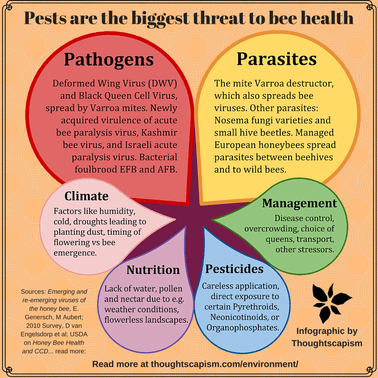
We do know that habitat loss, disease, invasive species, climate, and many other factors have detrimental effects on not only bees, but most wild animals, whereas glyphosate is an important method in the toolkit to counteract many environmentally harmful effects of farming. As weed ecology professor Andrew Kniss writes, if farmers would be forced to forgo glyphosate, on top of consequences like increased soil erosion and fuel use, we could well see a return to less diverse rotations:
If we truly want to encourage crop diversity, then glyphosate use can be a powerful tool in allowing those diverse crop rotations while still managing weeds.
Frankly, glyphosate wasn’t brought into the public discussion because of a sincere concern for bees (although many who end up repeating the claims may do this without realizing the dishonesty). Anti-GMO groups are campaigning against glyphosate because they will grasp any straws to use as arguments against Genetically Engineered crops. They don’t wait for solid support before making claims, either, because it is enough for them to be loud enough and sow doubt in the public perception (an example of the kind of striking anti-glyphosate bias among the French media here, or in French, here). This is an ideological and an emotional type of resistance, where evidence means little, unless it can be used to bolster one’s pre-existing passionate dislike of the idea of biotech crops and pesticides to begin with.
Bumblebees I photographed in Finland. Diminishing wildflower habitats and invasive species can pose grave problems for wild bees, whose situation is largely unknown. In many parts of the world, the farmed European honeybee is an invasive species, which especially if left untreated can spread disease.
If we care about bees, however, let’s remember the underlining principles about weighing scientific evidence – that we should rely on several converging lines of solid evidence to make sure we are not fooling ourselves – and try to focus on the big picture.
Iida Ruishalme is a writer and a science communicator who holds a M.Sc. in Biology from Sweden. Follow her on twitter @Thoughtscapism or on the Thoughtscapism Facebook page.
It’s 2 am. I’ve been in bed for hours, but I can’t fall asleep. I’m worrying about my upcoming project deadline or whether I’m eating enough protein or that time three months ago a waiter told me to enjoy my meal and I said, “You too!”
It’s tempting to reach for a pill to help us sleep — about 4 percent of Americans use prescription sleeping aids. But while medication may seem like an easy solution, many worry about addiction or rare but serious side effects like amnesia and hallucinations. So research labs across the globe are looking for better, safer ways to help people get the sleep they need.
Although historically sleep researchers have focused on the brain, new experiments are looking elsewhere: the gut. Recently, studies in both humans and animals have linked gut microbes to sleep behavior. Now, a research group in Japan is asking whether ingesting certain microbes can actually help us sleep better, especially in times of stress.
Results from a recently published study by researchers from Tokushima University and the Yakult Central Institute in Japan seem promising. In the study, microbiologists gave a fermented milk beverage to medical students undergoing a very stressful examination. The drink contained a type of bacteria called Lactobacillus casei strain Shirota (LcS), which has several purported health benefits like improving digestive health and reducing infections.
Lactobacillus is a genus of bacteria, meaning it’s a group of bacterial species that are related, but not exactly the same. Many Lactobacillus species naturally occur in the human gut and in fermented dairy products like yogurt. However, different species within a genus can have very different effects on human health.
For comparison, a dog and a wolf belong to the same genus, but you wouldn’t want a wolf in your house. Similar differences exist between species of bacteria, which is why many studies, including this one, examine the effects of a single species.
Image credit: Paul, Unsplash
In the weeks before and after the exam, researchers instructed students to drink either a beverage containing the bacteria of interest (LcS), or a placebo beverage. The study was double-blind, meaning neither the researchers nor the students knew which drink was which until after all of the data had been collected. As expected, students’ stress ratings increased as the exam approached. Unsurprisingly, the tense students who drank the placebo beverage took longer to fall asleep. This placebo group also experienced decreases in slow-wave sleep, a type of deep sleep which is thought to be important for memory. Although effects of stress on sleep are not always consistent across studies, increased sleep latency and decreased slow wave sleep have both been previously associated with stress.
But while the group that drank the LcS concoction had similar increases in reported anxiety, they didn’t seem to experience the sleep problems that usually come along with exam stress. They took less time to fall asleep, had more slow wave sleep, and reported being less sleepy when they woke up, compared to the placebo group. The study authors reported no harmful side effects and concluded that “daily consumption of LcS may help to maintain sleep quality during a period of increasing stress.”
Now, this sounds pretty good. But before you run out and buy a case of this probiotic drink, the study did have some caveats. First, researchers studied the effects of this drink in a fairly small and homogenous population: Japanese medical students. Small sample sizes are more subject to bias, and therefore the study’s conclusions may not hold true in the general population. This trial only used about 50 participants in each group. In comparison, Phase 3 clinical trials, which most drugs must go through before they are approved by the Food and Drug Administration (FDA), consist of hundreds or even thousands of participants.
Mis- and disinformation are distorting science and public policy. Subscribe to our Daily and Weekly Digests for incisive coverage of ‘disruptive’ innovations in AI, agricultural biotechnology, food, chemicals, nuclear energy, vaccines, and other disruptive innovations.
Second, it’s always important to look at who’s paying for the research being conducted. In this study, most of the researchers were paid by a company called Yakult Honsha Co.— the same company that makes (and sells) the probiotic beverage being assessed.
Does that mean the study is worthless? Probably not. The double-blind design makes it much less likely that researcher bias will affect the outcome of the study. Nevertheless, it’s important that this study be replicated by another group not affiliated with Yakult.
Finally, this study doesn’t answer how this probiotic beverage affected sleep. Research on probiotics has been plagued by the question of whether microbes we eat can actually survive the highly acidic environment of the stomach and establish a foothold in the intestines long enough to make an impact. After all, our gastrointestinal tract is already teeming with bacteria, all competing for limited resources like space and nutrients. Were the LcS bacteria used in this study actually able to set up shop in the intestines of the participants? If so, what chemicals did they produce once established in the gut? Did they signal to the brain through the vagus nerve, or secrete compounds that alter immune system function? We still need to figure out the mechanisms through which probiotics affect our bodies before we actually understand their impact.
These questions won’t be easy to answer. The microbiome is insanely complicated; it’s an entire ecosystem living in our gut that we are only beginning to understand. Furthermore, this is a world that is highly dynamic, changing based on our diet, our stress levels, the antibiotics we’ve taken, and a host of other factors. Unlike a healthy heart, which likely looks similar between different people, a healthy microbiome might look very different between different individuals.
Still, overall this study on the beneficial effects of LcS bacteria is promising. Studies like this one have given us tantalizing insights into how we might manipulate the microbiome to treat everything from post-partum depression to colorectal cancer. It is a field with the potential to revolutionize medicine — but there’s still an enormous amount of work to be done before we can understand the complex workings of our inner microbial worlds.
Hannah Thomasy is a neuroscientist at University of Washington Seattle.
In an effort to understand, on the finest level, what makes us human, [Bobby Kasthuri has] set out to create a complete map of the human brain: to chart where every neuron connects to every other neuron. The problem is, the brain has more connections than the Milky Way has stars.
…
Making that map seems like a task that could consume not just one lifetime, but dozens. Yet in just three years, it might just be possible. Kasthuri, a neuroscientist at Argonne National Laboratory, is one of many scientists whose research will use a new supercomputer the lab is building, which is scheduled to be deployed by 2021. The computer, called Aurora 21, will run one quintillion operations in parallel—a billion billion calculations—putting it on par with the processing power of the human brain.
…
Aurora 21 is designed for more than just simulating our brains. It will be able to perform computationally demanding simulations for tasks as diverse as predicting the weather, tracing the evolution of the cosmos, and understanding how new medicines will interact with the human body.
…
For [professor Michela] Taufer, the high-performance computing scientist, supercomputers like Aurora 21 swing open the door to possibilities that don’t exist in real life—the ability to test medicine, infrastructure, even weaponry free of the cost, safety, and ethical concerns that constrain real-life experiments.
California cannot require companies to place warning labels on glyphosate products, a federal judge affirmed in a ruling issued Tuesday [June 12] that questions the benefits of Proposition 65, which is meant to inform the state’s residents about cancer-causing chemicals.
“Given the evidence in the record, the court questions whether California has shown that requiring a Proposition 65 warning for glyphosate directly advances the law’s stated interest in informing Californians about exposures to chemicals that cause cancer,” U.S. District Judge William Shubb in Sacramento said in his order upholding a preliminary injunction he issued in February.
The label requirement for products containing glyphosate, the active ingredient in Monsanto’s Roundup herbicide, was scheduled to go into effect in July, but the judge’s ruling has scotched those plans. While not a final ruling in the case, Shubb’s injunction can be seen as a strong indication of how he will ultimately rule on summary judgment.
“What we’re seeing is a fast slide down a very slippery slope toward designer babies,” warned Marcy Darnovsky.
…
What has alarmed Darnovsky, a left-wing bioconservative from the Center for Genetics and Society? The fact that specialists at the Nadiya fertility clinic in Ukraine have used pronuclear transfer to help some parents to give birth to healthy babies.
…
Pronuclear transfer is used in cases where the mitochondria in a woman’s eggs are mutated in some way that would produce disease in her children or cause her infertility. The procedure involves removing the two pronuclei, or unfused nuclei, of the egg and sperm from a day-old embryo and transfering them into an enucleated donor egg containing healthy mitochondria.
…
Since mitochondrial DNA is inherited from a baby’s mother, female children born using this technique will pass along the healthy donor mitochondria to their progeny. Bioconservatives like Darnovsky decry this as germ-line genetic engineering.
…
Since 2015, Congress has included provisions in its annual federal appropriations laws that prohibit the FDA from accepting applications for clinical research using [mitochondrial replacement therapies].
…
But what about Darnovsky’s claim that MRT is the beginning of a fast slide down a very slippery slope toward designer babies? Bring it on. Parents using modern biotechnology to endow their children with longer, healthier, smarter, and perhaps even happier lives? It’s hard to see any ethical problem with that.
With timeframes beginning to take shape for the Agriculture Bill and Environment Act, Michael Gove is presented with a number of exciting opportunities for supporting and developing the agricultural sector and rural economy post-Brexit. Although leaving the EU raises certain challenges for the sector, opportunities for a forward looking and open-minded minister are presenting themselves, especially for the future of agri-tech and crop science.
Currently, the future of crop science is being stymied by the logistical quirks of EU membership.
…
Around 50 GMO crops have been authorised by the EU to date. However, wrangling and politics within the European Parliament have meant that many GMOs proven to be safe are still tied up in the pipeline.
Leaving the EU therefore presents opportunities for the UK to explore streamlined licencing of these hitherto tied up products, and even consider the integration of GMOs at home.
…
A minister that doesn’t get distracted by the background noise of “Frankenstein food” has the chance to make a lasting and profound impact on the sector.
Editor’s note: Alex Tiley is a consultant at Dods Monitoring, a UK political intelligence service
David Zaruk is an expert in European Union regulations and risk communication. He writes a blog, titled The Risk-Monger, which largely examines regulatory issues involving biotechnology, such as GMOs and glyphosate. For nearly a decade, he also was an adjunct professor of communications at Université Saint-Louis in Brussels, Belgium.
As Dr. Zaruk writes in a lengthy blog post, he recently lost his job from the university. Why? According to Dr. Zaruk, it’s because he is avidly pro-biotechnology and another professor (at a different university!) didn’t like it. So, he pulled a few strings and got Dr. Zaruk fired. It should be noted that Olivier de Schutter, the professor responsible for getting Dr. Zaruk fired, is a militant anti-GMO, anti-glyphosate, anti-Monsanto ideologue.
Though widely touted, there is no such thing as “free speech” in academia. Instead, there are two sets of standards: There is one standard for a largely far-left-wing, postmodernist or activist type who reject science and basic decency, and there is another standard for everybody else. If you belong to the former, you can literally do or say whatever you want without any consequences; if you belong to the latter, simply accepting the scientific consensus can get you fired.
If things to do not change quickly, academia will not and cannot endure. Nor should it.
DNA testing service MyHeritage [recently] revealed that hackers had breached 92 million of its accounts. Though the hackers only accessed encrypted emails and passwords — so they never reached the actual genetic data — there’s no question that this type of hack will happen more frequently as consumer genetic testing becomes more and more popular. So why would hackers want DNA information specifically? And what are the implications of a big DNA breach?
One simple reason is that hackers might want to sell DNA data back for ransom, says Giovanni Vigna, a professor of computer science at UC Santa Barbara and co-founder of cybersecurity company Lastline. Hackers could threaten to revoke access or post the sensitive information online if not given money.
…
[T]here are reasons genetic data specifically could be lucrative. “This data could be sold on the down-low or monetized to insurance companies,” Vigna adds. “You can imagine the consequences: One day, I might apply for a long-term loan and get rejected because deep in the corporate system, there is data that I am very likely to get Alzheimer’s and die before I would repay the loan.”
…
And ultimately, a breach of genetic data is much more serious than most credit breaches. Genetic information is immutable: Vigna points out that it’s possible to change credit card numbers or even addresses, but genetic information cannot be changed.
[T]oday, ever-sophisticated robots are graduating from Disneyland-style animatronics into increasingly realistic, intelligent beings. Take the famous human replicas of Hiroshi Ishiguro. Or the theatrical androids from Engineers Arts in the UK, or Sophia, the humanoid without a scalp.
…
They’re all so entrancing, it’s easy to forget how ethically problematic they could be.
…
Google ran smack into an early manifestation of those problems last month, when it debuted its Duplex AI-powered voice assistant. The audio algorithm is realistic enough to fool humans into thinking it’s human—and it turns out people don’t like being tricked. Google was forced to clarify that Duplex would introduce itself first as an AI.
…
[C]onvincing a user that an AI or humanoid robot is human is a dangerous game. “I think it creates the wrong expectation of the experience, and it’s somewhat dystopian,” [Intuition Robotics CEO Dor Skuler] says. “I don’t think we want to live in a world where AIs pretend to be human.”
…
But if you do know an android is an android—it’s revealed itself to you—might it be tempting to walk all over them?
…
It’s not hard to see a future, then, where different types of robots get different levels of respect and affection. Your home humanoid is a beloved companion, while you can treat the front-desk humanoid with a bit less respect.
In a study published today in Proceedings of the Royal Society B, researchers at the University of California, Riverside found that environmental threats are piling onto the stress faced by nest-building bumblebee queens.
Led by Hollis Woodard, an assistant professor of entomology, the team found that exposure to a widely used insecticide and a poor diet negatively impacted bumblebee queens’ health and work, which could have dramatic consequences on an already dwindling pollinator group.
…
Woodard’s team tested the effects of temporary or sustained exposure to the neonicotinoid imidacloprid and a single-source pollen diet on queens’ mortality, activity, and ability to establish healthy nests.
They showed bumblebee queens were far less active and six times more likely to die during sustained exposure (37 days) to the pesticide, which could be somewhat mitigated by a shorter exposure of 17 days. The surviving exposed bees also produced only a third of the eggs and a fourth of the larvae of untreated queens.
…
Woodard said the data support the idea that use of neonicotinoid insecticides in the U.S. should be reconsidered. The member states of the European Union recently agreed to ban neonicotinoids from all fields by the end of 2018 due to the serious danger they pose to bees.
Editor’s note: Read the full study (behind paywall)
Just after her second birthday, additional testing, including an MRI of her brain and spine followed by a genetic analysis, revealed that our daughter had metachromatic leukodystrophy. This lysosomal storage disorder is an autosomal recessive genetic disease that interferes with the body’s production of a single enzyme, arylsulfatase A.
…
Shire Pharmaceuticals has developed a therapy for the disease and has even found a way to deliver it across the blood-brain barrier, which is no mean feat. The company has even completed a multicenter Phase 1/2 trial of the drug, called SHP-611.
…
It meant that Radha should qualify for what the Food and Drug Administration calls its expanded access program, also known as compassionate use. It governs the use of an investigational medicine that has not been approved by the FDA outside of a clinical trial.
…
Radha’s physicians followed Shire’s protocol for applying for compassionate use exactly as directed on the company’s website. Within a day or two, their request was denied, without any legitimate medical reason given.
…
Many [companies] refuse to grant access to investigational drugs outside of clinical trials, and efforts to lobby them to release the medication as part of compassionate use are often rebuffed.
…
From Radha’s perspective, they are nothing more than a cruel joke, dangling a potential lifesaving therapy just out of her reach.