What jellyfish can show us about complex evolution through simple genomes

1-14-2019 jelly cc
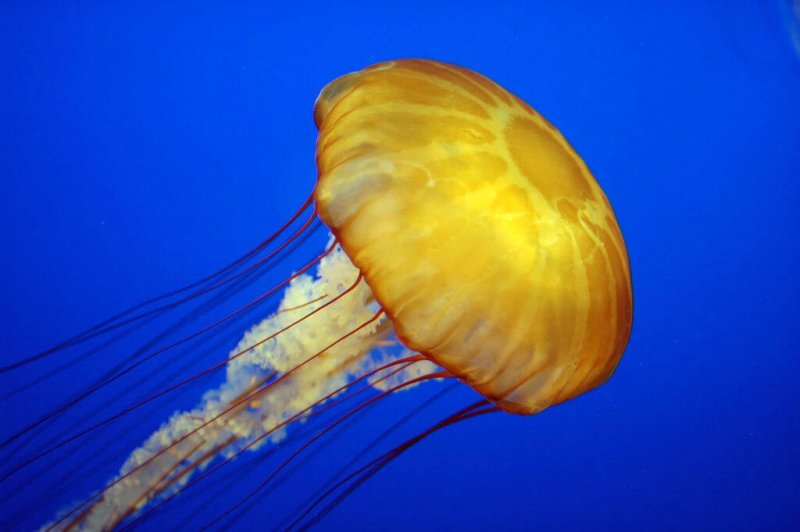
A Pacific sea nettle (Chrysaora fuscescens) at the Monterey Bay Aquarium in California, USA. Image credit: Dan90266/Flickr

You might expect that as bodies became more complex, genomes did as well.

But a recent study appearing in Nature Ecology & Evolution shows that not to be the case — at least for jellyfish, humble organisms that evolved at a crucial juncture in animal history. They did not need more genes — or even notably different ones — to power their giant leap in complexity.

Medusas actively hunt plankton and navigate the water column with neural sensory structures that detect light and orientation. To go from being a stationary polyp to a floating medusa is almost akin to humans evolving the ability to swim through the air and capture birds with springy, netlike appendages.

If a radical shift in life history requires a big boost in gene content, the Aurelia genome should be riddled with novel genes unique to jellyfish. Instead, Gold found that, broadly speaking, “there really isn’t a whole lot of difference between Aurelia and their relatives with simpler lifestyles.”

In any case, for now, the genetic changes that orchestrate this metamorphosis in jellyfish remain unknown. The transformation may depend on regions of the genome that don’t encode proteins, but instead regulate when genes are turned on and off. Perhaps it’s easier for life to innovate by rearranging its existing gene networks instead of evolving scores of new genes.

Read full, original post: Jellyfish Genome Hints That Complexity Isn’t Genetically Complex

{{ reviewsTotal }}{{ options.labels.singularReviewCountLabel }}
{{ reviewsTotal }}{{ options.labels.pluralReviewCountLabel }}
{{ options.labels.newReviewButton }}
{{ userData.canReview.message }}

Related Articles

Infographic: Global regulatory and health research agencies on whether glyphosate causes cancer

Infographic: Global regulatory and health research agencies on whether glyphosate causes cancer

Does glyphosate—the world's most heavily-used herbicide—pose serious harm to humans? Is it carcinogenic? Those issues are of both legal and ...

Most Popular

Screenshot 2026-05-26 at 10.15
Viewpoint: Double standard—Why does the wellness industry get a free pass while Big Healthcare is treated as morally suspect?
global warming
‘Implausible’: Top climate scientists reject worst-case scenario—soaring temperatures and fast-rising sea levels
Screenshot-2026-06-03-at-3.33.44-PM
Viewpoint: Vaccine deniers are attacking a life-saving Vitamin K shot for newborns that isn’t even a vaccine
Screenshot-2026-06-05-at-1.44.09-PM
Viewpoint: Scientists have scrapped the worst-case climate scenario. Is that proof that climate change is a hoax, as Trump claims?
Screenshot-2026-06-08-at-1.35.30-PM
Viewpoint: Social media and fake natural health propaganda fuel surge in use of mostly useless supplements
Screenshot 2025-08-25 203032
Mazzenga’s 20-year old muscles: How a still-going-strong 92-year old sprinter wins every race she enters
px extra strength tylenol and tylenol pm
Why ‘null-findings’ on Tylenol’s safety for pregnant women barely move the needle on countering misinformation
Screenshot-2026-06-08-at-10.19.30-AM
‘Natural’ wellness supplements linked to liver injury
ChatGPT-Image-Jun-10-2026-12_57_24-PM
Viewpoint: Why gene-editing babies is moral and certain to happen
ChatGPT-Image-May-28-2026-12_56_54-PM
Viewpoint: Vaccines' non-specific effects? The ‘shoddy’ Danish couple whose 'research’ inspires RFK, Jr.’s health delusion
Screen Shot at AM
Facts & Fallacies Podcast: Right-wing politics bad for your health? Separating speculation from science
Credit: ACSH
Viewpoint: Who and what’s to blame for the surge in vaccine-preventable diseases?
ChatGPT-Image-Mar-10-2026-01_39_01-PM
Viewpoint—“Miracle molecule” debunked: Why acemannan supplements don’t work
glp menu logo outlined

Get news on human & agricultural genetics and biotechnology delivered to your inbox.