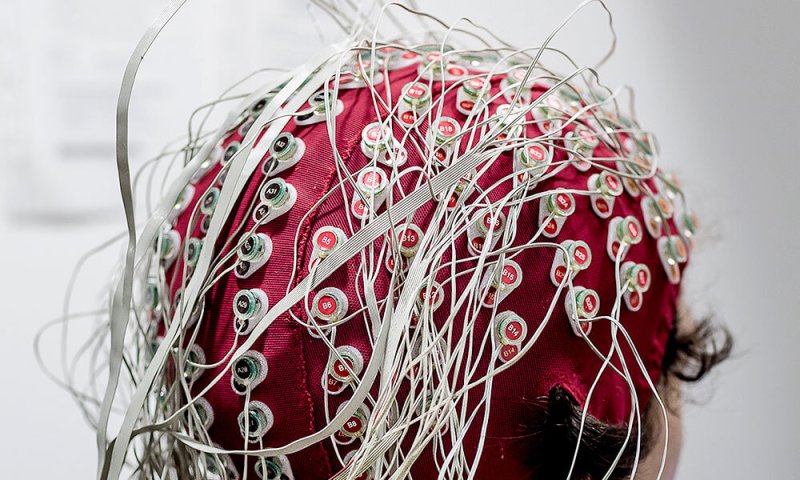
Three’s company? BrainNet successfully connects trio’s brains and thoughts

1-23-2019 brainnet featured brain eeg brain signal
Image credit: Sarmad Sameer

Neuroscientists have successfully hooked up a three-way brain connection to allow three people to share their thoughts – and in this case, play a Tetris-style game.

The team thinks this wild experiment could be scaled up to connect whole networks of people, and yes, it’s as weird as it sounds.

It works through a combination of electroencephalograms (EEGs), for recording the electrical impulses that indicate brain activity, and transcranial magnetic stimulation (TMS), where neurons are stimulated using magnetic fields.

The researchers behind the system have dubbed it BrainNet, and say it could eventually be used to connect many different minds together, even across the web.

In the experiment set up by the scientists, two ‘senders’ were connected to EEG electrodes and asked to play a Tetris-style game involving falling blocks. They had to decide whether each block needed rotating or not.

These choices were then relayed to a single ‘receiver’ through a TMS cap that could generate phantom flashes of light in the receiver’s mind, known as phosphenes.

The receiver couldn’t see the whole game area, but had to rotate the falling block if a light flash signal was sent.

Across five different groups of three people, the researchers hit an average accuracy level of 81.25 percent, which is decent for a first try.

Read full, original post: Brains of 3 People Have Been Successfully Connected, Enabling Them to Share Thoughts

{{ reviewsTotal }}{{ options.labels.singularReviewCountLabel }}
{{ reviewsTotal }}{{ options.labels.pluralReviewCountLabel }}
{{ options.labels.newReviewButton }}
{{ userData.canReview.message }}

Related Articles

Infographic: Global regulatory and health research agencies on whether glyphosate causes cancer

Infographic: Global regulatory and health research agencies on whether glyphosate causes cancer

Does glyphosate—the world's most heavily-used herbicide—pose serious harm to humans? Is it carcinogenic? Those issues are of both legal and ...

Most Popular

ChatGPT Image May 10, 2026, 08_16_59 PM 2
Overmedicalization? RFK Jr.’s antidepressant crackdown raises conflict questions over his fee stake in Wisner Baum, the tort firm built on suing drug makers
Screenshot-2026-05-01-at-1.29.41-PM
Viewpoint: What happens when whole grains meet modern food manufacturing? Labels don’t tell the whole story.
S
As vaccine rejectionism spreads, measles may be taking a more dangerous turn
ChatGPT-Image-Apr-13-2026-02_20_22-PM
Viewpoint: Misinformation infodemic? Why assessing evidence is so challenging 
Picture1-5
Science Disinformation Gap: The transatlantic battle over social media and censorship
Screenshot-2026-04-20-at-2.26.27-PM
Viewpoint — Food-fear world: The latest activist scientists campaign: Cancer-causing additives
ChatGPT-Image-Mar-27-2026-11_47_30-AM-2
FDA’s expedited drug reviews are hailed in some quarters but other approval practices are problematic
Screenshot-2026-03-13-at-12.14.04-PM
The FDA wants to make many popular prescription drugs OTC—a great idea. Here’s why it’s unlikely to happen
bigstock opioids on chalkboard with rol
GLP podcast: 'Safe injection sites': enabling drug addiction or saving lives?
Screenshot-2026-05-08-at-3.40.33-PM
Seeds of power: China turns to genetic engineering to become global superpower
Screenshot-2026-04-12-135256
Bixonimania: The fake disease scam that AI swallowed whole
glp menu logo outlined

Get news on human & agricultural genetics and biotechnology delivered to your inbox.