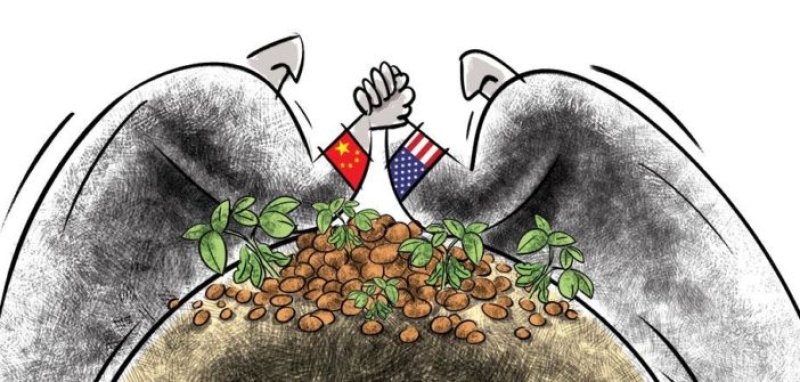
China’s approval of 5 GMO crop imports could fuel investment boom in biotech research

trade war
Image Credit: Gapping World

Lost in the news of contentious U.S.-China trade disputes was a meaningful regulatory approval that will improve agriculture around the world.

[In January] Chinese regulators approved the import of five genetically modified crops. These soybean, corn and canola “biotech traits” are designed to grow despite natural obstacles like pest infestation….

This little-noticed agreement will have a big impact on the U.S. agriculture industry. China has accounted for about 60% of total U.S. soy exports, representing $12 billion in trade for American farmers. Those figures may grow; the newly-approved crops will be in high demand.

The agricultural industry must increase investments in biotechnology. New soil-management, crop-protection and seed-enhancement techniques—which promise to make plants more resistant to drought, disease and pests—sometimes take hundreds of millions of dollars to develop and decades to bring to market. The newly-open Chinese market will reward such innovation.

Any global regulatory system that reviews and ultimately approves these technologies must be science-based. GMO regulatory processes have historically been plagued by politicized disputes which needlessly delay the sale of these vital crops. Hopefully the new agreement with China is a sign that chapter has passed.

Read full, original article: China Opens the Door to U.S. GMOs

Related Articles

Infographic: Global regulatory and health research agencies on whether glyphosate causes cancer

Infographic: Global regulatory and health research agencies on whether glyphosate causes cancer

Does glyphosate—the world's most heavily-used herbicide—pose serious harm to humans? Is it carcinogenic? Those issues are of both legal and ...

Most Popular

Screenshot-2026-09-16-at-2.26.42-PM
Viewpoint: How to ecologically damage America’s forests: Ban glyphosate
Screenshot-2026-09-20-at-9.03.54-AM
From Malaysia to the world: A pioneering science communicator reimagines global science communication for a digital age
Screenshot-2026-09-20-at-4.31.28-PM
White House drafting executive order to control what OMB Director Vought claims are “woke” NIH science grants
ChatGPT-Image-Sep-17-2026-12_28_43-PM
Vitamin D, omega-3 fish oil and glucosamine supplements could cause brain damage 
ChatGPT-Image-Mar-10-2026-01_39_01-PM
Viewpoint—“Miracle molecule” debunked: Why acemannan supplements don’t work
ChatGPT-Image-Sep-20-2026-04_22_32-PM
What’s Trump’s ‘AI Force’? Administration rushes to announce ill-defined watchdog agency and czar amid criticism of its resistance to curb AI acceleration
ChatGPT-Image-Sep-18-2026-10_49_24-AM
‘Symptom borrowing’: Young people are copying health problems they see on TikTok
Screenshot-2026-08-12-at-11.31.46-AM
AI is helping develop new vaccines
ChatGPT-Image-Sep-11-2026-01_53_42-PM
Should doctors engage in social media to counter misinformation?
Screenshot-2026-09-14-at-4.31.14-PM
Viewpoint: What’s the likely impact when the EPA loosens rules limiting methane pollution from oil and gas wells?
Screenshot-2026-08-19-at-6.19.42-PM
Facts & Fallacies podcast: 'Regenerative farming'? RFK Jr.’s federal push romanticizes the past and risks food security
Screenshot-2026-09-10-at-12.20.19-PM
'Jet fuel didn't melt the steel': 9/11 conspiracy theories debunked
glp menu logo outlined

Get news on human & agricultural genetics and biotechnology delivered to your inbox.