Microbes from Yellowstone National Park could spur lab-grown food innovation

unnamed file
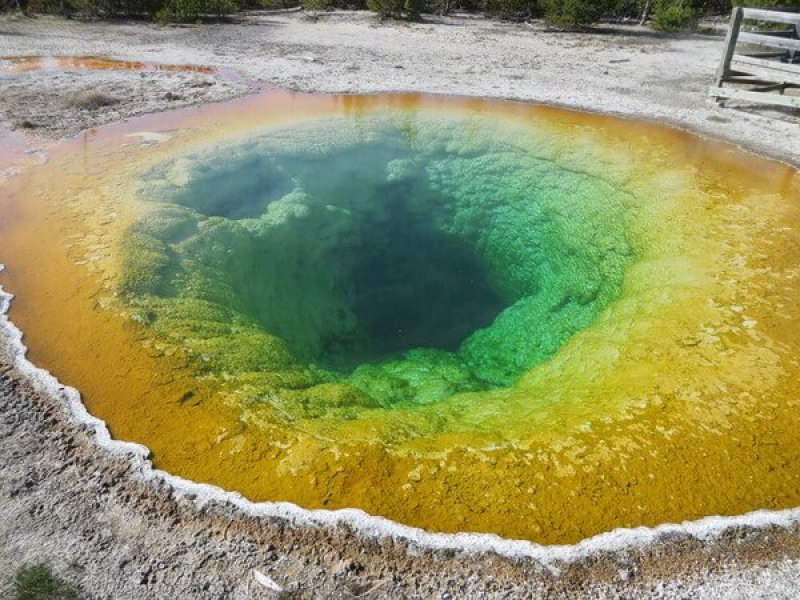
Morning Glory Pool, a hot spring in Yellowstone National Park, is home to diverse populations of microbes that could be used to produce lab-grown food. Image Credit: Alex Berezow

Scientists have long been captivated by a group of microscopic organisms in Yellowstone National Park. The microbes thrive at extreme temperatures and can efficiently multiply with limited resources. The feat has inspired a company called Sustainable Bioproducts, which is replicating the process in a laboratory and eventually, it hopes, at a large scale.

Sustainable Bioproducts said it feeds common components of food such as starches or glycerin to the already high-protein microbes, which then quickly multiply. The resulting protein, like meat or soy, contains the nine amino acids considered essential to the human diet. But the end product wouldn’t necessarily resemble meat. “It could be some things that are more meat-like,” said Thomas Jonas, the company’s chief executive officer. “It can be savory; it can be sweet; it can be liquid; it can be dairy-like.”

….Sustainable Bioproducts hopes to have a product to sell within two years, Jonas said. “These extremophiles learned to be extremely efficient in using their resources,” he said. “They are very relevant at a point in time when humanity already uses tremendous amounts of resources to support the highly inefficient animal-protein model.”

Read full, original article: Do These Tiny Organisms Hold the Key to Lab-Grown Food?

{{ reviewsTotal }}{{ options.labels.singularReviewCountLabel }}
{{ reviewsTotal }}{{ options.labels.pluralReviewCountLabel }}
{{ options.labels.newReviewButton }}
{{ userData.canReview.message }}

Related Articles

Infographic: Global regulatory and health research agencies on whether glyphosate causes cancer

Infographic: Global regulatory and health research agencies on whether glyphosate causes cancer

Does glyphosate—the world's most heavily-used herbicide—pose serious harm to humans? Is it carcinogenic? Those issues are of both legal and ...

Most Popular

Picture1-5
Science Disinformation Gap: The transatlantic battle over social media and censorship
ChatGPT Image May 10, 2026, 08_16_59 PM 2
Overmedicalization? RFK Jr.’s antidepressant crackdown raises conflict questions over his fee stake in Wisner Baum, the tort firm built on suing drug makers
Picture1-1
Cooling the planet with balloons: Could a geoengineering gamble slow global warming?
Screenshot-2026-05-11-104424
Hantavirus outbreak research: Trump administration shut down study last year on rodent-to-human transmission
Picture1-14
When superbugs threaten vulnerable children: Can AI help solve antibiotic resistance?
Screenshot 2026-05-11 at 11.30
Despite politicized disinformation, Midwest AI data centers are fueling a solar energy boom
ChatGPT-Image-Apr-13-2026-02_20_22-PM
Viewpoint: Misinformation infodemic? Why assessing evidence is so challenging 
Screenshot-2026-05-08-at-11.55.47-AM
Anti-vax activists falsely blame COVID vaccines for the rising U.S. cancer rate among younger people.
S
As vaccine rejectionism spreads, measles may be taking a more dangerous turn
Screenshot-2026-05-08-at-3.40.33-PM
Seeds of power: China turns to genetic engineering to become global superpower
Screenshot-2026-05-01-at-1.29.41-PM
Viewpoint: What happens when whole grains meet modern food manufacturing? Labels don’t tell the whole story.
Screenshot-2026-04-20-at-2.26.27-PM
Viewpoint — Food-fear world: The latest activist scientists campaign: Cancer-causing additives
glp menu logo outlined

Get news on human & agricultural genetics and biotechnology delivered to your inbox.