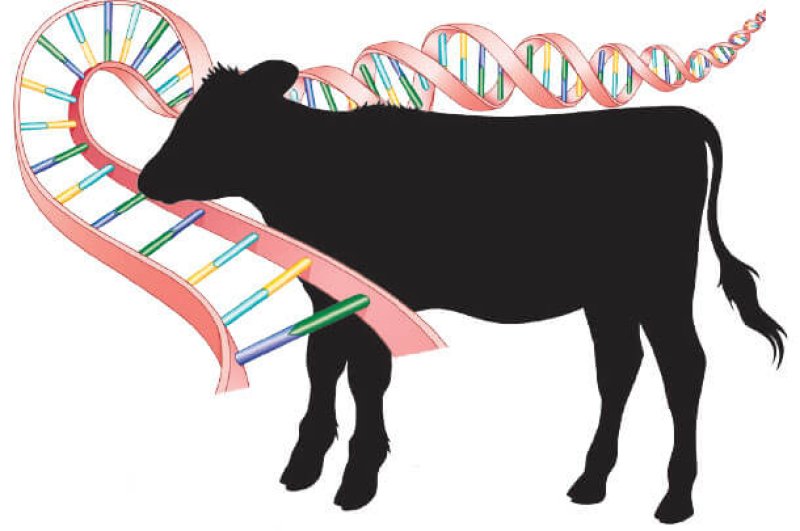
Breeding better steak: Geneticists aim to streamline development of heat-tolerant cattle

pd moore dna
Image: Alta Genetics

For Raluca Mateescu, the battle against climate change involves an unusual task: breeding a better steak.

A researcher at the University of Florida, Mateescu is tweaking cattle genes to try to unlock one of the mysteries of Southern agriculture: developing a breed that can withstand the hot, humid weather that has become more pronounced due to climate change while still producing high-quality beef.

[Editor’s note: This is part three in a three-part series. Click here for the first part and here for the second.]

Mateescu’s work, funded in part through grants from the Department of Agriculture, is one example of how climate science and agricultural science are coming together to help livestock and crops adjust to warmer conditions.

Mateescu’s work isn’t gene-editing, in which researchers change the DNA sequence of an animal to achieve a specific trait. That’s being done, in early stages, by companies such as Minnesota-based Acceligen …. But her work could help the process, by mapping out the genetic code so specifically that scientists know where to find a meat-quality trait, like toughness, and what to substitute in its place.

Read full, original article: Beef cattle get a genetic makeover for a warming world

{{ reviewsTotal }}{{ options.labels.singularReviewCountLabel }}
{{ reviewsTotal }}{{ options.labels.pluralReviewCountLabel }}
{{ options.labels.newReviewButton }}
{{ userData.canReview.message }}

Related Articles

Infographic: Global regulatory and health research agencies on whether glyphosate causes cancer

Infographic: Global regulatory and health research agencies on whether glyphosate causes cancer

Does glyphosate—the world's most heavily-used herbicide—pose serious harm to humans? Is it carcinogenic? Those issues are of both legal and ...

Most Popular

Screenshot-2026-03-13-at-12.14.04-PM
The FDA wants to make many popular prescription drugs OTC—a great idea. Here’s why it’s unlikely to happen
Screenshot-2026-05-04-at-12.54.32-PM
How Utah became the country’s supplement capital  — and a haven for unregulated, ineffective and fake products
Screenshot-2026-04-20-at-2.26.27-PM
Viewpoint — Food-fear world: The latest activist scientists campaign: Cancer-causing additives
Screenshot-PM-24
Viewpoint: The herbicide glyphosate isn’t perfect. Banning it would be far worse.
images
The never-ending GMO debate: Pros and cons
Screenshot-2026-05-01-at-11.56.24-AM
‘Science moves forward when people are willing to think differently’: Memories of DNA maverick Craig Venter
Screenshot-2026-04-30-at-2.19.37-PM
5 myths about summer dehydration that could damage your health — or even kill you
Screenshot-2026-04-03-at-11.15.51-AM
Paraben panic: How a flawed study, media hype, and chemophobia convinced the public of the danger of one of the safest classes of preservatives
79d03212-2508-45d0-b427-8e9743ff6432
Viewpoint: The Casey Means hustle—Wellness woo opportunism dressed up as medical wisdom
ChatGPT-Image-May-1-2026-02_20_13-PM
How RFK, Jr.’s false vaccine claims are holding up $600 million to fight diseases in poor countries
glp menu logo outlined

Get news on human & agricultural genetics and biotechnology delivered to your inbox.