Viewpoint: France’s bad science—its stances on food safety and GMOs at sharp odds with European scientists

rtx e pk
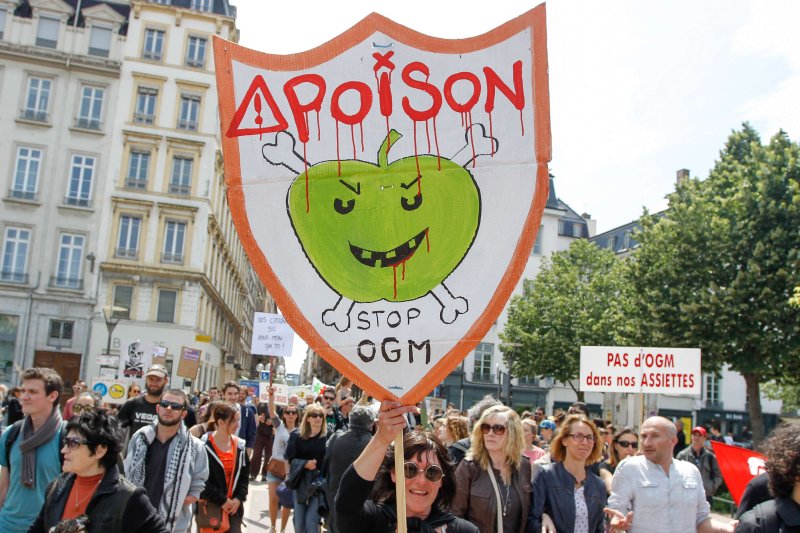
A woman holds a placard, "Poison - Stop GMO" in Lyon, France, May 23, 2015. Credit: REUTERS/Emmanuel Foudrot - RTX1E8PK

Paris is worried that the whitening additive that makes sweets gleam — titanium dioxide, also called E171 — and is used in a host of products from toothpaste to ice cream, chewing gum and cake frosting is unsafe. But the European Food Safety Authority (EFSA) doesn’t agree.

Rather than toe the EU’s line, Paris imposed its own restrictions on E171 starting [in 2020] that are tougher than those that apply in the rest of the bloc. That’s prompted warnings that the regulatory divergence will [make] it impossible to sell the same products in all countries.

France has long been much more activist on environmental issues than other EU countries. Its fervent movement opposed to genetically modified foods in recent years has broadened into a politically powerful effort to curtail chemicals ….

A Eurobarometer poll on chemical safety released in 2017 found that most EU citizens believe products to be broadly safe. In France, only 26 percent of respondents thought that products containing chemicals were safe …. That suspicion of regulations and governments is seen in other areas as well. France is Europe’s most vaccination-skeptical country, and has seen recent anti-government protests in the form of the Yellow Jacket movement.

Read full, original article: On chemicals, France stands alone

{{ reviewsTotal }}{{ options.labels.singularReviewCountLabel }}
{{ reviewsTotal }}{{ options.labels.pluralReviewCountLabel }}
{{ options.labels.newReviewButton }}
{{ userData.canReview.message }}

Related Articles

Infographic: Global regulatory and health research agencies on whether glyphosate causes cancer

Infographic: Global regulatory and health research agencies on whether glyphosate causes cancer

Does glyphosate—the world's most heavily-used herbicide—pose serious harm to humans? Is it carcinogenic? Those issues are of both legal and ...

Most Popular

Screenshot-2026-04-20-at-2.26.27-PM
Viewpoint — Food-fear world: The latest activist scientists campaign: Cancer-causing additives
Screenshot-2026-05-04-at-12.54.32-PM
How Utah became the country’s supplement capital  — and a haven for unregulated, ineffective and fake products
Screenshot-PM-24
Viewpoint: The herbicide glyphosate isn’t perfect. Banning it would be far worse.
Screenshot-2026-03-13-at-12.14.04-PM
The FDA wants to make many popular prescription drugs OTC—a great idea. Here’s why it’s unlikely to happen
Screenshot-2026-05-01-at-11.56.24-AM
‘Science moves forward when people are willing to think differently’: Memories of DNA maverick Craig Venter
Screenshot-2026-04-30-at-2.19.37-PM
5 myths about summer dehydration that could damage your health — or even kill you
ChatGPT-Image-Mar-27-2026-11_27_05-AM
The myths of “process”: What science says about the “dangers’ of synthetic products and ultra-processed foods
Screenshot-2026-04-03-at-11.15.51-AM
Paraben panic: How a flawed study, media hype, and chemophobia convinced the public of the danger of one of the safest classes of preservatives
glp menu logo outlined

Get news on human & agricultural genetics and biotechnology delivered to your inbox.