‘Defibrillator for the brain’: Implant could prevent epileptic seizures in autistic children

inline x
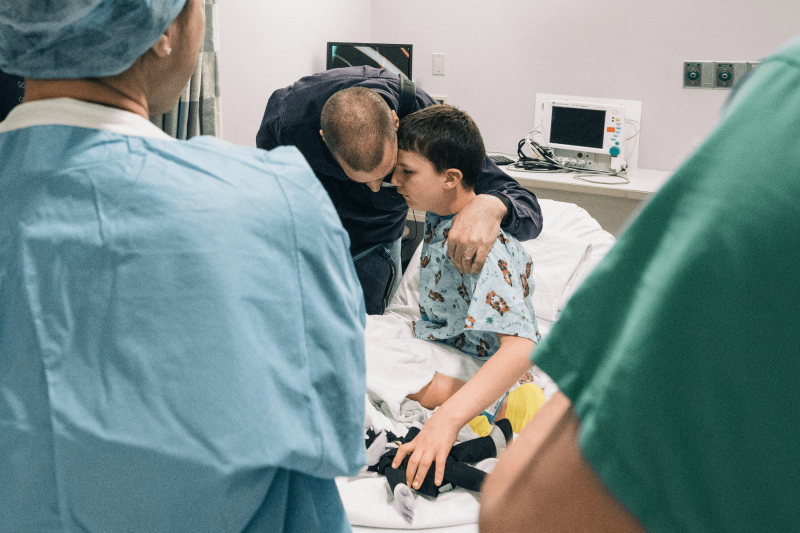
Pre-op pep talk: Kevin Lightner gets support from his father before his experimental epilepsy surgery. Image: William Mebane/Spectrum

Kevin, who has autism and has had seizures since he was 8 years old, lies uncharacteristically still in the center of the room, draped under a blue sheet, his tiger-print pajamas neatly folded on a nearby shelf.

What’s happening in this room may be the last chance to bring Kevin’s seizures under control.

The implant, a “responsive neurostimulation device,” is now transmitting signals from the electrodes planted in Kevin’s thalamus. The surgeons’ hope is that the device will learn to recognize what kind of brain activity precedes Kevin’s seizures and discharge electrical pulses to prevent them—like a “defibrillator for the brain,” as [neurosurgeon Saadi] Ghatan puts it.

As he and others chart the outcome of these surgeries, though, they might learn how autism and epilepsy are related, a lingering question in the field: About one in four autistic children older than 13 also has epilepsy; conversely, having epilepsy increases the chance of an autism diagnosis roughly 10-fold. A preponderance of evidence suggests the two conditions have common genetic origins. But does epilepsy cause autism or at least alter its course? These surgeries might answer that question.

Read full, original post: Can Preventing Seizures Alter the Course of Autism?

{{ reviewsTotal }}{{ options.labels.singularReviewCountLabel }}
{{ reviewsTotal }}{{ options.labels.pluralReviewCountLabel }}
{{ options.labels.newReviewButton }}
{{ userData.canReview.message }}

Related Articles

Infographic: Global regulatory and health research agencies on whether glyphosate causes cancer

Infographic: Global regulatory and health research agencies on whether glyphosate causes cancer

Does glyphosate—the world's most heavily-used herbicide—pose serious harm to humans? Is it carcinogenic? Those issues are of both legal and ...

Most Popular

Credit: ACSH
Viewpoint: Who and what’s to blame for the surge in vaccine-preventable diseases?
ChatGPT-Image-May-28-2026-12_56_54-PM
Viewpoint: Vaccines' non-specific effects? The ‘shoddy’ Danish couple whose 'research’ inspires RFK, Jr.’s health delusion
ChatGPT Image Jun 3, 2026, 03_14_43 PM
Viewpoint: How Earthjustice became the poster child for the abuse of special interest activist funding
Organic-Produce
Viewpoint: Why you should ignore organic food advocates’ advice to avoid ‘pesticide soaked’ conventional fruits and vegetables
Screenshot-2026-06-08-at-11.05.51-AM
Can vaping lead to cancer? New ‘association study’ raises questions of “links"
Screenshot-2026-06-05-at-2.12.30-PM
Some plants can poison you. So how did humans figure out what is safe to eat?
Screenshot-2026-06-08-at-10.19.30-AM
‘Natural’ wellness supplements linked to liver injury
Screenshot-2026-06-05-at-3.30.20-PM
Republican lawmakers spread misinformation claiming solar farms permanently destroy potato farms
edb7f6d7-2370-418f-9578-74e29678e35c
Facts & Fallacies Podcast: Nicotine vaping—public health miracle, or risk to children? Professor Cliff Douglas
ChatGPT-Image-Jun-5-2026-01_17_48-PM
GLP-1 weight-loss drugs may reshape our desires and emotions
Screenshot 2025-07-30 at 10.48
Can gene editing eliminate Down syndrome? Scientists have done it in lab-grown cells
downsyndrome_compilation_MID_1
CRISPR breakthrough that can remove the chromosome responsible for Down syndrome raises ethical questions
glp menu logo outlined

Get news on human & agricultural genetics and biotechnology delivered to your inbox.