Terminally ill cancer patients donating their bodies for research on how tumors spread

corbis ya
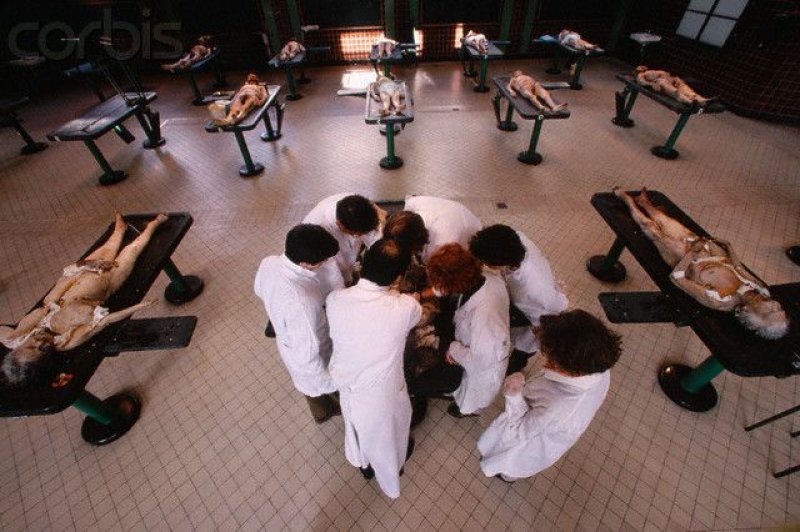
Image: Paris Medical School

It sounds macabre, but it’s important research. [Andrew] Rowan is one of a team of experts working on a new study into the way tumours spread. The Posthumous Evaluation of Advanced Cancer Environment (PEACE) study is an ongoing project, funded by Cancer Research UK, that follows a simple premise: terminally ill cancer patients agree to donate their body to science after they die, allowing researchers to perform autopsies to collect their blood and tissue for testing.

Until recently, scientists working in labs such as this one have relied upon cancer tissue taken from surgically removed biopsies – a small section of disease taken from one site while the patient is alive. But the scope for experimentation with these samples is limited, and reveals very little about the wider ecosystem of the disease inside a patient’s body. Thanks to the volunteers signed up to PEACE, the team is now able to access entire, fresh organs from multiple sites in a patient’s body. It is the only study like it in the world, and the researchers believe the discoveries made from it could be revolutionary – both in furthering scientific understanding of cancer, and in the continuing quest to find a cure.

Read full, original post: Dead bodies are revealing the secrets of how cancer kills


{{ reviewsTotal }}{{ options.labels.singularReviewCountLabel }}
{{ reviewsTotal }}{{ options.labels.pluralReviewCountLabel }}
{{ options.labels.newReviewButton }}
{{ userData.canReview.message }}

Related Articles

Infographic: Global regulatory and health research agencies on whether glyphosate causes cancer

Infographic: Global regulatory and health research agencies on whether glyphosate causes cancer

Does glyphosate—the world's most heavily-used herbicide—pose serious harm to humans? Is it carcinogenic? Those issues are of both legal and ...

Most Popular

Screenshot-2026-04-13-at-1.39.26-PM
Viewpoint: ‘Safer for children?’ Stonyfield yogurt under fire for deceptive organic marketing
Screenshot-2026-04-22-at-10.46.29-AM
Viewpoint: How to counter science disinformation? Science journalist offers 12 practical tips
ChatGPT-Image-May-7-2026-12_16_37-PM-2
Viewpoint: Are cancer rates ‘skyrocketing’ as RFK, Jr. and MAHA claim? The evidence says mostly the opposite
Picture1-14
When superbugs threaten vulnerable children: Can AI help solve antibiotic resistance?
ChatGPT-Image-May-12-2026-08_39_41-PM
GLP podcast: Big Pharma, Big Ag, Big Food—health harming industries or life-saving innovators?
Screenshot-2026-04-23-at-11.00.36-AM
Regulators' dilemma: Thalidomide, Metformin, and the cost of getting drug approvals wrong
Picture1-1
Cooling the planet with balloons: Could a geoengineering gamble slow global warming?
png-pill-omega-Supp-fish-oil
Millions take omega-3 fish oil for brain health. New research suggests it may do the opposite.
glp menu logo outlined

Get news on human & agricultural genetics and biotechnology delivered to your inbox.