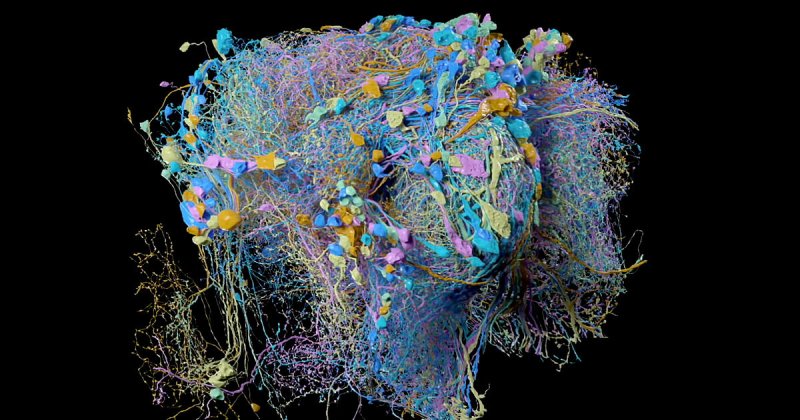
We’ve mapped a fly brain down ‘to the very last neuron’. That’s a big deal for human brain research

google d map fruit fly brain
Image: Janelia Research Campus
[A]s director of Janelia Research Campus, part of the Howard Hughes Medical Institute, [Gerry Rubin has] spent the last 12 years leading a team that’s mapping out the fly brain’s physical wiring, down to the very last neuron.

Janelia researchers announced a major step in that quest on [January 22], releasing a wiring diagram of the fly brain that contains 25,000 neurons and the 20 million connections between them. The so-called “connectome” corresponds to the fly’s hemibrain, a region that’s about 250 micrometers across—the size of a dust mite, or the thickness of two strands of hair. It’s about a third of the total fly brain, and contains many of the critical regions responsible for memory, navigation and learning.

Researchers like Rubin believe a physical blueprint of the brain could become a foundational resource for neuroscientists—doing for brain science what genome sequences have done for genetics. The argument is that to get anywhere with understanding brain circuits, you first need to know what the circuits are, and what kinds of cells they join. That physical schematic becomes a roadmap for all kinds of inquiries, Rubin says—anything from understanding the role of the brain’s wiring in psychiatric disorders to how our brains store memories.


Read the original post

{{ reviewsTotal }}{{ options.labels.singularReviewCountLabel }}
{{ reviewsTotal }}{{ options.labels.pluralReviewCountLabel }}
{{ options.labels.newReviewButton }}
{{ userData.canReview.message }}

Related Articles

Infographic: Global regulatory and health research agencies on whether glyphosate causes cancer

Infographic: Global regulatory and health research agencies on whether glyphosate causes cancer

Does glyphosate—the world's most heavily-used herbicide—pose serious harm to humans? Is it carcinogenic? Those issues are of both legal and ...

Most Popular

ChatGPT Image May 10, 2026, 08_16_59 PM 2
Overmedicalization? RFK Jr.’s antidepressant crackdown raises conflict questions over his fee stake in Wisner Baum, the tort firm built on suing drug makers
Picture1-5
Science Disinformation Gap: The transatlantic battle over social media and censorship
Screenshot-2026-05-08-at-3.40.33-PM
Seeds of power: China turns to genetic engineering to become global superpower
Screenshot-2026-05-01-at-1.29.41-PM
Viewpoint: What happens when whole grains meet modern food manufacturing? Labels don’t tell the whole story.
ChatGPT-Image-Apr-13-2026-02_20_22-PM
Viewpoint: Misinformation infodemic? Why assessing evidence is so challenging 
Picture1-14
When superbugs threaten vulnerable children: Can AI help solve antibiotic resistance?
S
As vaccine rejectionism spreads, measles may be taking a more dangerous turn
Farmers can talk to plants
Farmers are a major source of misinformation—about farming
Screenshot 2026-05-08 at 3.01
Transforming farming and nutrition with AI and robotics? Larry Ellison’s half-billion-dollar Hawaii greenhouse dream goes bust
Screenshot-2026-04-20-at-2.26.27-PM
Viewpoint — Food-fear world: The latest activist scientists campaign: Cancer-causing additives
ChatGPT-Image-May-8-2026-01_41_33-PM-3
Viewpoint: Surge of climate misinformation traced to right wing and anti-wind activists 
ChatGPT-Image-Mar-27-2026-11_47_30-AM-2
FDA’s expedited drug reviews are hailed in some quarters but other approval practices are problematic
Screenshot-2026-03-13-at-12.14.04-PM
The FDA wants to make many popular prescription drugs OTC—a great idea. Here’s why it’s unlikely to happen
glp menu logo outlined

Get news on human & agricultural genetics and biotechnology delivered to your inbox.