‘Nowhere in sight’: Sweden shows no signs of herd immunity developing

free spread of covid in sweden didnt lead to herd immunity
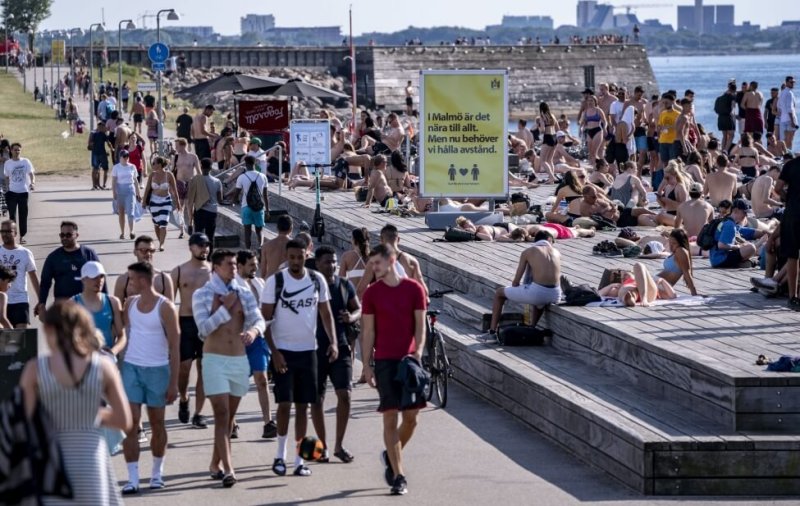
People stroll, sunbathe and swim at a bathing jetty in Malmo, Sweden, in June. Credit: EPA-EFE/Johan Nilsson/TT
[Sweden] didn’t enforce a lockdown to prevent the spread of the coronavirus, but instead advised citizens on how to behave. Shops, restaurants, and gyms stayed open, but schools and universities closed to over-16s, and large-scale gatherings of more than 50 people were banned. Over-70s and those with COVID-19 symptoms were told to self-isolate.

The country harnessed its concept of folkvett, or the common sense of the people as a collective, to try to combat the disease, professor David Goldsmith, a retired physician, and Eric Orlowski of the department of anthropology at the University College London, wrote in a commentary in the Journal of the Royal Society of Medicine. The commentary was titled “Four months into the COVID-19 pandemic, Sweden’s prized herd immunity is nowhere in sight.”

Follow the latest news and policy debates on sustainable agriculture, biomedicine, and other ‘disruptive’ innovations. Subscribe to our newsletter.

“The Swedish experience of attempting to achieve this, compared to other Nordic countries’ responses, resulted in much higher numbers of infections and deaths per capita, in addition to a prolonged outbreak. Moreover, far fewer Swedes than predicted generated antibodies to the coronavirus, suggesting the strategy failed to generate widespread protective immunity.

“These findings should prove a salutary warning, that appealing concepts and theories require supporting data when people’s lives are at stake and should not be used to fit preconceived narratives,” [said microbiologist Simon Clarke.]


Read the original post

{{ reviewsTotal }}{{ options.labels.singularReviewCountLabel }}
{{ reviewsTotal }}{{ options.labels.pluralReviewCountLabel }}
{{ options.labels.newReviewButton }}
{{ userData.canReview.message }}

Related Articles

Infographic: Global regulatory and health research agencies on whether glyphosate causes cancer

Infographic: Global regulatory and health research agencies on whether glyphosate causes cancer

Does glyphosate—the world's most heavily-used herbicide—pose serious harm to humans? Is it carcinogenic? Those issues are of both legal and ...

Most Popular

Screenshot 2026-05-26 at 10.15
Viewpoint: Double standard—Why does the wellness industry get a free pass while Big Healthcare is treated as morally suspect?
ChatGPT-Image-Jun-4-2026-01_27_58-PM
Viewpoint—N.A.D.+: Why Gwenyth Paltrow’s heralded anti-aging supplement doesn’t work
ChatGPT-Image-Mar-10-2026-01_39_01-PM
Viewpoint—“Miracle molecule” debunked: Why acemannan supplements don’t work
Screenshot 2025-07-30 at 10.48
Can gene editing eliminate Down syndrome? Scientists have done it in lab-grown cells
tick-DNA
GLP podcast: Spread meat allergy with gene-edited ticks? Bioethicists pose vile ‘thought experiment’
Screenshot-2026-06-03-at-1.24.46-PM
Challenging anti-GMO disinformation: Why genetically-tweaked crops offer bushels of benefits
ChatGPT-Image-Jun-4-2026-11_49_36-AM-2
‘You don’t understand Tolkien’: Skeptic Pope trolls tech giants about the exaggerated, risk-less benefits of AI
downsyndrome_compilation_MID_1
CRISPR breakthrough that can remove the chromosome responsible for Down syndrome raises ethical questions
Screenshot-2026-06-04-at-12.05.08-PM
Cases of brain inflammation surge as U.S. measles pandemic approaches 2000
ChatGPT-Image-May-26-2026-07_51_21-AM-2
Viewpoint: There are more than 1,000 chemicals in a cup of coffee—including many substances that can cause cancer. Why isn’t it banned?

Sorry. No data so far.

glp menu logo outlined

Get news on human & agricultural genetics and biotechnology delivered to your inbox.