Only 67% of schools teach evolution is ‘settled science’ although teaching creationism in schools is on the wane

creationism
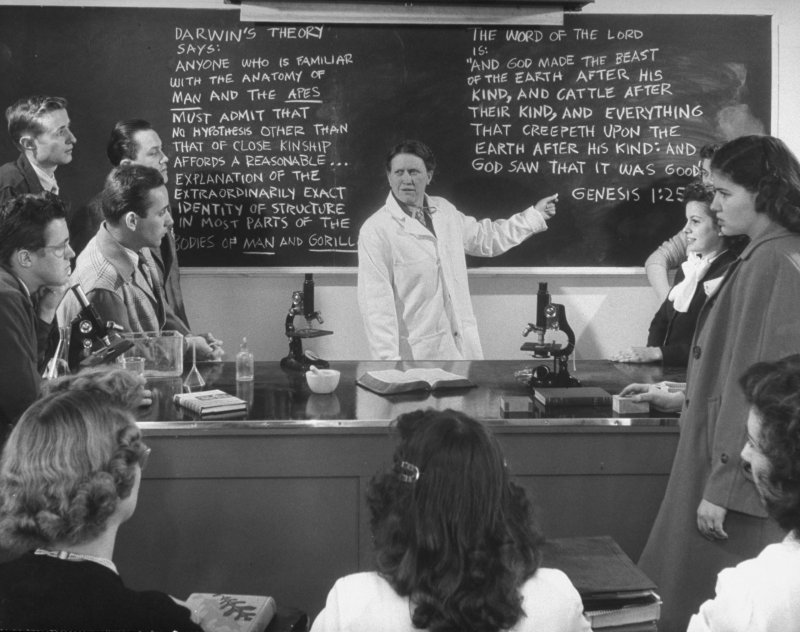
South Carolina Bob Jones University's Dr. Maude Stout "teaches the controversy" over evolution in 1948. Credit: Francis Miller/Time Life Pictures/Getty Images

American teachers have not always been afforded the luxury of teaching evolution forthrightly. John Thomas Scopes, for example, was famously prosecuted for violating Tennessee’s ban on teaching evolution in 1925. Although his conviction was subsequently overturned, a national survey of high school biology teachers conducted in 1939–1940 revealed that only about half were teaching evolution as a central principle of biology.

Between 2007 and 2019, there definitely was progress: from 51 percent of high school biology teachers reporting emphasizing evolution and not creationism in 2007 to 67 percent in 2019. It was matched by a drop from 23 to 12 percent of teachers who offer mixed messages by endorsing both evolution and creationism as a valid scientific alternative to evolution, from 18 to 15 percent of teachers who endorse neither evolution nor creationism, and from 8.6 to 5.6 percent of teachers who endorse creationism while not endorsing evolution.

What accounts for the improvement?

Follow the latest news and policy debates on sustainable agriculture, biomedicine, and other ‘disruptive’ innovations. Subscribe to our newsletter.

The results of the 2019 survey suggest that a concerted effort to improve state science standards helped to improve evolution education. The Next Generation Science Standards (NGSS), which debuted in 2013, include “Biological Evolution: Unity and Diversity” as a disciplinary core idea of the life sciences at the middle and high school levels. By now, 20 states (plus the District of Columbia) have adopted the NGSS, and a further 24 states have adopted standards based on the same evolution-friendly framework on which the NGSS are based.


Read the original post

{{ reviewsTotal }}{{ options.labels.singularReviewCountLabel }}
{{ reviewsTotal }}{{ options.labels.pluralReviewCountLabel }}
{{ options.labels.newReviewButton }}
{{ userData.canReview.message }}

Related Articles

Infographic: Global regulatory and health research agencies on whether glyphosate causes cancer

Infographic: Global regulatory and health research agencies on whether glyphosate causes cancer

Does glyphosate—the world's most heavily-used herbicide—pose serious harm to humans? Is it carcinogenic? Those issues are of both legal and ...

Most Popular

Screenshot 2025-07-30 at 10.48
Can gene editing eliminate Down syndrome? Scientists have done it in lab-grown cells
ChatGPT-Image-Mar-10-2026-01_39_01-PM
Viewpoint—“Miracle molecule” debunked: Why acemannan supplements don’t work
ChatGPT-Image-May-26-2026-07_51_21-AM-2
Viewpoint: There are more than 1,000 chemicals in a cup of coffee—including many substances that can cause cancer. Why isn’t it banned?
Screenshot-2026-06-04-at-12.05.08-PM
Cases of brain inflammation surge as U.S. measles pandemic approaches 2000
Screenshot 2026-05-26 at 10.15
Viewpoint: Double standard—Why does the wellness industry get a free pass while Big Healthcare is treated as morally suspect?
Screenshot-2026-05-28-at-1.36.28-PM
Viewpoint: Can mRNA research survive the Trump administration?
ChatGPT Image May 26, 2026, 08_42_17 AM (1)
Viewpoint: Greenpeace and poison: How environmental advocacy groups rely on compliant (and often ignorant) journalists to spread disinformation and spark litigation
Picture1
Sounds we can’t hear — the hidden planetary signals behind science, fear, and misinformation
downsyndrome_compilation_MID_1
CRISPR breakthrough that can remove the chromosome responsible for Down syndrome raises ethical questions
glp menu logo outlined

Get news on human & agricultural genetics and biotechnology delivered to your inbox.