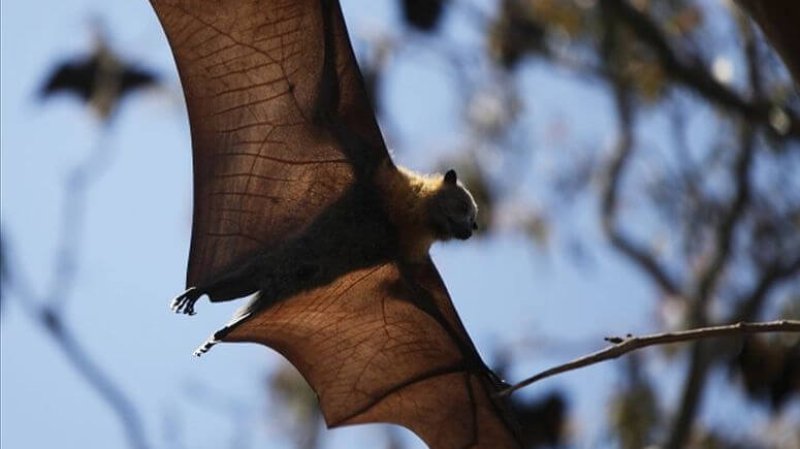
German measles likely jumped from bats to humans, much like COVID, raising concerns about future virus outbreaks

x xlarge

An estimated 100,000 newborns are affected by the [rubella virus] annually, mostly in Africa, the western Pacific, and the eastern Mediterranean; in many other countries the measles, mumps, and rubella (MMR) vaccine has made it a rarity.

[Tony] Goldberg and his former graduate student Andrew Bennett discovered one of the new viruses [in the same family as rubella] in apparently healthy cyclops leaf-nosed bats, netted at night in Kibale National Park in Uganda. They named it ruhugu virus, after the Ruteete region of Uganda and the local word for bat. The architecture of ruhugu’s genome is identical to that of the rubella virus, and 56% of the amino acids in its eight proteins matched those in rubella. The protein that interacts with the host’s immune cells was almost identical in both viruses.

As they were getting ready to publish, the researchers learned that a team led by Martin Beer at the Friedrich-Loeffler Institute had detected another rubella relative in brain tissue from a donkey, a kangaroo, and a capybara.


Mis- and disinformation are distorting science and public policy. Subscribe to our Daily and Weekly Digests for incisive coverage of ‘disruptive’ innovations in AI, agricultural biotechnology, food, chemicals, nuclear energy, vaccines, and other disruptive innovations.

It’s “really interesting” that rustrela was able to infect both placental and marsupial mammals… That flexibility could spell trouble, says vaccinologist Gregory Poland of the Mayo Clinic. “Who knows, if it could move from mice to other mammals, could it move to humans?” he asks. “In the end, the bugs win.”


Read the original post

Related Articles

Infographic: Global regulatory and health research agencies on whether glyphosate causes cancer

Infographic: Global regulatory and health research agencies on whether glyphosate causes cancer

Does glyphosate—the world's most heavily-used herbicide—pose serious harm to humans? Is it carcinogenic? Those issues are of both legal and ...

Most Popular

ChatGPT-Image-Mar-10-2026-01_39_01-PM
Viewpoint—“Miracle molecule” debunked: Why acemannan supplements don’t work
Screenshot-2026-09-22-at-12.26.15-PM
‘Forever chemical’ concerns: Separating hysteria from reasonable concern in the debate over PFAS danger
Screenshot-2026-10-06-at-11.13.59-AM
RFK Jr.’s plan to curb America’s appetite for ultra-processed foods and artificial dyes blocked by the White House
Screenshot 2026-10-08 at 1.34
Hooked on kratom: The unregulated, natural, alcohol-free “social tonic” that is destroying lives 
Screenshot-2026-10-06-at-2.36.47-PM
Is organic farming really more sustainable? 100 recent studies say ‘no’
Resolute-Portrait-with-Injured-Teddy-Bear
Anti-vax Texas Senate candidate Ken Paxton alleges conspiracy by doctors, drugmakers, and insurers to push childhood vaccination for profit
Screenshot-2026-09-28-at-11.26.17-AM
Viewpoint: Wellness movement activists reposition nicotine from a killer addictive drug into a cure-all for brain ills
Radioactive-Americana-Collage-2
The kooky logic behind the raft of spurious cancer claims from Harvard’s T.H. Chan School of Public Health
No-Data-Center-Farm-Protest-Sign-2
Rural revival or corporate windfall? Trump’s One Big Beautiful Bill tax law opens the door to big breaks for data centers—but tech giants aren’t cashing in
ChatGPT-Image-Sep-21-2026-11_21_39-AM
Viewpoint: Food cults: Online ‘nutrition communities’ can pose unique dangers
Screenshot 2025-09-17 at 12.41
Jump-starting global warming: Rising temperatures are driving up emissions from wildfires, fermenting wetlands, and melting permafrost
Supreme-Court-Amid-Climate-Crisis
Should fossil fuel companies be shielded from lawsuits over climate change damage? The Supreme Court takes up the question
glp menu logo outlined

Get news on human & agricultural genetics and biotechnology delivered to your inbox.