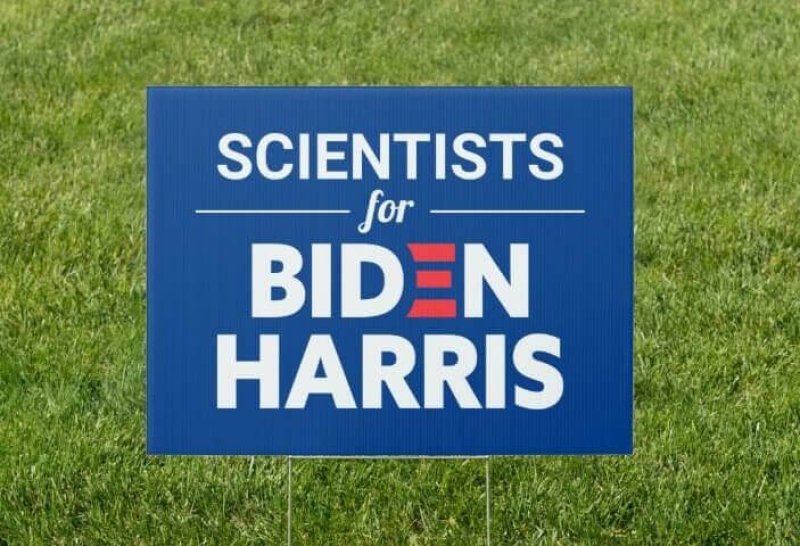
Scientists taking partisan stands on the coronavirus: Here comes the political backlash

scientists for biden harris custom text blue sign rcacd ebc e b da a e d tyqv
Credit: Zazzle

Today, although most Americans trust information from physicians and medical scientists, public trust in the scientific community has become increasingly partisan, and conservatives and Republicans are less likely to hold positive views toward that community. As a counter to this, scientists ran for Congress in record numbers in the 2018 midterm elections, mostly on the Democratic side. Scientists are running again this year.

Mobilized science, however, is not without potential costs. When scientists advocate for their interests in an expressly political way, they risk further polarizing public opinion about research.

…

This raises an important question: what can be done to combat the politicization of science? One place to start is to further spark Americans’ interest in, and curiosity about, scientific research. Studies find that people who take an interest in science—irrespective of whether they consider themselves to be Democrats, Republicans or independents—are more likely to hold positive views toward the scientific community and support federal funding for scientific research.
Mis- and disinformation are distorting science and public policy. Subscribe to our Daily and Weekly Digests for incisive coverage of ‘disruptive’ innovations in AI, agricultural biotechnology, food, chemicals, nuclear energy, vaccines, and other disruptive innovations.

This means that while advocacy could come at a cost of further politicizing Americans’ views toward the scientific community, there are strategies scientists can follow to mitigate that effect. The potential benefits of mobilized science may well be worth it.


Read the original post

Related Articles

Infographic: Global regulatory and health research agencies on whether glyphosate causes cancer

Infographic: Global regulatory and health research agencies on whether glyphosate causes cancer

Does glyphosate—the world's most heavily-used herbicide—pose serious harm to humans? Is it carcinogenic? Those issues are of both legal and ...

Most Popular

ChatGPT-Image-Mar-10-2026-01_39_01-PM
Viewpoint—“Miracle molecule” debunked: Why acemannan supplements don’t work
ChatGPT-Image-Sep-10-2026-10_36_07-AM
Viewpoint: Even lousy scientific articles can shield authors when they hype dubious health claims and products
sorghum farmers in kenya FARMERS TREND
Here are all the ways CRISPR gene editing is transforming Africa’s staple crops—and there’s a lot more innovation to come
Screenshot-2026-10-01-at-11.21.27-AM
Vaccine hesitancy, like malaria, surges globally, topping 35% in some countries
ChatGPT-Image-Sep-30-2026-01_11_07-PM
How U.S. teamed with Russia to block global human AI weapons oversight
ChatGPT-Image-Sep-30-2026-01_25_34-PM
Blood tests for Alzheimer’s? The latest grifter, social media scam.
ChatGPT-Image-Sep-21-2026-03_15_09-PM
Viewpoint: Chipotle-inspired lesson: 10,000 sick customers suggest that processed foods can be safer than fresh ones
ChatGPT-Image-Sep-30-2026-01_38_36-PM
Viewpoint: Died “with measles” vs. died “from measles”: RFK, Jr.’s dangerously subversive word games
ChatGPT-Image-Sep-29-2026-12_16_42-PM
Social media influencers are driving food misinformation across Europe
Screenshot-2026-09-28-at-1.16.38-PM
Defying public perceptions, U.S. cancer deaths plunged 35% since 1991
glp menu logo outlined

Get news on human & agricultural genetics and biotechnology delivered to your inbox.