Judge orders FDA to assess potential impact of escaped GM AquAdvantage salmon on wild fish

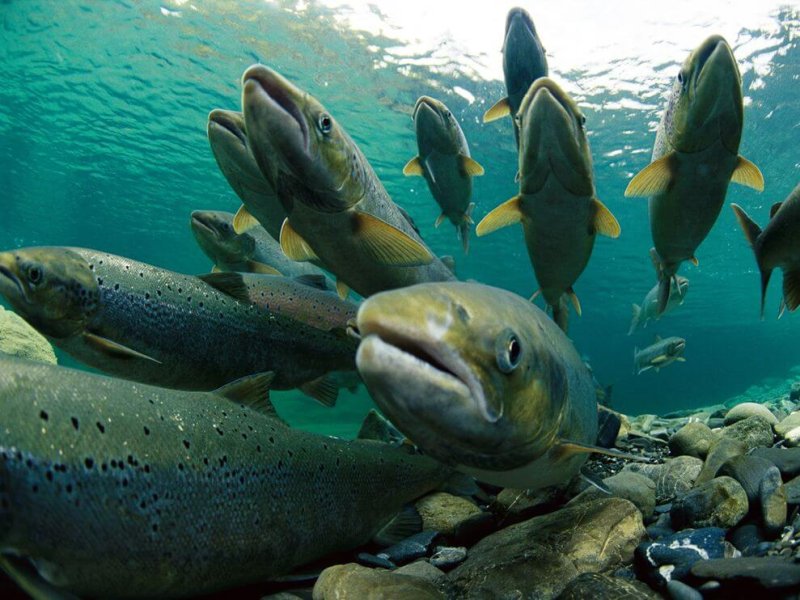
Spawning Atlantic Salmon

The Food and Drug Administration must evaluate the risks posed if genetically engineered salmon escape into the wild, a federal judge said in a case involving FDA’s 2015 approval of AquaBounty’s plans to create and farm GE Atlantic salmon.

FDA’s analysis, contained in an environmental assessment prepared under the National Environmental Policy Act (NEPA), “essentially stopped without assessing the possibility of harm to the natural salmon species in the unlikely event of [GE] salmon establishing themselves in the wild,” U.S. District Judge Vince Chhabria said in a ruling issued [Nov. 5].

The judge declined to shut down operations at the Indiana facility where AquaBounty is currently raising fish and making “continued progress towards the first-ever commercial scale harvest of AquAdvantage salmon,” AquaBounty CEO Sylvia Wulf said [Nov. 4] in releasing the company’s third-quarter results.

Follow the latest news and policy debates on sustainable agriculture, biomedicine, and other ‘disruptive’ innovations. Subscribe to our newsletter.

Chhabria said that “revoking the [FDA’s] approval would presumably require the current stock of salmon to be destroyed, a significant loss of property and animal life that would be wasteful given the real possibility that the FDA will be able to cure the NEPA and ESA errors on remand.”

“But because the FDA took the risk of escape seriously and imposed conditions designed to prevent escape, the short-term threat to the environment from engineered salmon at the Prince Edward Island facility (and, for that matter, the Indiana facility) is low,” he said.


Read the original post

{{ reviewsTotal }}{{ options.labels.singularReviewCountLabel }}
{{ reviewsTotal }}{{ options.labels.pluralReviewCountLabel }}
{{ options.labels.newReviewButton }}
{{ userData.canReview.message }}

Related Articles

Infographic: Global regulatory and health research agencies on whether glyphosate causes cancer

Infographic: Global regulatory and health research agencies on whether glyphosate causes cancer

Does glyphosate—the world's most heavily-used herbicide—pose serious harm to humans? Is it carcinogenic? Those issues are of both legal and ...

Most Popular

ChatGPT-Image-Jun-25-2026-12_23_17-PM
No, Bill Gates did not secretly engineer ticks to promote veganism
ChatGPT-Image-Jun-23-2026-03_12_23-PM
Is cellular reprogramming junk science? Nearly 20 patients are getting eye injections in the first FDA-cleared cellular trial
Screenshot-2026-06-15-at-1.55.27-PM
America's trust in Trump-Kennedy's CDC health recommendations is plunging
ChatGPT-Image-Jun-17-2026-10_52_43-AM
Anguished parents, doctors in tears: Utah’s long measles outbreak takes a toll
ChatGPT-Image-Jun-24-2026-11_36_47-AM
Why the human genome is less a script than a puzzle
ChatGPT-Image-Mar-10-2026-01_39_01-PM
Viewpoint—“Miracle molecule” debunked: Why acemannan supplements don’t work
Screenshot 2026-06-25 at 10.55
Leading OB-GYN group challenges RFK, Jr. gutting of maternal vaccine schedule
Screenshot-2026-06-24-at-2.57.41-PM
Viewpoint: Trump’s Reflecting Pool algae fiasco points to a bigger culprit: Climate change
Screenshot-2026-06-24-at-2.40.46-PM
Hegseth reversal: As Air Force flu outbreak continues to surge, military reinstitutes mandatory vaccines for recruits
Screenshot-2026-06-22-at-9.04.46-PM
Kennedy's nutrition prescription for medical schools: Real problem, bad cure
Screenshot-2026-06-25-at-1.48.40-PM
Glyphosate affirmed as safe: Supreme Court rejects lawsuit claiming Roundup herbicide causes cancer, upholding EPA determination

Sorry. No data so far.

glp menu logo outlined

Get news on human & agricultural genetics and biotechnology delivered to your inbox.