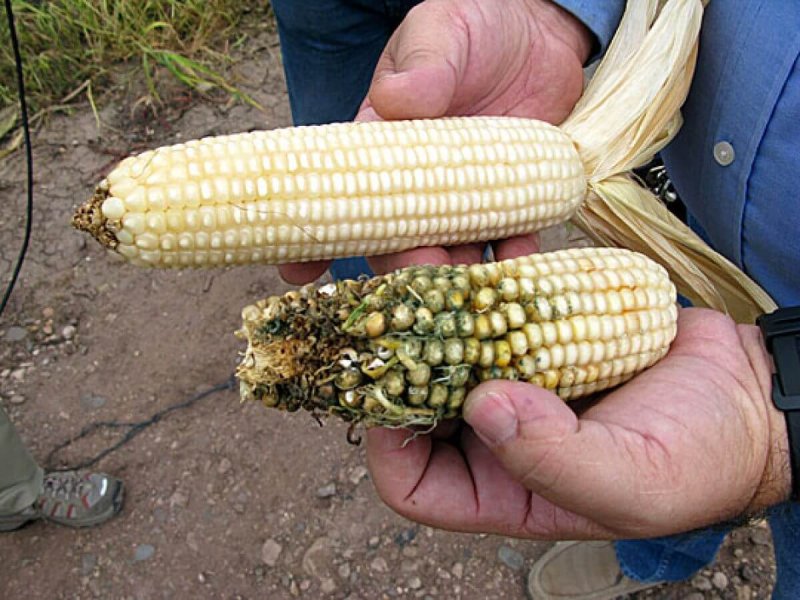
Can GM corn eliminate insecticide use? For some farmers, the answer is yes, study shows

Credit: Joshua Eley-McClain

Maize production is one of the most important activities for the Honduran economy, both in terms of area cultivated and food security provided. This article reports the results of a survey undertaken to gauge knowledge, perceptions, opinions, and attitudes of Honduran farmers towards genetically modified (GM) maize.

Data were collected from 32 maize producers in 2018–19, of both conventional and GM, in five different departments (regions) of Honduras. Results show that over 75% of interviewed farmers have significant knowledge of basic biotechnology concepts and GM maize.

Follow the latest news and policy debates on sustainable agriculture, biomedicine, and other ‘disruptive’ innovations. Subscribe to our newsletter.

Overall, producers have a positive opinion about GM maize because yields are higher than conventional maize, and adopting farmers have higher incomes. A significant finding was the reduction in the number of necessary pesticide applications, 84% of interviewees who used GM maize did not apply any pesticides.

Farmers indicate the two main reasons for using GM maize are higher incomes (48%) and ease of use of the crop (33%). Overall, GM maize impacts in Honduras could be greater if the federal government took on a more proactive role in knowledge dissemination and facilitation of credit access.


Read the original post

{{ reviewsTotal }}{{ options.labels.singularReviewCountLabel }}
{{ reviewsTotal }}{{ options.labels.pluralReviewCountLabel }}
{{ options.labels.noReviewsLabel }}
{{ options.labels.newReviewButton }}
{{ userData.canReview.message }}

Related Articles

Infographic: Global regulatory and health research agencies on whether glyphosate causes cancer

Infographic: Global regulatory and health research agencies on whether glyphosate causes cancer

Does glyphosate—the world's most heavily-used herbicide—pose serious harm to humans? Is it carcinogenic? Those issues are of both legal and ...

Most Popular

ChatGPT-Image-Jul-22-2026-09_13_07-AM
Viewpoint—The Strategic Litigation boom: Understanding the tightening coalition among NGOs, foundations, journalists, and tort lawyers
How to Include More Strawberries in Your Diet
Strawberries are berries—and 35 other surprising food and drink myths
close up arabica coffee farmer s hands picking beans plant his farm colombia
Viewpoint: Why do so many ‘mainstream’ and ‘respected’ media outlets exaggerate climate change threats?
diversity
We are entering a new era of personalized medicine—if you’re white
Screenshot-2026-07-07-at-12.55.44-PM
Viewpoint: Yes, we can adapt to a changing climate without devastating the environment and the economy
ChatGPT-Image-Mar-10-2026-01_39_01-PM
Viewpoint—“Miracle molecule” debunked: Why acemannan supplements don’t work
ChatGPT-Image-May-22-2026-10_26_09-AM
Trump-RFK, Jr. National Science Board firings: Accountability vs. partisan meddling
organic scaled
Facts & Fallacies podcast: Organic food cuts pesticide exposure? A response to Dr. Rhonda Patrick
Screenshot 2026-07-22 at 10.25
Science brain drain escalates as Trump purge extends to USDA
ChatGPT-Image-Jul-6-2026-02_25_26-PM
40 million Americans take glucosamine. If you have memory loss, it could accelerate cognitive decline.
ChatGPT-Image-Jun-25-2026-12_23_17-PM
No, Bill Gates did not secretly engineer ticks to promote veganism
using genetics to reverse aging
Is the longevity obsession a new form of ageism?
Screenshot-2026-07-01-at-2.49.48-PM
Dr. TikTok and male fertility: Viral claims tout GLP-1 drugs as fertility boosters. What does the science say?

Sorry. No data so far.

glp menu logo outlined

Get news on human & agricultural genetics and biotechnology delivered to your inbox.