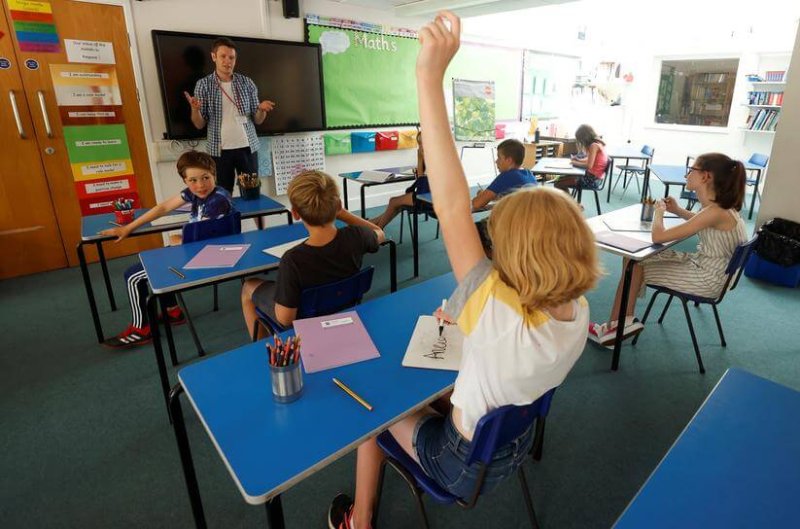
How most of Europe has kept schools open safely during the current COVID surge

Credit: Eddie Keogh/Reuters

Most of Europe kept schools open even during a worst-on-the-planet second wave of infections this fall. And still, schools appear to be relatively safe environments, public health officials say. As long as they adhered to a now-established set of precautions — mask-wearing, hand-washing, ventilation — schools are thought to have played only a limited role in accelerating coronavirus transmission in Europe.

Skeptics say schools aren’t ­doing enough testing to have a true sense of how much the virus is spreading. But communities with enough resources to conduct broader testing after possible exposure haven’t typically found many asymptomatic cases hiding among teachers and students. And because most European schools have embraced bubbles, where students and teachers mix only with their class and no one else, thorough contact tracing can be done in schools even when it falters in wider society.

“We are not seeing the tip of the iceberg; we are seeing the whole iceberg because of our good tracing,” said [Spanish pediatrician] Quique Bassat.

Follow the latest news and policy debates on sustainable agriculture, biomedicine, and other ‘disruptive’ innovations. Subscribe to our newsletter.

Overall, while some parents and teachers unions continue to have concerns, many European societies are broadly behind efforts to keep students in their classrooms. Advocates of in-person school say the cost of virtual classrooms for vulnerable students is steep, as is the economic toll of taking parents out of the workforce because their young children are at home.


Read the original post

{{ reviewsTotal }}{{ options.labels.singularReviewCountLabel }}
{{ reviewsTotal }}{{ options.labels.pluralReviewCountLabel }}
{{ options.labels.newReviewButton }}
{{ userData.canReview.message }}

Related Articles

Infographic: Global regulatory and health research agencies on whether glyphosate causes cancer

Infographic: Global regulatory and health research agencies on whether glyphosate causes cancer

Does glyphosate—the world's most heavily-used herbicide—pose serious harm to humans? Is it carcinogenic? Those issues are of both legal and ...

Most Popular

Picture1
The Orange Bowl without oranges: Can CRISPR save Florida citrus?
global warming
‘Implausible’: Top climate scientists reject worst-case scenario—soaring temperatures and fast-rising sea levels
vax-misinformation-main
Facts & Fallacies Podcast: Limit free speech to blunt social media misinfo?
Screenshot 2026-05-22 at 11.31
‘Realistic and durable’: EPA proposes loosening restrictions on some PFAS ‘forever chemicals.’
ChatGPT-Image-May-1-2026-11_42_59-AM-2
Viewpoint: NAD is the wellness grifters latest evidence-lite longevity fad. At least the mice are impressed.
Screenshot-2026-04-22-at-12.21.32-PM
Viewpoint: Why the retracted Monsanto glyphosate study doesn’t change the science—the world’s most popular herbicide is safe 
ChatGPT Image May 26, 2026, 12_06_53 PM
Fake Ebola cure promoters already cashing in as disinformation videos flood social media
ChatGPT Image May 24, 2026, 03_16_36 PM
Here come the biohackers' Enhanced Games—The Olympics for athletes doping up on steroids, hormones and peptides. What’s wrong with that?
Screenshot-2026-05-21-at-12.15.17-PM
UK gene-editing milestone: Livestock barley that increases ruminant value and reduces methane emissions is first-approved CRISPR crop
glp menu logo outlined

Get news on human & agricultural genetics and biotechnology delivered to your inbox.