Pfizer vaccine data offer hope for a return to normalcy

Credit Dado Ruvic/Reuters
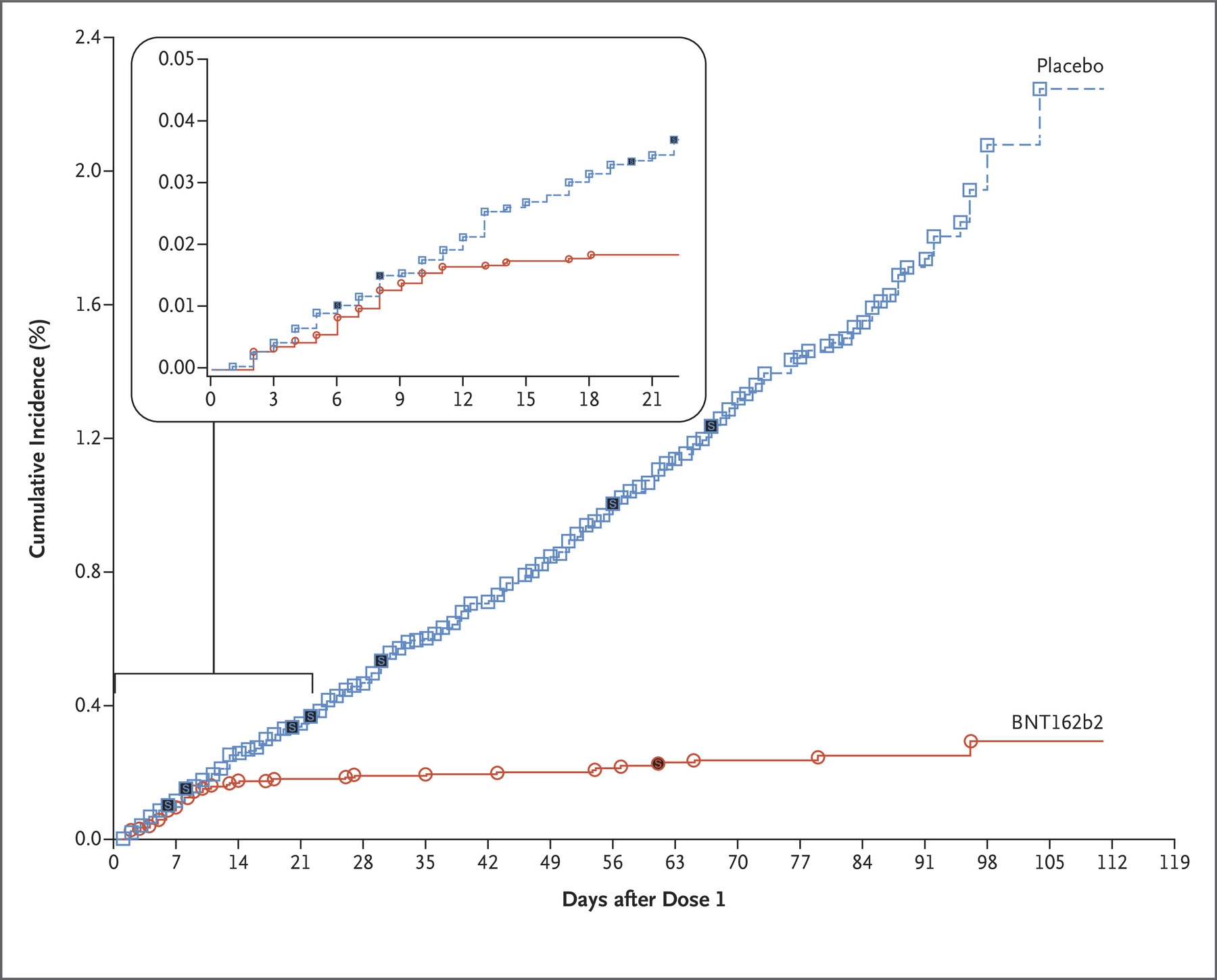
[A]dvisors to the US Food and Drug Administration voted in favor of emergency authorization for Pfizer’s covid-19 shot, and the data in this chart is a big reason why.

The graphic (below), released by Pfizer and its partner, BioNTech, shows the difference in covid-19 infection rates between the people in their trial who got a novel gene vaccine and those who got a placebo.

The volunteers who were given a placebo shot appear as the blue line. The ones who got a vaccine are in red. Each time either line jumps up, that’s when a new covid-19 case occurred.

What the data shows is that during the first week after getting their shots, both groups of people kept getting covid-19 at about the same rate. But after that, the lines start to separate. And they just keep separating and separating.

That’s the result of the vaccine taking effect, which usually takes a few days and gets boosted by a second dose. After two weeks, hardly anyone with the vaccine was getting covid-19. But the disease kept striking those who got the placebo with clockwork regularity.

Follow the latest news and policy debates on sustainable agriculture, biomedicine, and other ‘disruptive’ innovations. Subscribe to our newsletter.

This is what the researchers have been working toward all year. And the data in this graphic leaves no room for rumors, politics, or uninformed commentary. It’s as plain as day: this vaccine is one of the best we’ve ever seen.

Read the original post

{{ reviewsTotal }}{{ options.labels.singularReviewCountLabel }}
{{ reviewsTotal }}{{ options.labels.pluralReviewCountLabel }}
{{ options.labels.newReviewButton }}
{{ userData.canReview.message }}

Related Articles

Infographic: Global regulatory and health research agencies on whether glyphosate causes cancer

Infographic: Global regulatory and health research agencies on whether glyphosate causes cancer

Does glyphosate—the world's most heavily-used herbicide—pose serious harm to humans? Is it carcinogenic? Those issues are of both legal and ...

Most Popular

Screenshot-2026-05-01-at-1.29.41-PM
Viewpoint: What happens when whole grains meet modern food manufacturing? Labels don’t tell the whole story.
S
As vaccine rejectionism spreads, measles may be taking a more dangerous turn
ChatGPT-Image-Apr-13-2026-02_20_22-PM
Viewpoint: Misinformation infodemic? Why assessing evidence is so challenging 
Screenshot-2026-04-20-at-2.26.27-PM
Viewpoint — Food-fear world: The latest activist scientists campaign: Cancer-causing additives
ChatGPT Image May 10, 2026, 08_16_59 PM 2
Overmedicalization? RFK Jr.’s antidepressant crackdown raises conflict questions over his fee stake in Wisner Baum, the tort firm built on suing drug makers
ChatGPT-Image-Mar-27-2026-11_47_30-AM-2
FDA’s expedited drug reviews are hailed in some quarters but other approval practices are problematic
Screenshot-2026-03-13-at-12.14.04-PM
The FDA wants to make many popular prescription drugs OTC—a great idea. Here’s why it’s unlikely to happen
Picture1-5
Science Disinformation Gap: The transatlantic battle over social media and censorship
bigstock opioids on chalkboard with rol
GLP podcast: 'Safe injection sites': enabling drug addiction or saving lives?
circular-bioeconomy-should-focus-on-sustainable-wellbeing
GLP podcast: What's wrong with 'doomsday' environmentalism? It's false.
Screenshot-2026-04-12-135256
Bixonimania: The fake disease scam that AI swallowed whole
glp menu logo outlined

Get news on human & agricultural genetics and biotechnology delivered to your inbox.