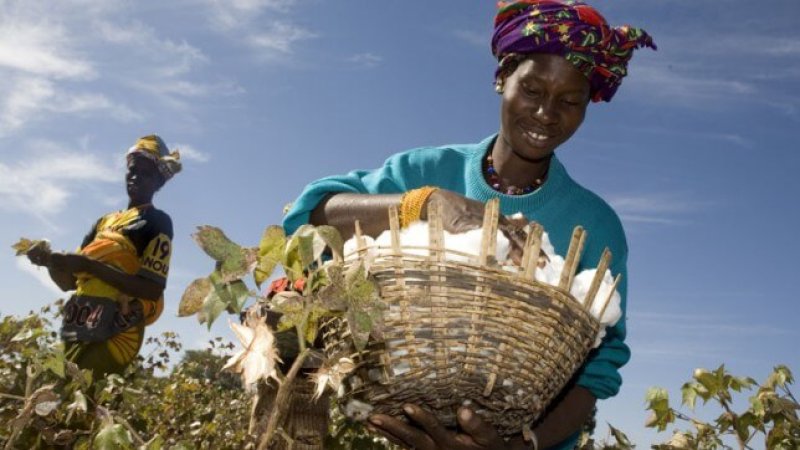
After all, the situation had created so much brouhaha worldwide, and Burkina Faso still stars in numerous academic papers that use it as an example of why Africa should steer clear of biotechnology.
Let me summarize the story briefly. In 2008, Burkina Faso approved the cultivation of genetically modified Bt cotton capable of resisting the bollworm pests which can destroy up to 80 percent of yield on cotton farms. The only national survey conducted in Burkina Faso on Bt cotton impact revealed the variety helped farmers cut down on pesticide use by up to 70 percent while increasing productivity by about 22 percent. Smallholder farmer profits also increased by an average of 51 percent. But cotton processers complained fiber from the new variety was shorter in length and in 2016 the government decided to phase out GM cotton varieties and return to non-GM seeds.
Reuters reported the GM cotton seeds had “sown trouble” in Africa. The situation was the buzz in every major conversation about agricultural biotechnology across the world. For more than a year, much of what I knew about the situation was from second- and third-hand sources. So, it was a real honor to be in Burkina Faso to see things first-hand and cover the story from the perspective of farmers who grow cotton.
In one of my very first encounters, a tall, dark, well-built farmer told me that “English speaking foreigners” accompanied by Burkinabe translators had come to his community seeking his views on the government’s decision to pull breaks on the GM cotton. A lot of those who visited him are whites from Europe and America. But he found my visit unique, as I happen to be black, and from neighboring Ghana.
I wasn’t surprised he’d had a lot of foreign journalists, academics and researchers visit him. The country had quickly become the go-to example for those seeking to discredit the GM technology. No major anti-GM conference happens without Burkina Faso being mentioned these days. And in countries like Kenya, Uganda, Nigeria and Ghana, where work is progressing on GM crop varieties, anti-GM campaigners are quick to point to Burkina Faso as the reason why the technology is a bad idea.
On the ground in Burkina Faso, the picture is clear: farmers were really happy with the GM cotton variety, despite processors’ concerns about the length and quality of the fiber, and they’re struggling with its loss. For me, the farmers’ voices matter, so I documented their views very vividly.
In Pandema District, I met cotton farmer Seidu Konatey, who was full of praise for the GM variety that had just been phased out. “From 15 times spraying a year, they promised us that with Bt cotton, we will spray only two times,” Konatey recalled. “We were surprised. We tried it and realized that was true. We were all very happy.”
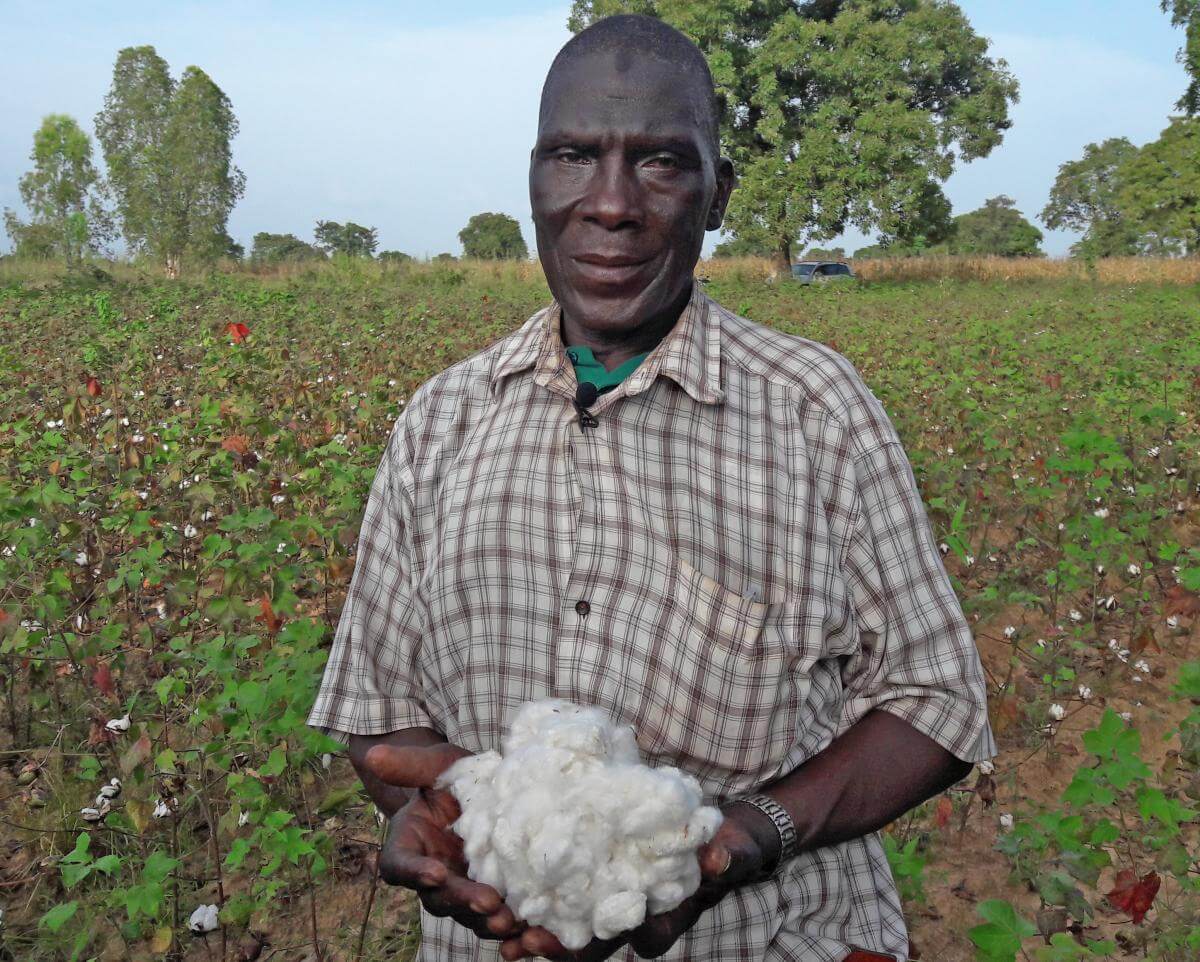
Kuraogo Salifu, another farmer in the Pandema District told me: “Since they brought this new (non-GM) variety two years ago, the pressure from the pest has been serious… If the government wants to help farmers, they need to bring back GM cotton.” His wife, Shekinatu Kuraogo, was worried that pest attacks on their farm fields had gone up with the phasing out of GM cotton. “The cotton fields would usually look far better than this… But this one, there are no leaves even five months after planting and no fiber, although they have matured. I prefer GM seeds to this one,” she said.
At Lamfirakura in the Dande District, I met Abdul Aziz Giro, who complained that the return to conventional seeds had increased his investments in pesticides while lowering productivity. “We are supposed to spray six times, but now we have sprayed 10 times. We are supposed to harvest two tonnes, but for now, it looks like we will get only 200 kg… So, I am not expecting any profit,” he said.
At Sirayirikoro in the Fo District, the situation was no different. I met 64-year-old Tanou Loumissa, who told me he does not think he will be willing to continue cotton if he has to keep using the same non-GM variety. “If they bring this variety next year, we won’t farm. The company should think twice about sending those same seeds here next year,” he said.
Karboe Guile, a farmer at Kiere in the Hounde District, told me that without GM seeds, “the pests are not going away. Treating them is expensive and tiresome. I hope the government will re-introduce the previous seeds which were less demanding and helpful to us,” he added.
These are only a few of the testimonies I heard. A few months after I left Burkina Faso in February 2018, the National Union of Cotton Producers of Burkina Faso (UNPCB) took a similar stance. In a press statement, the association said: “UNPCB is for genetically modified cotton because we are all aware of its benefits… UNPCB is committed to finding a solution quickly for the return of the GM cotton together with the cotton companies and the government,” the statement said.

These stories are real. You only need to be on the ground in Burkina Faso, with an open mind, to hear them.
Clarifying the narrative
I found it necessary to write again about that memorable trip to Burkina Faso after reading a paper titled knowledge politics and the Bt cotton success narrative in Burkina Faso, published recently by two academics I respect. They, among others, argued that the faulty and incomplete success narrative about Burkina Faso’s Bt cotton did not reflect the reality on the ground. They argued that estimates on the benefits that farmers derived from Bt cotton was over blown and they specifically blamed organizations like ISAAA and the Cornell Alliance for Science for playing “a disproportionate role in creating and propagating this success narrative.”
The authors of the paper found it discomforting that the Burkina Faso story was still being told as a successful one. “Even after Burkina Faso’s phase out of Bt cotton, the narrative of success continued. One organization in particular, Cornell Alliance for Science, published articles claiming that ‘‘GM cotton in Burkina Faso has in reality been a runaway success” (Conrow, 2016), and that the withdrawal of Bt cotton was ‘‘reversing the tide of progress” (Gakpo, 2017),”the paper noted.
Thankfully, Burkina Faso is within walking distance of my home in Ghana. Seidu, the Kuraogos, Abdul Aziz, Karboe and Tanou are still alive today to re-tell their stories, if need be. So, there is absolutely no basis for anyone to claim the so-called “success narrative” is false. The voices of these farmers matter.
The bigger picture
More importantly, I want to draw attention to the bigger picture — Africa’s adoption of the technology — and how the situation in Burkina Faso serves as a distraction. I believe it would be an error for Africa to allow the story told by cotton processors in Burkina Faso to shape the discourse in terms of biotechnology’s future on the continent. In 2017, small holder farmers in developing nations, including Bangladesh, Brazil, South Africa, Argentina, Sudan and India, accounted for more than 53 percent of the world’s total GM crop fields. In 2018 alone, GM crops added an estimated US$18.95 billion to farmers’ direct income, 53 percent of which went to farmers in the developing world.
So, why do the self-described “academic neutrals” in the GM debate, particularly those from the Global North, keep running back to Burkina Faso to bolster their claims that GM crops will not succeed in Africa? They need only to look at South Africa, the was the first country on the continent to embrace GMOs, for a very different perspective. South Africa adopted GM crops back in 2000, almost a decade and half before Burkina Faso. Today, it is estimated that 95 percent of South Africa’s maize, 87 percent its soybeans and almost 100 percent of its cotton is GM. But rather than tell that success story, academics seem to prefer to focus on the situation in Burkina Faso, which actually had nothing to do with the technology itself but was instead a plant breeding problem.
Sometimes, the argument is made that GM crops are successful in South Africa because it has more largi scale commercial farming than other countries on the Africa. But many small-scale farmers — Motlatsi Musi is but one example — in South Africa have benefitted greatly from GM crops, and that is a model the rest of Africa can look to as well.
Gradually, we are turning the GM debate into a political football, an “us versus them” debate, when in fact the larger priority should be the interest of farmers and food consumers. We don’t need to treat this issue like a boxing match with rules that say there must necessarily be a winner and a loser, with no middle ground.
I believe if all 53 African countries toe the line of Burkina Faso by pulling brakes on the growing of GM crops, the Sustainable Development Goal 1 to end hunger will never materialize. Similarly, if every African country decides to follow the footsteps of South Africa and grow GM crops, it’s not necessarily a 100 percent guarantee of food security. So, let’s allow choice to be the watch word that guides decisions on GM crops by various societies in Africa going forward.
Joseph Opoku Gakpo is a 2016 Cornell Alliance for Science Global Leadership Fellow and contributes to the Multimedia Group Limited in Ghana, working with Joy FM, Joy News TV, and MyJoyOnline. He has a master’s degree in communications studies from the University of Ghana and is a member of the Ghana Journalists Association. Find Joseph on Twitter @josephopoku1990
A version of this article was originally posted at the Cornell Alliance for Science and has been reposted here with permission. The Cornell Alliance for Science can be found on Twitter @ScienceAlly