US consumers still prefer beef to plant-based meat on nutrition and taste, survey shows

Credit: CCF
Credit: CCF

[A] 79-page report​​ – commissioned by the Cattlemen’s Beef Promotion and Research Board and written by Glynn Tonsor and Ted Schroeder at Kansas State University and Jayson Lusk at Purdue University – surveyed 3,000 US adults in September 2020.

Just over two thirds (68%) indicated they regularly consumed meat, while the rest described themselves as flexitarian, vegetarians, vegans, or none of the above. 

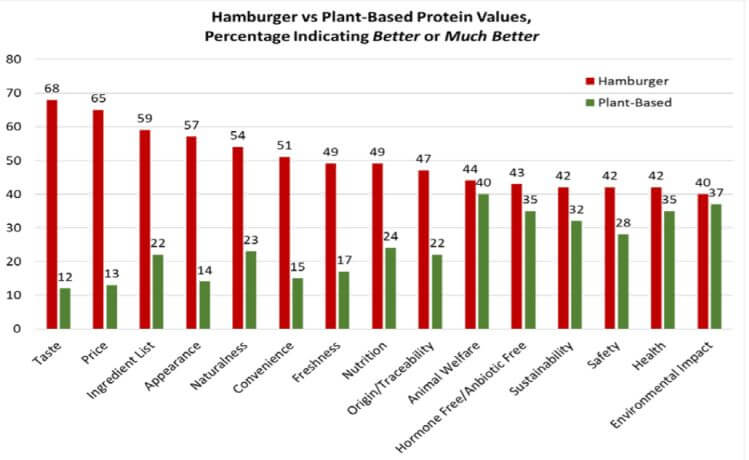
Overall, note the authors, “Beef has a good image. Consumers’ perceptions of taste, appearance, price, and naturalness of beef greatly exceed that for plant-based proteins.”

While plant-based proteins score highest on animal welfare, health, and environmental concerns, “on average these are still slightly lower scores than beef for the same attributes​,” say the authors.

Follow the latest news and policy debates on sustainable agriculture, biomedicine, and other ‘disruptive’ innovations. Subscribe to our newsletter.

When it comes to price, the assumption from many stakeholders in the plant-based industry has been that as plant-based meat approaches price parity with conventional meat, it will aggressively gain market share and ultimately even displace animal-based products [assuming all other things are equal, which right now, they are not]. 

But the data does not necessarily support this hypothesis, says the report: “​Changes in the price of beef have a much larger impact on consumer decisions to buy beef than the impact of changes in the price of plant-based offerings. This means plant-based burgers are relatively weak substitutes for beef.​”

Read the original post

{{ reviewsTotal }}{{ options.labels.singularReviewCountLabel }}
{{ reviewsTotal }}{{ options.labels.pluralReviewCountLabel }}
{{ options.labels.newReviewButton }}
{{ userData.canReview.message }}

Related Articles

Infographic: Global regulatory and health research agencies on whether glyphosate causes cancer

Infographic: Global regulatory and health research agencies on whether glyphosate causes cancer

Does glyphosate—the world's most heavily-used herbicide—pose serious harm to humans? Is it carcinogenic? Those issues are of both legal and ...

Most Popular

Picture1-5
Science Disinformation Gap: The transatlantic battle over social media and censorship
ChatGPT Image May 10, 2026, 08_16_59 PM 2
Overmedicalization? RFK Jr.’s antidepressant crackdown raises conflict questions over his fee stake in Wisner Baum, the tort firm built on suing drug makers
Screenshot-2026-04-23-at-11.00.36-AM
Regulators' dilemma: Thalidomide, Metformin, and the cost of getting drug approvals wrong
ChatGPT-Image-May-12-2026-08_39_41-PM
GLP podcast: Big Pharma, Big Ag, Big Food—health harming industries or life-saving innovators?
Screenshot-2026-05-12-at-9.58.31-PM
'He seems fine': Marty Makary out as FDA commissioner
Picture1-1
Cooling the planet with balloons: Could a geoengineering gamble slow global warming?
Picture1-14
When superbugs threaten vulnerable children: Can AI help solve antibiotic resistance?
Screenshot-2026-05-12-at-10.05.11-AM
Pro-vaccine “hero” vs. an anti-vax “villain”: ‘Bad Vaxx’ video stirs MAHA backlash
Screenshot-2026-05-11-104424
Hantavirus outbreak research: Trump administration shut down study last year on rodent-to-human transmission
Screenshot 2026-05-11 at 11.30
Despite politicized disinformation, Midwest AI data centers are fueling a solar energy boom
ChatGPT Image May 12, 2026, 10_19_00 AM 2
Viewpoint— 'Muscular governance': How authoritarianism is surging corporate-linked energy misinformation
S
As vaccine rejectionism spreads, measles may be taking a more dangerous turn
Screenshot-2026-05-01-at-1.29.41-PM
Viewpoint: What happens when whole grains meet modern food manufacturing? Labels don’t tell the whole story.
glp menu logo outlined

Get news on human & agricultural genetics and biotechnology delivered to your inbox.