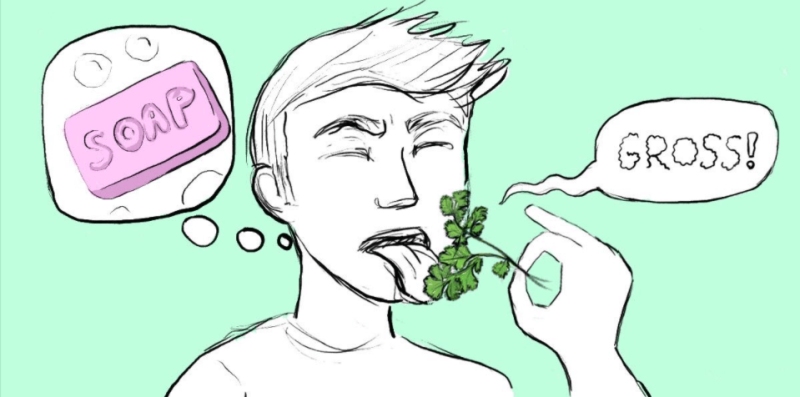
Cilantro is one of the most loved — and hated — herbs. Why does it taste like soap to some people?

Credit: Sam Brosnan/Food Beast

Coriander, also known as cilantro, is one of the most commonly used herbs in the world, but a preference for this little leafy green is just one more thing that divides people.

Humans have hundreds of receptors, which send signals to our brains to produce what we recognize as aromas and flavors.

But exactly how this works is complex and differs from person to person. The same chemical can be found in both appealing and unappealing places — cheese and body odor, for example. Conversely, the same ingredient — such as cilantro — can contain both pleasant and unpleasant chemicals. Whether stinky cheese and cilantro are delicious or disgusting depends on your particular perception of many different chemicals.

The two genetic variants used in 23andMe’s Cilantro Taste Aversion trait report are both located in a cluster of olfactory receptor genes. These are biological sensors that detect chemicals in the air and in food. These receptor genes are also linked to the ability to detect what are called aldehydes, chemical compounds that are found in soap and thought to be a major component of cilantro aroma.

Follow the latest news and policy debates on sustainable agriculture, biomedicine, and other ‘disruptive’ innovations. Subscribe to our newsletter.

One of the eight genes near the variants 23andMe uses in its report codes for a receptor called OR6A2, which is known to detect aldehydes such as those found in cilantro. 

Read the original post

{{ reviewsTotal }}{{ options.labels.singularReviewCountLabel }}
{{ reviewsTotal }}{{ options.labels.pluralReviewCountLabel }}
{{ options.labels.newReviewButton }}
{{ userData.canReview.message }}

Related Articles

Infographic: Global regulatory and health research agencies on whether glyphosate causes cancer

Infographic: Global regulatory and health research agencies on whether glyphosate causes cancer

Does glyphosate—the world's most heavily-used herbicide—pose serious harm to humans? Is it carcinogenic? Those issues are of both legal and ...

Most Popular

Screenshot-2026-06-17-at-12.31.01-PM
Viewpoint: The dangerous influence of ‘woke’ post-modernism in science
ChatGPT-Image-Jun-25-2026-12_23_17-PM
No, Bill Gates did not secretly engineer ticks to promote veganism
ChatGPT-Image-Mar-10-2026-01_39_01-PM
Viewpoint—“Miracle molecule” debunked: Why acemannan supplements don’t work
Sampling_a_strawberry_32206461974
Viewpoint: Which is worse: Trace PFAS ‘forever chemicals’ on strawberries or the fear that scares people away from eating them?
marijuana-pot-in-hand-nveri-st-xpm-t-abq-fkifeos-s-rws-cmpx-
Facts & Fallacies podcast: Legalized weed drives drug addiction, psychosis?
NYPICHPDPICT000011561063
Viewpoint: From magnetizing your head to taking useless supplements, the wellness craze has morphed into an obsession of the affluent
photodune farming tractor s
Viewpoint: Glyphosate may be hazardous, but it is not dangerous as used by farmers. Critics of the Supreme Court’s Roundup ruling garble hazard with risk
covid-vaccine
Blocked by Kennedy’s CDC, validated by peer-reviewed scientists: Suppressed COVID vaccine study published in JAMA finds 50% risk cut
ChatGPT-Image-Jun-30-2026-11_55_58-AM
Viewpoint—Junk science: How predatory mass tort lawyers twist facts, scare the public about phantom chemical risks, and cash in on billion-dollar settlements
ChatGPT-Image-Jun-25-2026-01_14_50-PM
Viewpoint: Disinformation grift: The wellness industry is a lucrative and mostly worthless marketplace of ‘balms, brews, and baloney’
ChatGPT-Image-Mar-4-2026-09_39_03-AM
Transgender female athletes and Title IX: Separating ‘policy’ from ‘legality’
Podolay_1_transplantacia_srdca_1968
From printers to pigs: The precarious future of organ transplants
Screenshot-2026-06-25-at-4.08.41-PM
Even in blue states, hospitals have continued to drop gender-affirming care for youths
Screenshot-2026-06-25-at-11.18.03-AM
Viewpoint: Appreciating a simpler past without swallowing the misleading ‘nature is healthier and safer’ myth
glp menu logo outlined

Get news on human & agricultural genetics and biotechnology delivered to your inbox.