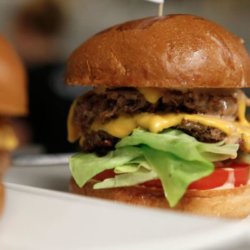
‘Meat: It’s still what’s for dinner.’ Can popular plant-based burgers really displace beef?

Credit: Shutterstock

Walmart now peddles house-brand vegan “chick’n patties,” and KFC is trialing not-chicken nuggets developed by Beyond Meat. 

But here’s a question: When will all this plant-based “meat” consumption start to curtail the US appetite for the real stuff? Americans lead the globe in carnivory, and the great bulk of our meat supply comes from massive confinement operations that spew greenhouse gases, pollute air in other ways, and foul water. Venture capital darlings like Impossible Foods may claim their ground legume patties—tweaked to look and taste like flesh—hold the key to enticing consumers to cut back.

But so far, there’s no sign of it.

Mis- and disinformation are distorting science and public policy. Subscribe to our Daily and Weekly Digests for incisive coverage of ‘disruptive’ innovations in AI, agricultural biotechnology, food, chemicals, nuclear energy, vaccines, and other disruptive innovations.

The US Department of Agriculture just released 2020 numbers on meat consumption. For chicken, pork, and even beef—so far, the main target of Silicon Valley disruption—the per capita numbers have crept up since 2016, the year the Manhattan restaurant Momofuku Nishi served the first Impossible Burger. 
Sure, tech-enhanced, hyper-realistic fake meat hasn’t been around long enough for any definitive judgment of its efficacy. Maybe it’ll eventually work. Or maybe Americans are treating the Impossible Burger like an amuse bouche—a palate-tickling prelude to a meaty meal.


Read the original post

Related Articles

Infographic: Global regulatory and health research agencies on whether glyphosate causes cancer

Infographic: Global regulatory and health research agencies on whether glyphosate causes cancer

Does glyphosate—the world's most heavily-used herbicide—pose serious harm to humans? Is it carcinogenic? Those issues are of both legal and ...

Most Popular

ChatGPT Image Jul 31, 2026, 08_05_37 AM
26% and far worse than during COVID: Under RFK Jr., Americans’ opinion of ‘revamped’ CDC hits an all-time low
Cancer mRNA Vaccine Concept
'A new frontier': Though scorned by RFK Jr., personalized mRNA vaccine offers hope for many suffering from melanoma skin cancer
ChatGPT-Image-Mar-10-2026-01_39_01-PM
Viewpoint—“Miracle molecule” debunked: Why acemannan supplements don’t work
Screenshot-2026-10-26-at-11.06.10-AM
Viewpoint: The organic, good-food, small-farm movement is seductive but wrongheaded. Here’s the sustainability and environmental case for industrial farming
Screenshot-2026-10-24-121036
Many hospitals embrace longevity medicine. Are they separating science from hype?
Picture1
Viewpoint: How badly is the U.S. food-safety net fraying? FDA’s bungled handling of the tainted lettuce crisis deepens concerns over cuts to disease tracking and response
China Innovation Lightbulb 2
China’s 5-year plan to accelerate science innovation is putting the U.S. and Europe in the rearview mirror
Screenshot-2026-10-23-at-10.37.12-AM
Viewpoint: Drones, dollars and baby food: Critical innovations that anti-plastic ideologues willfully ignore
Crimson Drips Over the White House
In Trump administration redirect, U.S. steers NIH sharply away from biodefense and pandemic preparedness
Healthy Food Sensitivity Test Collection
Viewpoint: That’ll be $300: The wellness industry’s junk science scam to ‘fix’ your immune system that isn’t broken
West-Virginia-SNAP-Water-Bottle-Sticker
A ‘shining success’ or 'empty promises’: Two years along, West Virginians assess MAHA’s food promises
Screenshot-2026-10-19-at-12.04.51-PM
Victims of their own success: As memories of killer diseases fade, vaccine rejectionism soars
Screenshot 2026-10-16 at 5.38
PFAS in Agriculture: Science, Uncertainty, and Risk Communication
glp menu logo outlined

Get news on human & agricultural genetics and biotechnology delivered to your inbox.