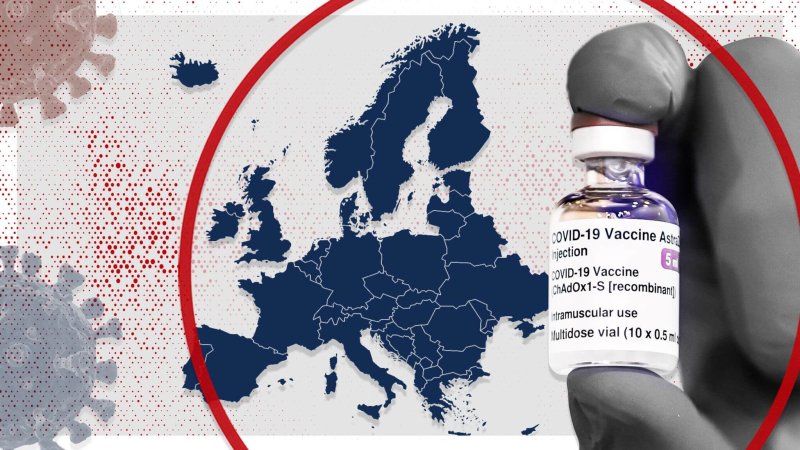
Eastern European countries that opted for less expensive (and possibly less safe and effective) AstraZeneca vaccine see surge in cases as supplies lag

Credit: Sky News
Credit: Sky News

Bulgaria, Croatia, Estonia, Latvia and Slovakia, which declined part of their Pfizer allotments to wait for Astra doses, are among the slowest in the bloc to administer vaccines, according to a European Union document seen by Bloomberg. While Pfizer has met its commitments, Astra has delivered just 30 million of its originally committed 120 million doses in the first quarter.

As a result, Bulgaria and Croatia are expected to vaccinate 45% of their populations by the middle of the year, according to the document, the lowest in the EU after the Czech Republic. Estonia will vaccinate 50%, Latvia 53% and Slovakia 46%. That compares to 61% in Germany, 80% in Denmark and 93% in Malta.

Follow the latest news and policy debates on sustainable agriculture, biomedicine, and other ‘disruptive’ innovations. Subscribe to our newsletter.

So far, the EU has administered 15.5 doses per 100 people, less than a third of what the U.K. has managed. The U.S. has given 45 shots per 100 people.

The EU is discussing a mechanism to divert a batch of 10 million Pfizer doses that will be delivered earlier than expected to some of those countries in need. The latest proposal would see five of those countries — Bulgaria, Croatia, Estonia, Latvia and Slovakia — share 3 million of the extra shots, according to two people familiar with the talks.


Read the original post

{{ reviewsTotal }}{{ options.labels.singularReviewCountLabel }}
{{ reviewsTotal }}{{ options.labels.pluralReviewCountLabel }}
{{ options.labels.newReviewButton }}
{{ userData.canReview.message }}

Related Articles

Infographic: Global regulatory and health research agencies on whether glyphosate causes cancer

Infographic: Global regulatory and health research agencies on whether glyphosate causes cancer

Does glyphosate—the world's most heavily-used herbicide—pose serious harm to humans? Is it carcinogenic? Those issues are of both legal and ...

Most Popular

Screenshot-2026-03-13-at-12.14.04-PM
The FDA wants to make many popular prescription drugs OTC—a great idea. Here’s why it’s unlikely to happen
Screenshot-2026-05-04-at-12.54.32-PM
How Utah became the country’s supplement capital  — and a haven for unregulated, ineffective and fake products
Screenshot-2026-04-20-at-2.26.27-PM
Viewpoint — Food-fear world: The latest activist scientists campaign: Cancer-causing additives
Screenshot-PM-24
Viewpoint: The herbicide glyphosate isn’t perfect. Banning it would be far worse.
images
The never-ending GMO debate: Pros and cons
Screenshot-2026-05-01-at-11.56.24-AM
‘Science moves forward when people are willing to think differently’: Memories of DNA maverick Craig Venter
Screenshot-2026-04-30-at-2.19.37-PM
5 myths about summer dehydration that could damage your health — or even kill you
Screenshot-2026-04-03-at-11.15.51-AM
Paraben panic: How a flawed study, media hype, and chemophobia convinced the public of the danger of one of the safest classes of preservatives
ChatGPT-Image-May-1-2026-02_20_13-PM
How RFK, Jr.’s false vaccine claims are holding up $600 million to fight diseases in poor countries
79d03212-2508-45d0-b427-8e9743ff6432
Viewpoint: The Casey Means hustle—Wellness woo opportunism dressed up as medical wisdom
bigstock opioids on chalkboard with rol
GLP podcast: 'Safe injection sites': enabling drug addiction or saving lives?
glp menu logo outlined

Get news on human & agricultural genetics and biotechnology delivered to your inbox.