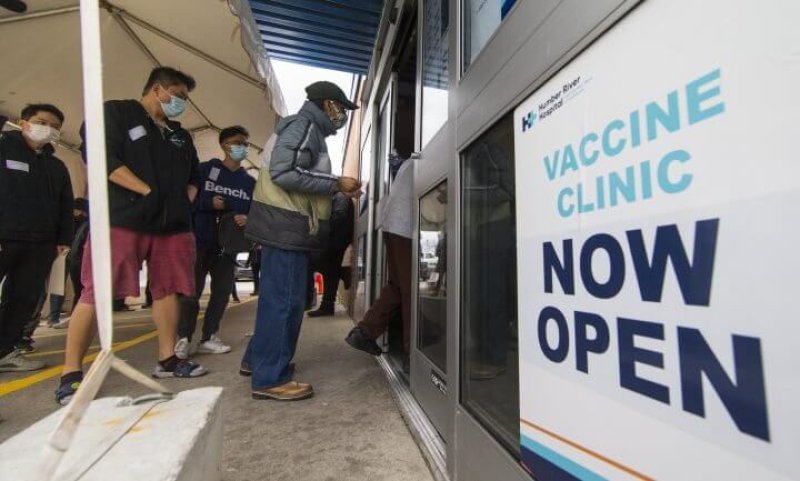
Going forward, will we need an annual COVID vaccine or will ‘one and done’ be enough?

Credit: Global News
Credit: Global News

[New COVID] mutations are popping up in increasingly complicated patterns, spurring a drive by top biologists to devise new ways to track a fire hose of incoming genomic data.

The goal: Quickly detect variants that can lessen the effectiveness of vaccines for a pathogen that’s unlikely to be eradicated any time soon. The SARS-CoV-2 virus could settle down and become a mere nuisance like the common cold. Or much like influenza, it could retain its ability to cause severe disease in some segments of the population, a scenario that could require regular booster shots.

…

“Does it mean we need to make a new vaccine every year?” said Paul Duprex, who heads the University of Pittsburgh’s Center for Vaccine Research. ”We don’t know.”

For one thing, mRNA vaccines for Covid-19 have efficacy rates above 90%, much higher than the 60% rate for flu shots in a good year. But vaccine makers Moderna and Pfizer, along with its partner BioNTech, aren’t taking any chances. Just in case, they’re already starting trials of booster shots aimed at B.1.351.

Mis- and disinformation are distorting science and public policy. Subscribe to our Daily and Weekly Digests for incisive coverage of ‘disruptive’ innovations in AI, agricultural biotechnology, food, chemicals, nuclear energy, vaccines, and other disruptive innovations.

What makes SARS-CoV-2’s future so hard to predict is that viral evolution is like a three dimensional chess game. It’s not just the individual mutations that matter, but also the order and combinations in which they occur.


Read the original post

Related Articles

Infographic: Global regulatory and health research agencies on whether glyphosate causes cancer

Infographic: Global regulatory and health research agencies on whether glyphosate causes cancer

Does glyphosate—the world's most heavily-used herbicide—pose serious harm to humans? Is it carcinogenic? Those issues are of both legal and ...

Most Popular

ChatGPT-Image-Sep-23-2026-02_36_39-PM
Viewpoint: After firing the entire National Science Board, Trump reshapes funding initiatives. Here’s the good and the bad.
ChatGPT-Image-Mar-10-2026-01_39_01-PM
Viewpoint—“Miracle molecule” debunked: Why acemannan supplements don’t work
sorghum farmers in kenya FARMERS TREND
Here are all the ways CRISPR gene editing is transforming Africa’s staple crops—and there’s a lot more innovation to come
ChatGPT-Image-Sep-10-2026-10_36_07-AM
Viewpoint: Even lousy scientific articles can shield authors when they hype dubious health claims and products
ChatGPT-Image-Sep-30-2026-01_38_36-PM
Viewpoint: Died “with measles” vs. died “from measles”: RFK, Jr.’s dangerously subversive word games
ChatGPT-Image-Sep-30-2026-01_25_34-PM
Blood tests for Alzheimer’s? The latest grifter, social media scam.
Screenshot-2026-10-01-at-11.21.27-AM
Vaccine hesitancy, like malaria, surges globally, topping 35% in some countries
ChatGPT-Image-Sep-30-2026-01_11_07-PM
How U.S. teamed with Russia to block global human AI weapons oversight
ChatGPT-Image-Sep-21-2026-03_15_09-PM
Viewpoint: Chipotle-inspired lesson: 10,000 sick customers suggest that processed foods can be safer than fresh ones
glp menu logo outlined

Get news on human & agricultural genetics and biotechnology delivered to your inbox.