4 in 10 healthcare workers have not gotten a COVID vaccine and many say they never will

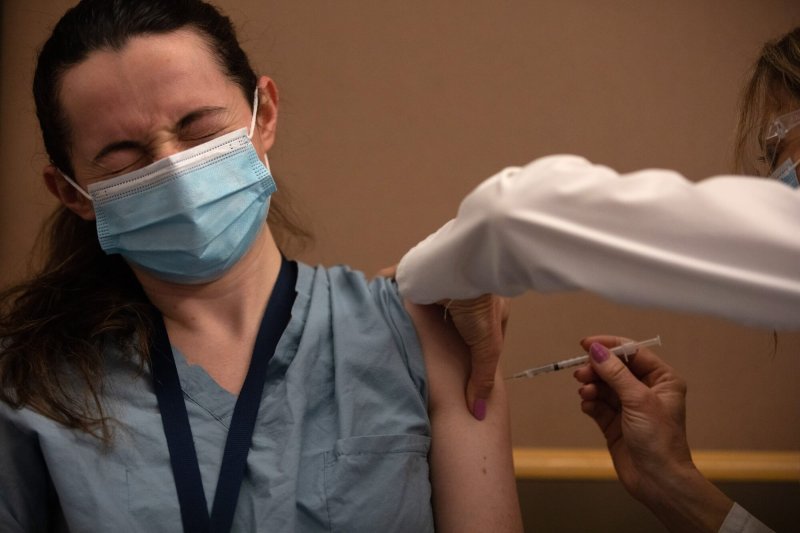
Credit: Emily Welcoming/Bloomberg

Health-care workers were the first group in the United States to be offered coronavirus vaccinations. But three months into the effort, many remain unconvinced, unreached and unprotected. The lingering obstacles to vaccinating health-care workers foreshadow the challenge the United States will face as it expands the pool of people eligible and attempts to get the vast majority of the U.S. population vaccinated.

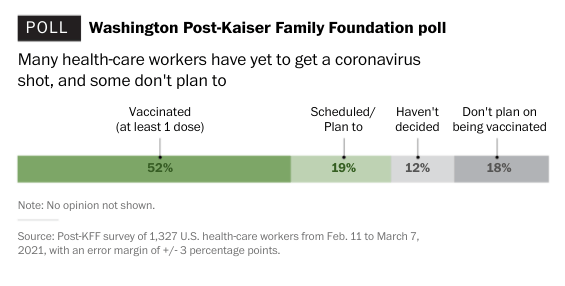
According to a Washington Post-Kaiser Family Foundation poll, barely half of front-line health-care workers (52 percent) said they had received at least their first vaccine dose at the time they were surveyed. More than 1 in 3 said they were not confident vaccines were sufficiently tested for safety and effectiveness.

Follow the latest news and policy debates on sustainable agriculture, biomedicine, and other ‘disruptive’ innovations. Subscribe to our newsletter.

The new vaccines were shipped immediately after receiving emergency use authorization from the federal government. And because health-care workers were the first to be offered vaccinations, some took a wait-and-see approach.

“There was very little time to prepare health-care workers for the vaccines,” said Kelly Moore, deputy director of the Immunization Action Coalition, which promotes vaccine education.

Now that more than 75 million people have been vaccinated, with very few side effects and broad-based national educational campaigns being launched to counter concerns, experts hope vaccine confidence will increase among health-care workers and others.

Read the original post

{{ reviewsTotal }}{{ options.labels.singularReviewCountLabel }}
{{ reviewsTotal }}{{ options.labels.pluralReviewCountLabel }}
{{ options.labels.newReviewButton }}
{{ userData.canReview.message }}

Related Articles

Infographic: Global regulatory and health research agencies on whether glyphosate causes cancer

Infographic: Global regulatory and health research agencies on whether glyphosate causes cancer

Does glyphosate—the world's most heavily-used herbicide—pose serious harm to humans? Is it carcinogenic? Those issues are of both legal and ...

Most Popular

ChatGPT-Image-Mar-10-2026-01_39_01-PM
Viewpoint—“Miracle molecule” debunked: Why acemannan supplements don’t work
Screenshot 2025-07-30 at 10.48
Can gene editing eliminate Down syndrome? Scientists have done it in lab-grown cells
Screenshot 2026-05-26 at 10.15
Viewpoint: Double standard—Why does the wellness industry get a free pass while Big Healthcare is treated as morally suspect?
ChatGPT-Image-May-26-2026-07_51_21-AM-2
Viewpoint: There are more than 1,000 chemicals in a cup of coffee—including many substances that can cause cancer. Why isn’t it banned?
Screenshot-2026-06-04-at-12.05.08-PM
Cases of brain inflammation surge as U.S. measles pandemic approaches 2000
Screenshot-2026-05-28-at-1.36.28-PM
Viewpoint: Can mRNA research survive the Trump administration?
ChatGPT Image May 26, 2026, 08_42_17 AM (1)
Viewpoint: Greenpeace and poison: How environmental advocacy groups rely on compliant (and often ignorant) journalists to spread disinformation and spark litigation
Picture1
Sounds we can’t hear — the hidden planetary signals behind science, fear, and misinformation

Sorry. No data so far.

glp menu logo outlined

Get news on human & agricultural genetics and biotechnology delivered to your inbox.