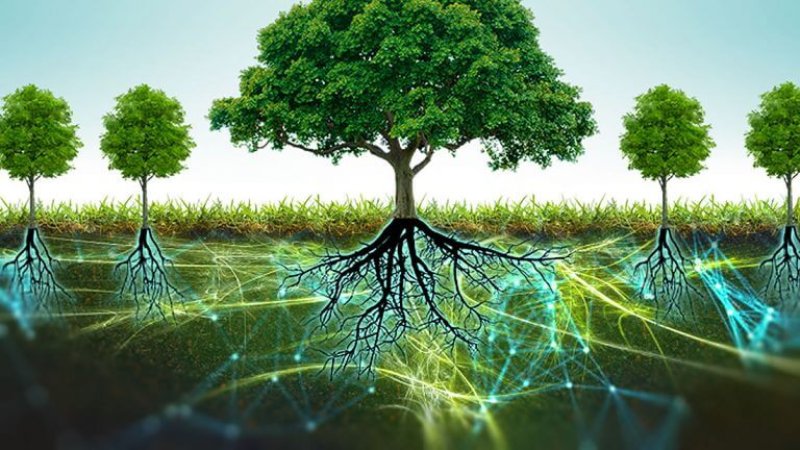
Are trees social beings? They exchange nutrients, help one another, and communicate about pests and other environmental threats

Credit: Riverside Club

Previous ecologists had focused on what happens aboveground, but [Suzanne] Simard used radioactive isotopes of carbon to trace how trees share resources and information with one another through an intricately interconnected network of mycorrhizal fungi that colonize trees’ roots. In more recent work, she has found evidence that trees recognize their own kin and favor them with the lion’s share of their bounty, especially when the saplings are most vulnerable.

Simard’s first book, Finding the Mother Tree: Discovering the Wisdom of the Forest, was released by Knopf [recently]. In it, she argues that forests are not collections of isolated organisms but webs of constantly evolving relationships. Humans have been unraveling these webs for years.

Follow the latest news and policy debates on sustainable agriculture, biomedicine, and other ‘disruptive’ innovations. Subscribe to our newsletter.

”Studies show that biodiversity leads to stability—it leads to resilience, and it’s easy to see why. Species collaborate. It’s a synergistic system. One plant has a high photosynthetic capacity, and it fuels all these soil bacteria that fix nitrogen. Then there’s this other deep-rooted plant, and it goes down and brings up water, which it shares with the nitrogen-fixing plant because that nitrogen plant needs a lot of water to carry out its activities. So suddenly the whole productivity of the ecosystem goes way up,” [said Simard].


Read the original post

{{ reviewsTotal }}{{ options.labels.singularReviewCountLabel }}
{{ reviewsTotal }}{{ options.labels.pluralReviewCountLabel }}
{{ options.labels.newReviewButton }}
{{ userData.canReview.message }}

Related Articles

Infographic: Global regulatory and health research agencies on whether glyphosate causes cancer

Infographic: Global regulatory and health research agencies on whether glyphosate causes cancer

Does glyphosate—the world's most heavily-used herbicide—pose serious harm to humans? Is it carcinogenic? Those issues are of both legal and ...

Most Popular

Screenshot-2026-06-17-at-12.31.01-PM
Viewpoint: The dangerous influence of ‘woke’ post-modernism in science
marijuana-pot-in-hand-nveri-st-xpm-t-abq-fkifeos-s-rws-cmpx-
Facts & Fallacies podcast: Legalized weed drives drug addiction, psychosis?
ChatGPT-Image-Mar-4-2026-09_39_03-AM
Transgender female athletes and Title IX: Separating ‘policy’ from ‘legality’
ChatGPT-Image-Mar-10-2026-01_39_01-PM
Viewpoint—“Miracle molecule” debunked: Why acemannan supplements don’t work
ChatGPT-Image-Jun-25-2026-12_23_17-PM
No, Bill Gates did not secretly engineer ticks to promote veganism
Sampling_a_strawberry_32206461974
Viewpoint: Which is worse: Trace PFAS ‘forever chemicals’ on strawberries or the fear that scares people away from eating them?
photodune farming tractor s
Viewpoint: Glyphosate may be hazardous, but it is not dangerous as used by farmers. Critics of the Supreme Court’s Roundup ruling garble hazard with risk
ChatGPT-Image-Jun-25-2026-01_14_50-PM
Viewpoint: Disinformation grift: The wellness industry is a lucrative and mostly worthless marketplace of ‘balms, brews, and baloney’
ChatGPT-Image-Jun-30-2026-11_55_58-AM
Viewpoint—Junk science: How predatory mass tort lawyers twist facts, scare the public about phantom chemical risks, and cash in on billion-dollar settlements
ChatGPT-Image-Jun-19-2026-04_11_20-PM
Daubert for Dummies—Scientific Reliability in U.S. Courts: Daubert, Rule 702, and Made-for-Litigation Evidence
Trans-flag
Explaining the Supreme Court ruling empowering states to ban transgender female athletes from competing in women’s sports
NYPICHPDPICT000011561063
Viewpoint: From magnetizing your head to taking useless supplements, the wellness craze has morphed into an obsession of the affluent
glp menu logo outlined

Get news on human & agricultural genetics and biotechnology delivered to your inbox.