African scientists have created a CRISPR-edited banana that’s resistant to a disease ravaging farms across the continent

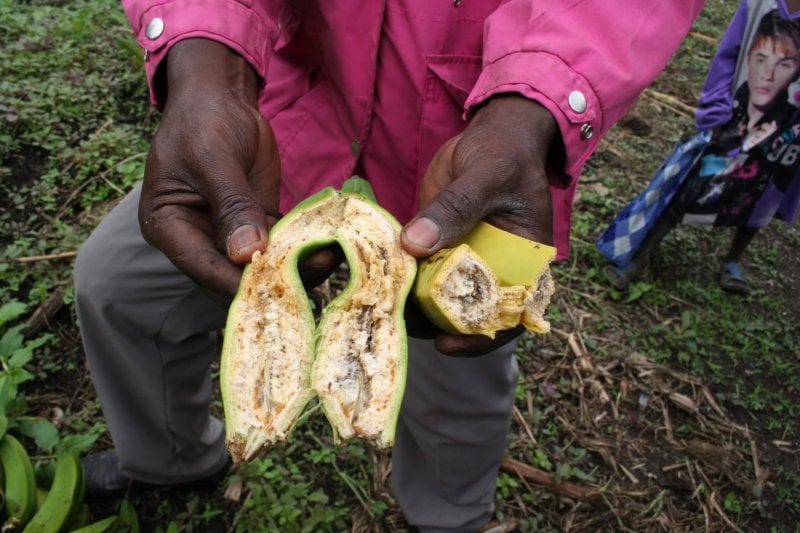
A farmer showing a banana affected by the Banana Xanthomonas Wilt disease (BXW), whose signs include premature ripening of the bunch and rotting of the fruit. Credit: Busani Bafana/IPS

Banana xanthomonas wilt (BXW) is a bacterial disease that spreads easily and kills any banana plant it infects — farmers’ only recourse once an infection takes hold is to cut down and burn the entire plant.

Every species of cultivated banana is susceptible to BXW, and in places where the fruit is a primary source of both income and food, such as Africa, an infection can threaten not only farmers’ livelihoods but the entire local economy.

In an attempt to stop the devastation caused by BXW, International Institute of Tropical Agriculture (IITA) scientists in Kenya set out to develop a disease-resistant banana.

For their study, they focused on a gene called downy mildew resistance 6 (DMR6) — during a pathogen infection, the expression of this gene increases, and that suppresses the plant’s immune function.


Follow the latest news and policy debates on sustainable agriculture, biomedicine, and other ‘disruptive’ innovations. Subscribe to our newsletter.

Bananas are notoriously susceptible to disease because they are all clones. In the past, varieties of banana have been driven virtually extinct by infections like Panama Disease, and today, viruses, bacteria, and fungi again threaten the world’s banana supply.

But if CRISPR can help bananas survive BXW, it may offer a solution to the plant’s other enemies, too.


Read the original post

{{ reviewsTotal }}{{ options.labels.singularReviewCountLabel }}
{{ reviewsTotal }}{{ options.labels.pluralReviewCountLabel }}
{{ options.labels.newReviewButton }}
{{ userData.canReview.message }}

Related Articles

Infographic: Global regulatory and health research agencies on whether glyphosate causes cancer

Infographic: Global regulatory and health research agencies on whether glyphosate causes cancer

Does glyphosate—the world's most heavily-used herbicide—pose serious harm to humans? Is it carcinogenic? Those issues are of both legal and ...

Most Popular

vax-misinformation-main
Facts & Fallacies Podcast: Limit free speech to blunt social media misinfo?
Picture1
The FDA couldn’t find a vaccine safety crisis, so it buried its own research
ChatGPT-Image-Apr-16-2026-02_56_53-PM
Financial incentives, over diagnosis, and weak oversight: Autism claims are driving up Medicare costs
ChatGPT-Image-May-12-2026-11_27_01-AM-2
AI likely to improve health care, research shows—but not for blacks and ethnic minorities
modi visit sikkim
Viewpoint: Indian PM wants farmers to switch to 50% organic. It would take at least 10 years, likely won’t work, and isn’t more sustainable
ChatGPT-Image-May-7-2026-12_32_36-PM
Viewpoint: The state of U.S. vaccine policy? Dismal nationally, but some states are stepping up.
Screenshot-2026-04-22-at-12.21.32-PM
Viewpoint: Why the retracted Monsanto glyphosate study doesn’t change the science—the world’s most popular herbicide is safe 
Screenshot-2026-05-19-at-11.23.34-AM
West-originated vaccine disinformation sparks murders of health care workers across Africa
Screenshot-2026-04-13-at-1.39.26-PM
Viewpoint: ‘Safer for children?’ Stonyfield yogurt under fire for deceptive organic marketing
Screenshot-2026-05-18-at-12.57.12-PM
Viewpoint—‘Technology is pulling us apart’: Environmental, political, and economic
ChatGPT-Image-May-12-2026-08_39_41-PM
GLP podcast: Big Pharma, Big Ag, Big Food—health harming industries or life-saving innovators?
ChatGPT-Image-May-20-2026-04_53_21-PM-2
Viewpoint: Doctors can fight health misinformation — if hospitals let them
ChatGPT-Image-May-7-2026-12_16_37-PM-2
Viewpoint: Are cancer rates ‘skyrocketing’ as RFK, Jr. and MAHA claim? The evidence says mostly the opposite
glp menu logo outlined

Get news on human & agricultural genetics and biotechnology delivered to your inbox.