Kenyan scientists deploy CRISPR to protect bananas from diseases threatening to wipe out the world’s most popular variety

Credit: AfricaME
Credit: AfricaME

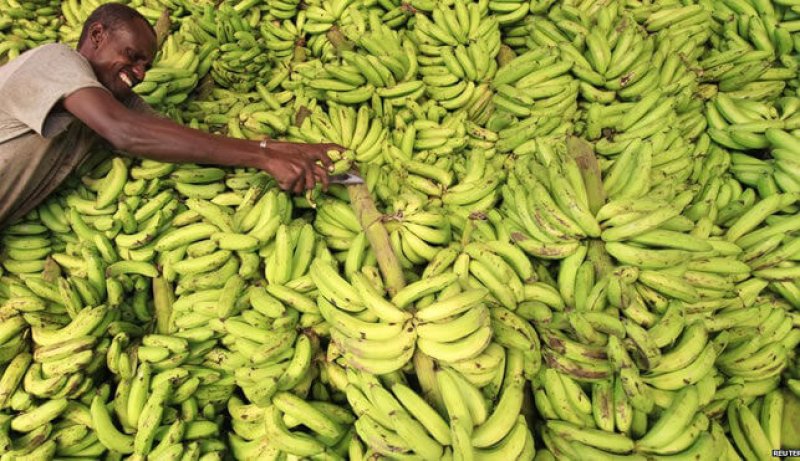
All the cultivated banana varieties are susceptible to diseases — and Banana xanthomonas wilt (BXW) is particularly problematic. BXW is a bacterial disease that has emerged as one of the largest threats to bananas. Overall economic losses from the disease were estimated at US$ 2–8 billion over a decade.

Mis- and disinformation are distorting science and public policy. Subscribe to our Daily and Weekly Digests for incisive coverage of ‘disruptive’ innovations in AI, agricultural biotechnology, food, chemicals, nuclear energy, vaccines, and other disruptive innovations.

With this in mind, researchers from the International Institute of Tropical Agriculture (IITA) scientists in Kenya set out to use genetic modifications to produce more resilient bananas. They used CRISPR/Cas9, a precise but also relatively affordable gene-editing tool, a discovery that earned a Nobel Prize in 2020.

…
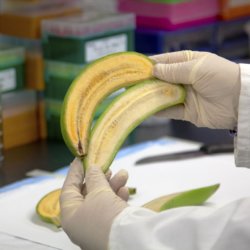
They focused on a gene called downy mildew resistance 6 (DMR6), a gene that has previously been shown to be important for many plants in fighting disease. During pathogen infection, the expression of this gene works to reduce or suppress the plant’s immune function — so if the gene were to be switched off, the plant’s immune system could be turbocharged.

The plants edited with CRISPR showed increased resilience to the disease, in some cases by up to 66% more resilient. Other than the increased resilience, there seemed to be no differences.


This is an excerpt. Read the original post.

Related Articles

Infographic: Global regulatory and health research agencies on whether glyphosate causes cancer

Infographic: Global regulatory and health research agencies on whether glyphosate causes cancer

Does glyphosate—the world's most heavily-used herbicide—pose serious harm to humans? Is it carcinogenic? Those issues are of both legal and ...

Most Popular

ChatGPT-Image-Mar-10-2026-01_39_01-PM
Viewpoint—“Miracle molecule” debunked: Why acemannan supplements don’t work
Screenshot-2026-10-06-at-11.13.59-AM
RFK Jr.’s plan to curb America’s appetite for ultra-processed foods and artificial dyes blocked by the White House
Screenshot-2026-09-22-at-12.26.15-PM
‘Forever chemical’ concerns: Separating hysteria from reasonable concern in the debate over PFAS danger
Screenshot 2026-10-08 at 1.34
Hooked on kratom: The unregulated, natural, alcohol-free “social tonic” that is destroying lives 
Screenshot-2026-10-06-at-2.36.47-PM
Is organic farming really more sustainable? 100 recent studies say ‘no’
Screenshot-2026-09-28-at-11.26.17-AM
Viewpoint: Wellness movement activists reposition nicotine from a killer addictive drug into a cure-all for brain ills
AI-Force-Uniform-Insignia-Close-Up
Trump wants an AI Force like Space Force, but that could make AI’s risks harder to manage
Resolute-Portrait-with-Injured-Teddy-Bear
Anti-vax Texas Senate candidate Ken Paxton alleges conspiracy by doctors, drugmakers, and insurers to push childhood vaccination for profit
Radioactive-Americana-Collage-2
The kooky logic behind the raft of spurious cancer claims from Harvard’s T.H. Chan School of Public Health
ChatGPT-Image-Sep-21-2026-11_21_39-AM
Viewpoint: Food cults: Online ‘nutrition communities’ can pose unique dangers
AI Doctor with a Digital Neural Head
Utah becomes first state to empower AI to bypass doctors and prescribe certain drugs
No-Data-Center-Farm-Protest-Sign-2
Rural revival or corporate windfall? Trump’s One Big Beautiful Bill tax law opens the door to big breaks for data centers—but tech giants aren’t cashing in
Supreme-Court-Amid-Climate-Crisis
Should fossil fuel companies be shielded from lawsuits over climate change damage? The Supreme Court takes up the question
glp menu logo outlined

Get news on human & agricultural genetics and biotechnology delivered to your inbox.