Stories of life-saving dogs who use their power of smell to rescue humans are legendary. One of the most famous is Treo, a black Labrador who served with the British military in Afghanistan. He twice saved dozens of lives, sniffing out hidden bombs set by the Taliban, and was decorated a war hero as a result, making headlines around the world.

But in a unique twist of the power of the canine nose, dogs are also able to smell out a less obvious danger facing their loved ones—medical distress.
Dr. Claire Guest founded a British-based outreach organization, Medical Detection Dogs, after her pet Labrador Daisy saved her life. Here is her account:
Not long after she started to behave strangely, I took Daisy for a walk. When I opened up the back of the car so she could jump out, she refused. Instead she kept staring and nudging at my chest.
Eventually I coaxed her out of the car and as we were walking, I decided to feel where she nuzzled me. To my horror, I felt a small lump.
The discovery prompted me to see my GP and after being referred for further tests, I was shocked to discover I had early stage breast cancer.
The consultant told me that it had been situated so deeply in my chest that had Daisy not spotted it, my prognosis would have been a lot different if we’d had waited for the lump to grow enough for me to notice it. … I literally owed my life to her.
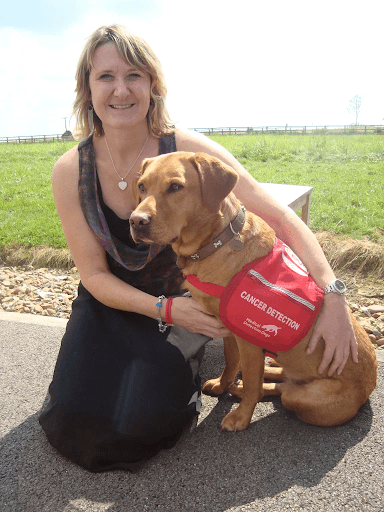
This is not an isolated case of a dog offering a medical alert. Her site and the journal “The Sniff” she puts out is filled with stories. Guest recalled how a colleague of hers sniffed a malignant melanoma on the leg of a friend, who thought it was just a blemish.
More recently, a woman from Wisconsin suffering from mysterious lower abdominal pain was saved by her pup Siberan Husky, Sierra.
“She put her nose on my lower belly and sniffed so intently that I thought I spilled something on my clothes. She did it a second and then a third time. After the third time, Sierra went and hid,” Stephanie Herfel told the Milwaukee Journal Sentinel.

She saw her doctor, who dismissed the symptoms as an ovarian cyst, and gave her some pain medication. But Sierra was persistent. She tried to show her owner that something more serious was going on by curling up in a ball and hiding in the back of the closet. After an appointment with a gynecologist, the woman was diagnosed with ovarian cancer. She had surgery and appeared to be recovering, when the dog hid in the closet once more. The cancer was back, this time in the liver. Twice more the cancer returned and each time Sierra detected it. Thankfully, this story has a happy ending, as the owner is now fine.
The science of canines and disease detection
These news reports are not isolated, just a few of the many anecdotal accounts of dogs saving their grateful owner’s lives. Dogs are renowned for their superior sense of smell. Their genetics and physiology make them perfectly suited for sniffing. Dogs have so many more genes that code for olfactory ability, and many more olfactory nerve cells than humans. And for centuries now, humans have taken advantage of this exquisite sense of smell to hunt, search and detect drugs and explosives and now diseases.
As a result of the post-war baby-boom, the ageing population is set to grow exponentially over the next 30 years. We will need all the help we can get to stay healthier, for longer. Perhaps detection dogs can be another weapon in our armory?
There are high-quality research articles published in major medical journals which document the use of dogs for early disease detection. In a 2006 study, five dogs were trained to detect cancer based on breath samples. Once trained, the dogs were able to detect breast cancer with 88 percent accuracy, and lung cancer with 99 percent accuracy. They could do this across all four stages of the diseases. More recently, a study has even shown that dogs can use their highly evolved sense of smell to pick out blood samples from people with cancer with almost 97 percent accuracy.
A study published in 2013, found that two trained dogs detected 11 out of 12 narcolepsy patients using sweat samples, demonstrating that dogs can detect a distinct scent for the disorder. The dogs pick up on biochemical changes in the body that lead to an attack and help with different tasks to avoid injury. But most importantly, they can provide a warning up to 5 minutes before an attack comes on, giving their handler a chance to get to a safe place or a safe position.
Cancers and other diseases produce odor signatures in our bodies. These signatures, or odor traces are released in our secretions, which means they can be detected by a dog’s highly efficient olfactory system. Changes to our body’s emitted odors occur in many diseases and physical conditions. In late-stage diseases, the odors are much stronger and can even be detected by humans. Dogs have also been known to detect epileptic “seizure odor”, alert diabetics when their blood sugar level is dropping (smelling isoprene on their breath), and even predict migraines.
Recruiting life savers
Humans have been harnessing this canine ability for many years, in various service roles. Suitable dogs will be selected and rigorously trained to undertake search and rescue, tracking and detection work.
More rapid identification of disease requires better noses than ours, and dogs are becoming highly accurate at early detection of many conditions, including:
- Malaria
- Parkinson’s Disease
- Alzheimer’s
- Diabetes
- Migraines
- Cirrhosis
- Tuberculosis
- Covid-19
- Cancers:
- Skin (melanoma)
- Bowel
- Lung
- Ovarian
- Prostate
- Breast
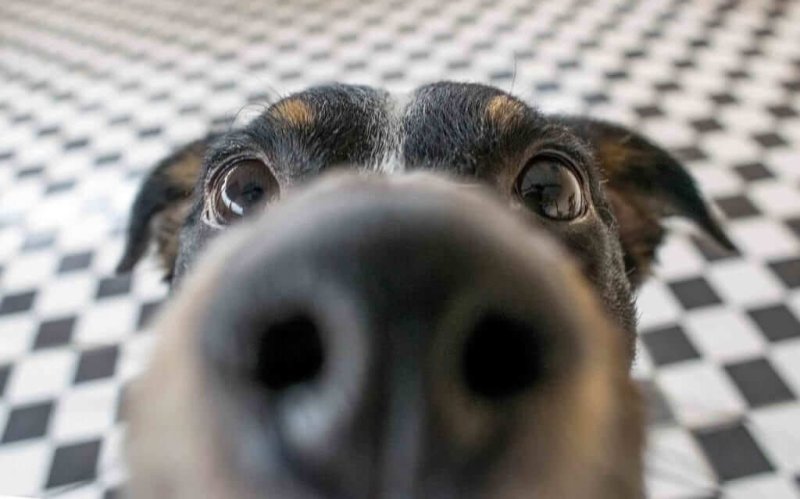
A dog’s nose is a highly evolved and complex apparatus, far superior to our own. “If you make the analogy to vision, what you and I can see at a third of a mile, a dog could see more than 3,000 miles away and still see as well.” Their sense of smell has ensured canine survival long before humans domesticated dogs.
While humans have 5 million scent receptors, dogs have about 220 million, and they are ten times more sensitive. Scientists say their nose is powerful enough to detect substances at concentrations of one part per trillion – a single drop of liquid in 20 Olympic-size swimming pools. Dogs also inhale up to 300 times per minute in short breaths, meaning that their olfactory cells are constantly supplied with new odor particles. AND their noses differentiate between right and left.




Dogs have two olfactory systems that are designed to deal with different odor signatures and their interpretations.
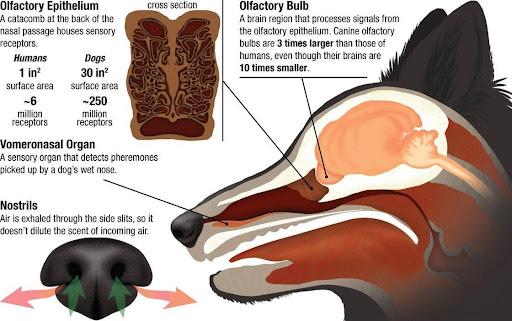
Canine’s highly developed olfactory system
Nasal Cavity: Made up of two chambers which are separated by a central septum. The nostrils, of course, being the openings to each chamber.
Turbinates: A complex labyrinth of delicate bones in the upper chambers of the nasal cavity, which are all lined with olfactory epithelium. This convoluted turbinate network greatly increases the available surface area of the epithelium. This is important, since the epithelial cells are vital mucus producers.
Olfactory Epithelium: The mucus produced by the epithelium contains millions of olfactory receptor cells. The dog’s sense of smell depends on this moist receptor area.
Olfactory Receptor Cells: The olfactory receptor cells have tiny hairs, or cilia, embedded in them. These cilia have odor receptors, more than 220 million in the dog’s nasal cavity. Humans, by comparison, have only six million receptors. The receptors bind themselves to odor molecules as they go past, which causes an electrical signal to be produced.
Olfactory Bulb: A structure in the front of the brain which is made up of neural (nerve) tissue. The olfactory bulb processes all the odor information it receives from the receptor cells. This bulb then relays that information, in the form of electrical signals, to the limbic system, the part of the brain that deals with smell recognition and identification. The human olfactory bulb is markedly smaller than that of the dog.
Limbic System: A set of structures in the brain that receives electrical signals, which then activates functions such as emotion, behavior, long-term memory, and olfaction.
The dog’s accessory olfactory system consists of a vomeronasal organ. Humans do not have this structure. It is designed solely for animals to detect pheromones, which are chemical signals from other dogs. Pheromones contain information about the health and well-being of the dog, and whether it would be a good potential mate.
The receptors send electrical signals to the accessory olfactory bulb (located next to the main olfactory bulb). This information is then processed in different parts of the brain to the limbic system. The vomeronasal organ relays information pertaining to instinct and emotions such as fear, aggression and mating urges.
If you see a dog tracking a scent or searching for something, you’d be amazed at the elaborate air exchange sequence that they perform, so naturally.
Firstly, the air is inhaled into the nose through the inside and front region of the nostrils, while air is exhaled through the outside region and the slits of the nostrils. Inhalation and exhalation occur simultaneously in dogs. It is a constant gathering of odor information as well as respiration function. This is why dogs perform a lot of short, fast, sniffing actions when they are actively tracking scents. Sniffing in this manner delivers about 2.5 times more air to the olfactory system than just inhaling normally.
About 13% of the inhaled air goes through the nasal cavity, through and around the turbinate bones, all the while passing odor information to the receptor cells in the mucus lining, which results in electrical signals. These signals then travel to the olfactory bulb, which in turn uses the limbic system in the brain to identify and categorize the smell. The remaining 87% of inhaled air is exhaled simultaneously.
Why do humans smell differently when we’re sick?
All this brings us to the question of the unique smells generated by humans when we are ill or distressed. Our body odor is largely attributable to bacteria on the skin, and our sweat-gland secretions. A vast combination of volatile organic compounds and microbes also contribute to our personal scent.
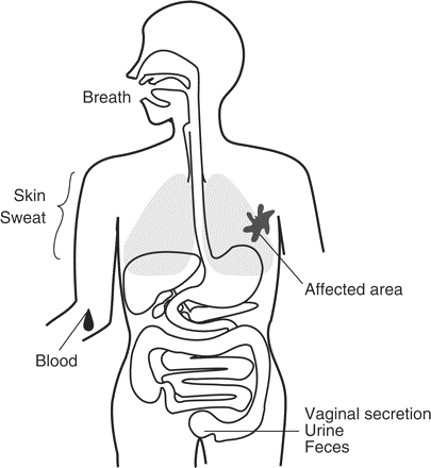
An immune response, active disease or neoplasia (cancerous process) will effectively alter all these conditions. There may be production of new volatile organic compounds, or merely a difference in the ratio of those we produce normally. This explains how a dog’s higher-level sense of smell can pick up the changes occurring in our body. It makes complete sense to continue researching and training dogs to carry out this task.
There have been several anecdotal accounts of dogs highlighting a health issue without any training in the field at all. The earliest recorded was in 1989, when the British journal, The Lancet, published a letter to the editor from two dermatologists. They described how a dog reportedly spent several minutes each day sniffing a lesion on its owner’s thigh, and even tried to bite it off. Concerned, the woman consulted her physician. The lesion turned out to be a malignant melanoma.
The training organization, In-Situ Foundation, developed the first medical protocol for training cancer-detecting dogs. Strict protocols are followed, using hundreds of samples, collected by doctors, in order for each dog to be trained. Dogs are trained to ignore healthy samples, and the emphasis is on detection of cancer. Other diseases are not yet included in the protocol.
The program takes around eight months to produce a competent detection dog, and the foundation is now training other dog trainers to be able to continue this important work around the world. Dogs in similar organizations are being trained to help researchers gather data they will use to build a ‘mechanical nose’. This is a device that will detect odors just like a dog’s nose but will be easily available to the wider medical an, research community.
There are numerous ways that dogs improve the health of humans, from getting us to exercise more, to providing much needed companionship and entertainment. But dogs do so much more for us. They can, and do, actually save our lives.
Most recently, they’ve been deployed to detect COVID-19. These super-sniffers could be effective as a new rapid, non-invasive screening tool at ports of entry, as COVID-19 has a distinct odor that can be detected by trained dogs, with a high degree of accuracy, up to 94%, according to new research.
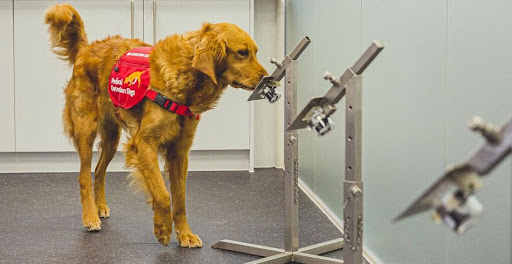
This study was the first to comprehensively assess whether trained dogs can distinguish between the odor of people infected with SARS-CoV-2 and those who are uninfected.
“These fantastic results are further evidence that dogs are one of the most reliable biosensors for detecting the odor of human disease,” said Dr. Guest.
Laura Horton, MSc. is founder of Hound101.com, a website which helps you to be your dog’s best friend. She is also a registered clinical health professional with many years’ experience in diagnostic imaging, teaching and health research.