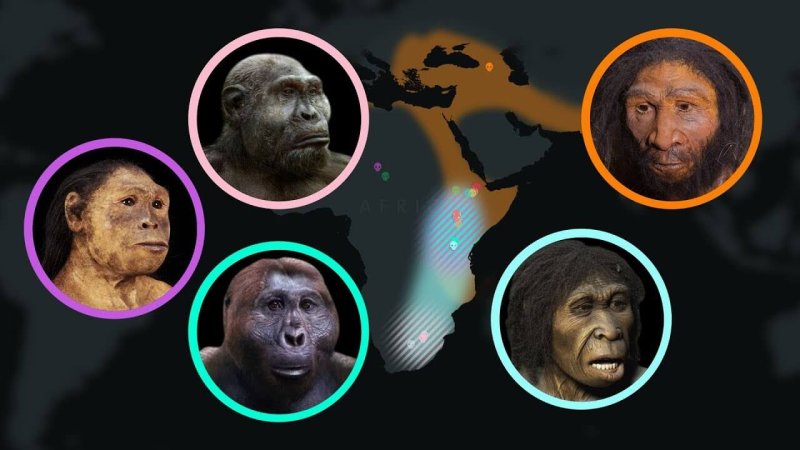
Mongrel humans: Evolution has forged genetically diverse and overlapping populations

Credit: American Museum of Natural History

“We are all mongrels – the idea of a pure population doesn’t exist,” says Professor Himla Soodyall.

In the fragmented and divided society of 2021, the geneticist insists on driving home this point. It’s because this isn’t the only narrative of us. At the level of our DNA, another story holds too – the one where the rich diversity of who we are today converges as an ancient truth of common heritage.

“Every living person today can see themselves as a leaf on a tree placed on a small branch that eventually connects to bigger branches that are ultimately connected to a common trunk. And the path of the branch is based on the movement and collective history of your ancestors,” Soodyall says.

Follow the latest news and policy debates on sustainable agriculture, biomedicine, and other ‘disruptive’ innovations. Subscribe to our newsletter.

Understanding the tangled paths of these metaphorical branches gives us clues to understanding our evolutionary journey. It’s from when we dragged our knuckles, hunched close to the ground to evolving to use tools for a determined outcome.


Early humans all migrated out of sub-Saharan Africa between 100,000 and 200,000 years ago and then settled with their domesticated animals and crops.

Today, we imagine futures of gene editing for disease-free offspring, maybe also green-eyed babies on demand and the return of mammoths to reinhabit tundra somewhere.


This is an excerpt. Read the original post here.

{{ reviewsTotal }}{{ options.labels.singularReviewCountLabel }}
{{ reviewsTotal }}{{ options.labels.pluralReviewCountLabel }}
{{ options.labels.newReviewButton }}
{{ userData.canReview.message }}

Related Articles

Infographic: Global regulatory and health research agencies on whether glyphosate causes cancer

Infographic: Global regulatory and health research agencies on whether glyphosate causes cancer

Does glyphosate—the world's most heavily-used herbicide—pose serious harm to humans? Is it carcinogenic? Those issues are of both legal and ...

Most Popular

ChatGPT-Image-Mar-10-2026-01_39_01-PM
Viewpoint—“Miracle molecule” debunked: Why acemannan supplements don’t work
ChatGPT-Image-Jun-25-2026-12_23_17-PM
No, Bill Gates did not secretly engineer ticks to promote veganism
ChatGPT-Image-Jul-7-2026-12_01_35-PM
Viewpoint: 21 worthless wellness trends inspired by RFK, Jr.’s ill-informed MAHA followers that can harm or even kill you.
Screenshot-2026-07-06-at-12.30.23-PM
2,300 endangered species: Controversial de-extinction company Colossal Biosciences joins U.S. effort to preserve their DNA
Screenshot 2026-07-08 at 10.13
What happens when a pro-life congresswoman needs an abortion?
ChatGPT-Image-Jul-1-2026-03_33_49-PM
‘Alternative’ cancer treatments that could kill you
ChatGPT-Image-Jul-9-2026-10_36_24-AM
Deeply-flawed ivermectin study revives scientifically unsupported miracle cancer drug myth
Screenshot-2026-06-05-at-2.12.30-PM
Some plants can poison you. So how did humans figure out what is safe to eat?

Sorry. No data so far.

glp menu logo outlined

Get news on human & agricultural genetics and biotechnology delivered to your inbox.