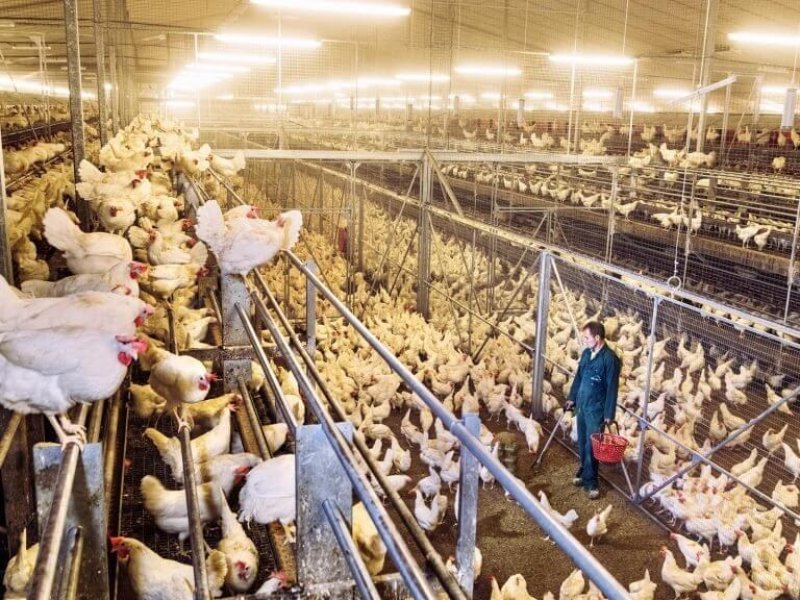
Switching from beef to chicken can have big environmental benefits — but it also means many more animals to miserable lives and death

Credit: Luca Locatelli/National Geographic

We often talk about steak, lamb chops, bacon and chicken nuggets as if they’re on a level playing field. Just ‘meat’. But their impacts are vastly different. Per gram of protein, beef has almost ten times the carbon footprint of chicken. It uses 23 times as much farmland. If we were to rank them in order: beef and lamb have the highest cost; pork has significantly less; chicken is even lower; and many types of fish are better still.

This means that if you want to reduce the environmental footprint of your diet, substituting beef and lamb with chicken and fish gets you really far.

Follow the latest news and policy debates on sustainable agriculture, biomedicine, and other ‘disruptive’ innovations. Subscribe to our newsletter.

Problem solved, right? Well, not quite. This recommendation has a darker side. It’s completely at odds with animal welfare. We often ignore this fact, but it’s nonetheless true. The most environmentally-friendly meat choices mean condemning a greater number of animals to live miserable lives.

[Lab grown meat offers] us a ‘get out of jail free’ card for this ethical dilemma. We could enjoy the same experience of eating meat without the environmental or the welfare cost that comes with it. We’ve yet to fully appreciate how pivotal this might be.

This is an excerpt. Read the original post here.

{{ reviewsTotal }}{{ options.labels.singularReviewCountLabel }}
{{ reviewsTotal }}{{ options.labels.pluralReviewCountLabel }}
{{ options.labels.newReviewButton }}
{{ userData.canReview.message }}

Related Articles

Infographic: Global regulatory and health research agencies on whether glyphosate causes cancer

Infographic: Global regulatory and health research agencies on whether glyphosate causes cancer

Does glyphosate—the world's most heavily-used herbicide—pose serious harm to humans? Is it carcinogenic? Those issues are of both legal and ...

Most Popular

Screenshot-2026-04-22-at-12.21.32-PM
Viewpoint: Why the retracted Monsanto glyphosate study doesn’t change the science—the world’s most popular herbicide is safe 
Picture1
The FDA couldn’t find a vaccine safety crisis, so it buried its own research
ChatGPT-Image-May-1-2026-11_42_59-AM-2
Viewpoint: NAD is the wellness grifters latest evidence-lite longevity fad. At least the mice are impressed.
ChatGPT-Image-Apr-16-2026-02_56_53-PM
Financial incentives, over diagnosis, and weak oversight: Autism claims are driving up Medicare costs
ChatGPT-Image-May-12-2026-11_27_01-AM-2
AI likely to improve health care, research shows—but not for blacks and ethnic minorities
ChatGPT-Image-May-7-2026-01_23_27-PM-2
Viewpoint: Will AI democratize personalized cancer treatment or fuel medical misinformation?
global warming
‘Implausible’: Top climate scientists reject worst-case scenario—soaring temperatures and fast-rising sea levels

Sorry. No data so far.

glp menu logo outlined

Get news on human & agricultural genetics and biotechnology delivered to your inbox.