From changing Earth’s climate to destroying, degrading and altering ecosystems on a massive scale, human choices now largely dictate the environmental conditions across much of the globe and, as a result, which species of plants and animals can survive and persist and which will go extinct. Species lucky enough to be directly or indirectly aided by human activities are likely to survive and can be thought of as “winners,” while those that are pushed to ecological irrelevance or extinction by those same activities are the ultimate “losers” in evolutionary terms.

Kress encountered this concept of evolutionary winners and losers in the age of humans (known to some researchers as the Anthropocene), in the writings of John McNeill and wanted to see if it might be possible to tally the plant species that were winning and losing now and in the future.
“I actually started this project from a place of optimism,” Kress said. “I had just planted all these trees around my house in Vermont and thought to myself that maybe there are actually more winners than losers, and we are just focused on everything that’s disappearing.”
In the summer of 2019, Kress brought Krupnick into the fold to help compile and analyze the mountains of data required to put every plant species for which there was enough information into the categories of winners and losers. The researchers split the winners and losers into species that are and are not useful to humans.
In addition to these four categories, Kress and Krupnick created four others: Species that appeared likely to win or lose in the future were deemed tentative winners or potential losers, and species that do not seem to be winning or losing at present were considered currently neutral. A fourth and final category included 571 species that have already gone extinct.
To place plants in these categories, Kress and Krupnick combed through databases that listed endangered plant species, economically important species such as crops, invasive and weedy plants, and endangered plants that are involved in legal and illegal global trade.
In total, the researchers were able to place 86,592 species of vascular plants—a large group of plants that have vascular tissue which transport water, nutrients and other substances—into the eight categories that describe their prospects for survival in the Anthropocene. That may sound like an inconceivably large number of species, but it is actually just under 30% of the nearly 300,000 known species of vascular plants. There simply was not enough data to categorize the remaining 70% of global plant diversity, which reflects how much is left to learn about Earth’s botanical riches, Kress said.
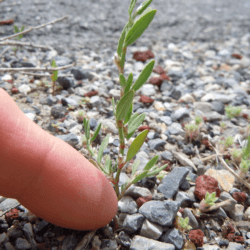
The analysis revealed that losers currently outnumber winners, and that losers are likely to continue to outpace winners in the future if human impact on the planet maintains its current trajectory. Kress and Krupnick categorized 20,293 species of plants as losers, with the vast majority of those losing species being identified as not useful to humans. By contrast, the researchers found just 6,913 species of winners, with all but 164 of those species having some human use.
In the future, barring significant changes in how people conduct themselves on Earth, losers are projected to continue to outnumber winners, with 26,002 species in the potential losers category compared to 18,664 species in the tentative winners category.
To look for evolutionary patterns within the clear winners and losers identified by the study, the researchers also mapped the locations of these lucky and unlucky species on the tree of life.



“The question was whether there were some lineages of plants that were more packed with winners or were full of losers we should be concerned about,” Kress said.
As it turned out, winners and losers were for the most part evenly distributed across plant orders. The exceptions came primarily from small lineages, which were more prone than lineages with many species to leaning heavily in favor of winners or losers, Krupnick said. Three of the lineages most at risk of extinction include cycads, the cypress family (which includes redwoods and junipers) and an ancient family of conifers called the araucariales which are today mostly found in New Caledonia.
Branches of the plant evolutionary tree with few species and more losers than winners such as these have an elevated risk of being lost altogether, taking with them everything there is yet to learn about their biology and their lineage’s genetic uniqueness.
“Now and in the future, plants have to adapt to the environment humans have created or they will go extinct,” Krupnick said. “Our results suggest that this means the plant communities of the future will be more homogenized than those of today.”
This increased homogeneity is likely to have serious consequences for ecosystems around the world as well as humanity. Losing plant diversity can drive a loss of animal diversity, Kress said, and make ecosystems less resilient in the face of hardship or change.
“The list of winners shows that we’ve selected certain species that are useful to us, but as that pool of plants we have to select from decreases in the future, humanity will have many fewer options when we want to reforest the planet, find new medicines or foods, or develop new products,” Kress said.
Kress said he hopes that these lists will afford other researchers opportunities to look more in depth about why certain species of lineages are winning or losing in the age of humans and to identify the plants that are most in need of conservation.
“It still looks green outside my window, and that can create the illusion that plants are doing well,” Kress said. “But this study suggests we’re on course for a big loss of plant diversity, and we better wake up.”
Funding and support for this research were provided by the Smithsonian.
A version of this article was originally posted at the Smithsonian Institution and is reposted here with permission. Check out the Smithsonian Institution on Twitter @smithsonian