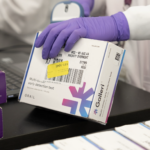
Brain-recording earbuds? High-tech headphones record neural data — and could unlock the mysteries of the mind

Credit: Christie Hemm Klok

After acting as the scanner-in-chief for the company that invented the eFit, [Konstantin] Borodin is now the lead ear spelunker for NextSense, which was born at Google and spun out of Alphabet’s X division.

The startup’s focus is brain health—improving sleep, helping patients with epilepsy, and eventually enriching the lives of people with a range of mental conditions. The idea is to use its earbuds to capture an electroencephalogram, a standard tool for assessing brain activity.

Just as an ECG tracks the fibrillations of the heart, an EEG is used to diagnose anomalies in brain activity. While some smart watches—Apple, Samsung, Fitbit—offer versions of an ECG and aim to spy on your sleep, collecting neural data has mostly been a can’t-try-this-at-home activity. Until now.

Follow the latest news and policy debates on sustainable agriculture, biomedicine, and other ‘disruptive’ innovations. Subscribe to our newsletter.

NextSense has struck up partnerships with universities and drug companies to explore the medical uses of its earbuds. A multinational pharmaceutical firm called Otsuka hopes to use NextSense’s earbuds to assess the efficacy of medication, not only for epilepsy but for depression and other mental health issues. NextSense plans to submit its device for FDA approval this year, and Emory is conducting more studies in hopes of developing an algorithm to predict seizures, ideally hours or days in advance.


This is an excerpt. Read the original post here

{{ reviewsTotal }}{{ options.labels.singularReviewCountLabel }}
{{ reviewsTotal }}{{ options.labels.pluralReviewCountLabel }}
{{ options.labels.newReviewButton }}
{{ userData.canReview.message }}

Related Articles

Infographic: Global regulatory and health research agencies on whether glyphosate causes cancer

Infographic: Global regulatory and health research agencies on whether glyphosate causes cancer

Does glyphosate—the world's most heavily-used herbicide—pose serious harm to humans? Is it carcinogenic? Those issues are of both legal and ...

Most Popular

Screenshot-2026-04-20-at-2.26.27-PM
Viewpoint — Food-fear world: The latest activist scientists campaign: Cancer-causing additives
Screenshot-2026-03-13-at-12.14.04-PM
The FDA wants to make many popular prescription drugs OTC—a great idea. Here’s why it’s unlikely to happen
Screenshot-2026-05-04-at-12.54.32-PM
How Utah became the country’s supplement capital  — and a haven for unregulated, ineffective and fake products
Screenshot-2026-05-01-at-11.56.24-AM
‘Science moves forward when people are willing to think differently’: Memories of DNA maverick Craig Venter
ChatGPT-Image-May-1-2026-02_20_13-PM
How RFK, Jr.’s false vaccine claims are holding up $600 million to fight diseases in poor countries
Screenshot-2026-04-03-at-11.15.51-AM
Paraben panic: How a flawed study, media hype, and chemophobia convinced the public of the danger of one of the safest classes of preservatives
Screenshot-2026-04-30-at-2.19.37-PM
5 myths about summer dehydration that could damage your health — or even kill you
ChatGPT-Image-Mar-27-2026-11_27_05-AM
The myths of “process”: What science says about the “dangers’ of synthetic products and ultra-processed foods
viva-la-vida-watermelons
Misinformation and climate change are endangering summer watermelons
Drinking lots of water can help reduce the effects of aging
Nanoplastics in drinking water: MAHA activists forge science-based bipartisan coalition 
ChatGPT-Image-Mar-10-2026-01_39_01-PM
Viewpoint—“Miracle molecule” debunked: Why acemannan supplements don’t work
glp menu logo outlined

Get news on human & agricultural genetics and biotechnology delivered to your inbox.