
RAC has concluded that the existing classifications for glyphosate as a substance that causes serious eye damage and is toxic to aquatic life with long lasting effects should be retained. The committee found that the available scientific evidence did not meet the criteria to classify glyphosate for specific target organ toxicity, or as a carcinogenic, mutagenic or reprotoxic substance.
The committee assessed glyphosate’s hazardous properties against criteria in the Classification, Labelling and Packaging (CLP) Regulation. They considered an extensive volume of scientific data and many hundreds of comments received during consultations when forming their opinion.
The new RAC opinion is consistent with the proposal of the four Member States currently assessing glyphosate: Sweden, France, Hungary and The Netherlands as well as with RAC’s 2017 opinion.
The adopted opinion will be published on ECHA’s website and sent to the European Commission and European Food Safety Authority (EFSA) by mid-August. EFSA will carry out its risk assessment of glyphosate, with this expected to be ready in July 2023.
The European Commission will analyse EFSA’s conclusions and the renewal assessment report that was prepared by Sweden, France, Hungary and The Netherlands. The Commission will then put forward a renewal report and a draft regulation to Member States on whether the approval of glyphosate can be renewed or not.
Background
Harmonised classification and labelling
Together with the Commission and the Member States, ECHA implements the harmonised classification and labelling (CLH) process for hazardous substances. The aim is to protect people’s health and the environment from those hazards that matter the most.
Harmonised classification and labelling focuses only on the hazardous properties of the substance: its potential to cause harm. It does not assess the exposure of people or the environment to glyphosate. This will be part of the peer review of the risk assessment done by EFSA.




Committee for Risk Assessment (RAC)
The Committee for Risk Assessment is made up of scientists nominated by EU Member States and appointed by ECHA’s Management Board in their personal capacity. The committee has observers from different EU organisations representing civil society, academia and industry. Together, they are responsible for making scientific opinions that are then used by the European Commission and EU Member States when deciding how chemical risks need to be controlled.
Further information
- Questions and answers on glyphosate [EN] [PDF]
- European Commission – status of glyphosate in the EU
- EFSA’s assessment
- Glyphosate – hot topics
- Harmonised classification and labelling report
———————————————————————–
The Genetic Literacy Project has compiled a list of all 20 independent international agencies that reviewed claims by advocacy groups and random scientists alleging that glyphosate is carcinogenic. This chart presents their findings with links to the actual studies and reviews. Not one organization, including the three UN agencies or sub-agencies, that reviewed the existing data or undertook additional studies concluded that glyphosate poses a threat to consumers because of micro-traces of glyphosate in the food system. As Health Canada has concluded numerous times, most recently in 2019:
No pesticide regulatory authority in the world currently considers glyphosate to be a cancer risk to humans at the levels at which humans are currently exposed.
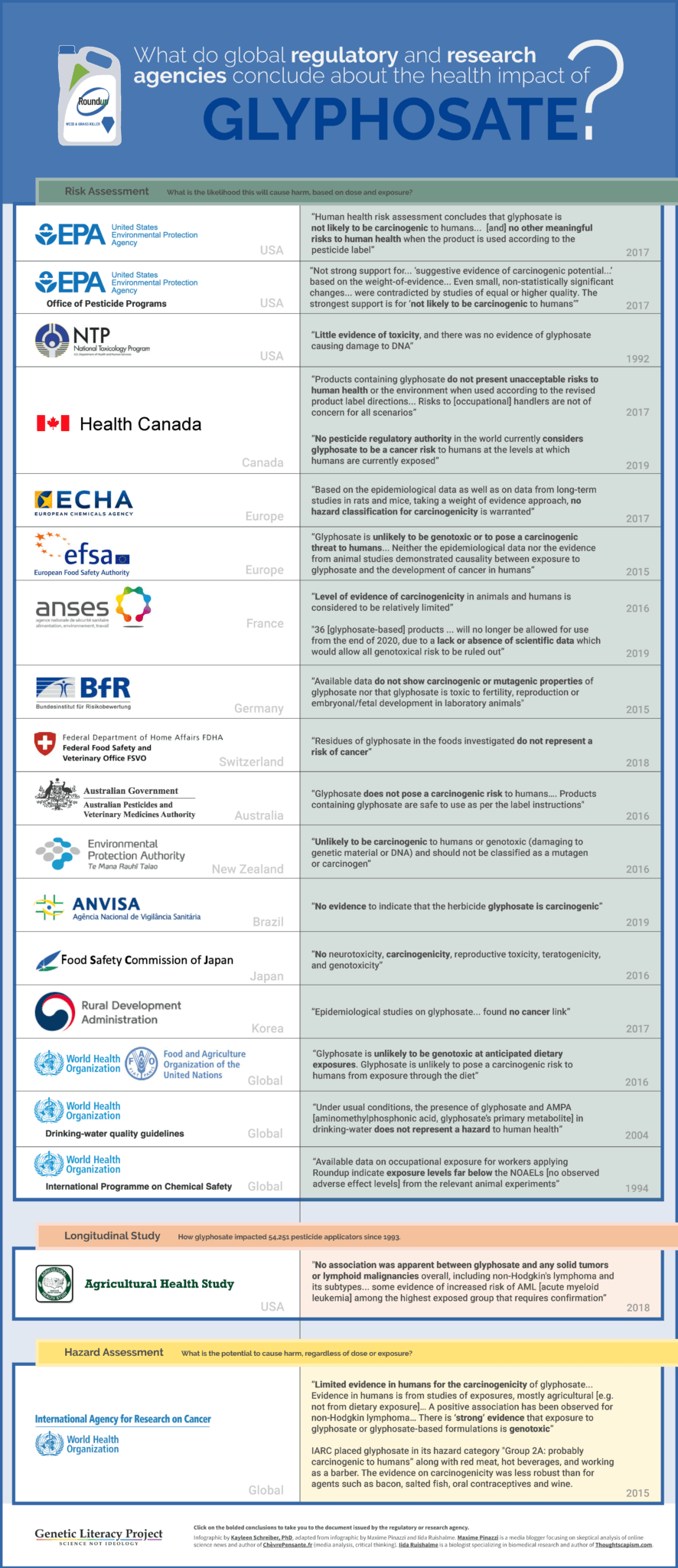
[Editor’s note: See the full infographic here.]