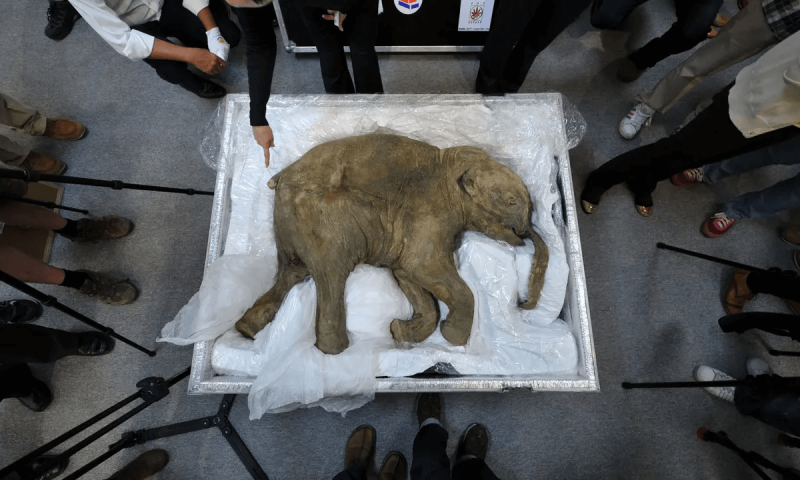
Why resurrecting near-replicas of extinct woolly mammoths might work

Credit: Aaron Tam/AFP/Getty Images

Woolly mammoths, the iconic giants of the last ice age, went extinct around 4,000 years ago.

But one company is trying to revive the species—or at least something resembling it—and the scientist at the head of the project envisions thousands of these animals roaming the Arctic.

Colossal Biosciences is a start-up launched by tech entrepreneur Ben Lamm and renowned geneticist George Church that is aiming to resurrect the woolly mammoth, or more accurately to create a genetically engineered Asian elephant that will be cold-resistant and have all the core biological traits of its extinct relative.

Follow the latest news and policy debates on sustainable agriculture, biomedicine, and other ‘disruptive’ innovations. Subscribe to our newsletter.

[Church] said Colossal was planning to make a number of [gene] edits in cells taken from Asian elephants, an endangered species that is the woolly mammoth’s closest living relative, sharing around 99.6 percent of its DNA.

“Indeed, the Asian elephant and the woolly mammoth are closer to each other than either of them is to the African,” Church told Newsweek.

In order to determine which edits to make, Colossal’s researchers have to compare elephant genomes to that of the woolly mammoth to identify where the key differences are. Fortunately, some mammoth remains have been preserved remarkably well, with some tissue samples containing intact DNA, from which researchers can build at least partial genomes.


This is an excerpt. Read the original post here

{{ reviewsTotal }}{{ options.labels.singularReviewCountLabel }}
{{ reviewsTotal }}{{ options.labels.pluralReviewCountLabel }}
{{ options.labels.noReviewsLabel }}
{{ options.labels.newReviewButton }}
{{ userData.canReview.message }}

Related Articles

Infographic: Global regulatory and health research agencies on whether glyphosate causes cancer

Infographic: Global regulatory and health research agencies on whether glyphosate causes cancer

Does glyphosate—the world's most heavily-used herbicide—pose serious harm to humans? Is it carcinogenic? Those issues are of both legal and ...

Most Popular

organic scaled
Facts & Fallacies podcast: Organic food cuts pesticide exposure? A response to Dr. Rhonda Patrick
ChatGPT-Image-Mar-10-2026-01_39_01-PM
Viewpoint—“Miracle molecule” debunked: Why acemannan supplements don’t work
ChatGPT-Image-Jul-22-2026-09_13_07-AM
Viewpoint—The Strategic Litigation boom: Understanding the tightening coalition among NGOs, foundations, journalists, and tort lawyers
ChatGPT-Image-Jul-26-2026-05_58_17-PM
Louisiana and Texas bring RFK,Jr.- MAHA-backed restrictions on dyes and other ‘controversial’ ingredients to eight states
Screenshot-2026-07-07-at-12.55.44-PM
Viewpoint: Yes, we can adapt to a changing climate without devastating the environment and the economy
ChatGPT-Image-Jul-6-2026-02_25_26-PM
40 million Americans take glucosamine. If you have memory loss, it could accelerate cognitive decline.
ChatGPT-Image-Jul-26-2026-05_35_53-PM
FDA takes up peptide therapies as hype outpaces science
ChatGPT-Image-Jun-25-2026-12_23_17-PM
No, Bill Gates did not secretly engineer ticks to promote veganism
Screenshot-2026-06-26-at-10.14.50-AM
Viewpoint: The facts behind the grifter-promoting wellness and anti-aging peptide craze: Don’t waste your money
ChatGPT-Image-Jul-9-2026-11_33_49-AM
Viewpoint: High-dose resveratrol supplements to extend health and life? Don’t waste your money.
ChatGPT-Image-Jul-10-2026-09_42_12-AM-1
Peptides, patient autonomy, and the limits of medical freedom
ChatGPT-Image-Jul-8-2026-12_32_48-PM
Viewpoint: SCOTUS strikes a blow against junk science in Bayer glyphosate case. Will it deter mass tort litigators?
glp menu logo outlined

Get news on human & agricultural genetics and biotechnology delivered to your inbox.