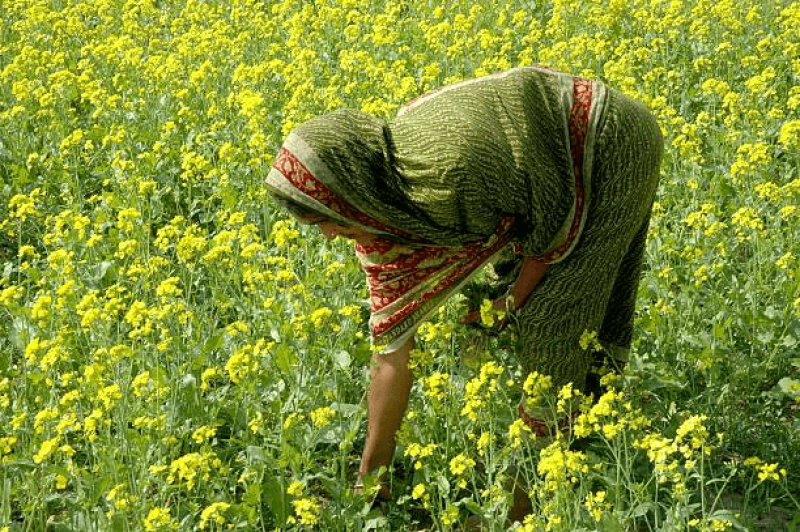
India’s Supreme Court mulls impact of green lighting GM crops on peasant woman farm laborers, who will no longer need to hand-weed

Credit: Getty Images

The [Indian] Supreme Court on [November 30] expressed concern about the plight of thousands of women agricultural labourers in rural areas, traditionally engaged in de-weeding, who will be part of the human cost if the government permits the commercial cultivation of herbicide-tolerant crops such as GM mustard in India.

“In rural areas, women are experts in removing weeds. They are a part of the labour force in agriculture in India. It brings them employment…” Justice B.V. Nagarathna observed orally while hearing challenges against the environmental clearance given to genetically modified mustard by the government.

Follow the latest news and policy debates on sustainable agriculture, biomedicine, and other ‘disruptive’ innovations. Subscribe to our newsletter.

Justice Dinesh Maheshwari, the lead judge on the Bench, agreed that women were an integral part of the Indian agricultural landscape, from paddy fields to tea estates, across the country.

“They work in knee-deep water in the fields, bending the whole day and working,” Justice Nagarathna said.

Senior advocate Sanjay Parikh, for a petitioner, said the widespread use of herbicide-tolerant crops would encourage farmers to spray chemical weed-killers.

“The Supreme Court’s own Technical Expert Committee [TEC] had said that these GM crops were not meant for agriculture in the Indian context. They may be suitable in the western context where there are large farms, but not here,” Mr. Parikh argued.


This is an excerpt. Read the original post here

{{ reviewsTotal }}{{ options.labels.singularReviewCountLabel }}
{{ reviewsTotal }}{{ options.labels.pluralReviewCountLabel }}
{{ options.labels.noReviewsLabel }}
{{ options.labels.newReviewButton }}
{{ userData.canReview.message }}

Related Articles

Infographic: Global regulatory and health research agencies on whether glyphosate causes cancer

Infographic: Global regulatory and health research agencies on whether glyphosate causes cancer

Does glyphosate—the world's most heavily-used herbicide—pose serious harm to humans? Is it carcinogenic? Those issues are of both legal and ...

Most Popular

ChatGPT-Image-Mar-10-2026-01_39_01-PM
Viewpoint—“Miracle molecule” debunked: Why acemannan supplements don’t work
ChatGPT-Image-Jul-22-2026-09_13_07-AM
Viewpoint—The Strategic Litigation boom: Understanding the tightening coalition among NGOs, foundations, journalists, and tort lawyers
organic scaled
Facts & Fallacies podcast: Organic food cuts pesticide exposure? A response to Dr. Rhonda Patrick
Screenshot-2026-07-07-at-12.55.44-PM
Viewpoint: Yes, we can adapt to a changing climate without devastating the environment and the economy
ChatGPT-Image-Jul-6-2026-02_25_26-PM
40 million Americans take glucosamine. If you have memory loss, it could accelerate cognitive decline.
ChatGPT-Image-Jun-25-2026-12_23_17-PM
No, Bill Gates did not secretly engineer ticks to promote veganism
Screenshot-2026-06-26-at-10.14.50-AM
Viewpoint: The facts behind the grifter-promoting wellness and anti-aging peptide craze: Don’t waste your money
ChatGPT-Image-Jul-8-2026-12_32_48-PM
Viewpoint: SCOTUS strikes a blow against junk science in Bayer glyphosate case. Will it deter mass tort litigators?
glp menu logo outlined

Get news on human & agricultural genetics and biotechnology delivered to your inbox.