Post-mortem reproduction: Can your eggs or sperm be used after you die — and who should get to decide?

Credit: Uwemuell/Wikimedia Commons

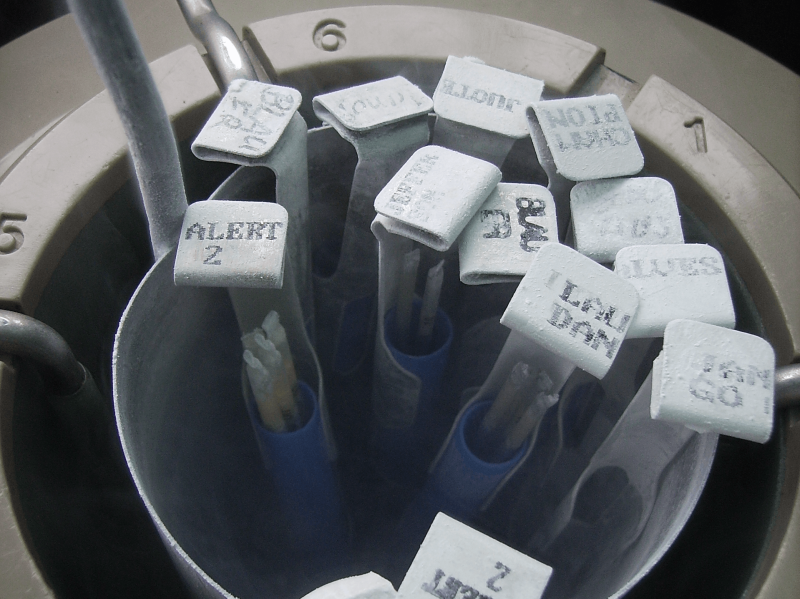
Sex cells and embryos aren’t property—they don’t fall under property law and can’t be inherited by family members. But there is some degree of legal ownership for the people who provided the cells. It is complicated to define that ownership, however, Robert Gilmour, a family law specialist based in Scotland, said at the event. “The law in this area makes my head hurt,” he said.

The law varies depending on where you are, too. Posthumous reproduction is not allowed in some countries, and is unregulated in many others. In the US, laws vary by state. Some states won’t legally recognize a child conceived after a person’s death as that person’s offspring, according to the American Society for Reproductive Medicine (ASRM). “We do not have any national rules or policies,” Gwendolyn Quinn, a bioethicist at New York University, tells me.

Follow the latest news and policy debates on sustainable agriculture, biomedicine, and other ‘disruptive’ innovations. Subscribe to our newsletter.

The people who want to use the eggs, sperm or embryos of dead partners or family members are often painted as “selfish”, but, in James Lawford Davies’s experience, that just isn’t the case. Lawford Davies, a UK-based solicitor specializing in reproductive and genetic technologies, has been involved in several similar cases. “All of these cases have involved incredibly brave people who have been faced with tragedy,” he said. The people involved all wanted to deliver on the wishes of those who had died, he added.

This is an excerpt. Read the full article here

{{ reviewsTotal }}{{ options.labels.singularReviewCountLabel }}
{{ reviewsTotal }}{{ options.labels.pluralReviewCountLabel }}
{{ options.labels.newReviewButton }}
{{ userData.canReview.message }}

Related Articles

Infographic: Global regulatory and health research agencies on whether glyphosate causes cancer

Infographic: Global regulatory and health research agencies on whether glyphosate causes cancer

Does glyphosate—the world's most heavily-used herbicide—pose serious harm to humans? Is it carcinogenic? Those issues are of both legal and ...

Most Popular

Picture1
The FDA couldn’t find a vaccine safety crisis, so it buried its own research
Screenshot-2026-04-22-at-12.21.32-PM
Viewpoint: Why the retracted Monsanto glyphosate study doesn’t change the science—the world’s most popular herbicide is safe 
ChatGPT-Image-May-7-2026-12_32_36-PM
Viewpoint: The state of U.S. vaccine policy? Dismal nationally, but some states are stepping up.
Screenshot-2026-04-22-at-10.46.29-AM
Viewpoint: How to counter science disinformation? Science journalist offers 12 practical tips
Screenshot-2026-04-13-at-1.39.26-PM
Viewpoint: ‘Safer for children?’ Stonyfield yogurt under fire for deceptive organic marketing
placebo
Viewpoint — Alternative medicine and the placebo effect: Selling a reassuring illusion of health
ChatGPT-Image-May-7-2026-12_16_37-PM-2
Viewpoint: Are cancer rates ‘skyrocketing’ as RFK, Jr. and MAHA claim? The evidence says mostly the opposite
Defense_Secretary_Ash_Carter_tours_the_Microsoft_Cybercrime_Center_in_Seattle_March_3_2016
How criminals are using AI to target social media users and steal their money and confidential data
ChatGPT-Image-May-18-2026-01_45_05-PM-2
Newest hantavirus conspiracy: Online disinformation turns outbreak into latest ivermectin grift
_20250221_nib_rfk_trump
Viewpoint: 'Crisis of public trust': Autism support community shocked RFK continues to peddle false claims about the danger of vaccines
the magic of mRNA
Viewpoint: Anti-vax fake ‘turbo cancer’ claims threaten cancer treatment breakthroughs
artificial intelligence brain think illustration md
Viewpoint — Digital gods and human extinction: Will we be the first species ever to design our own descendants?
glp menu logo outlined

Get news on human & agricultural genetics and biotechnology delivered to your inbox.