Video: Is there such a thing as ‘backward evolution’? Turkish family that walks on all fours under study by scientists

Credit: YouTube
Credit: YouTube

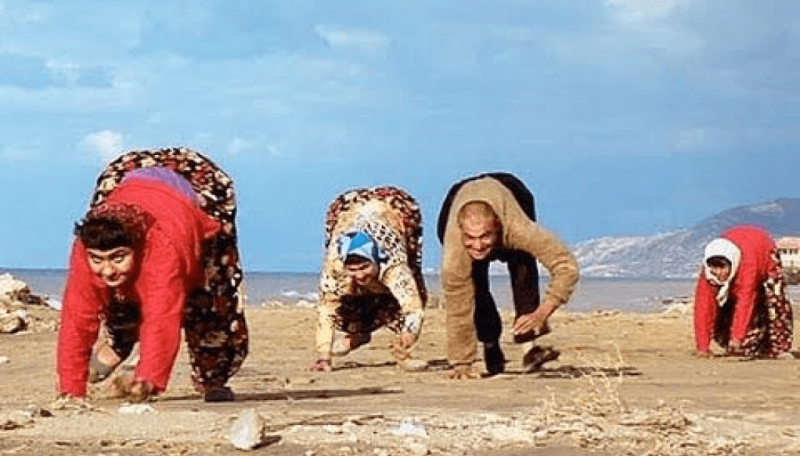
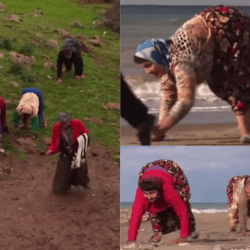
The Ulas family live in rural southern Turkey. In total, 19 children live with their parents, seven of whom are intellectually disabled and the rest non-disabled. Subject to intense research, the family has five children who display extreme imbalance along with their cognitive disabilities, which make it difficult for them to stay upright while walking. As a result, these five children all move around on their hands and feet, having become adept at moving in this way after years of never standing upright.

When observed by Üner Tan of Çukurova University Medical School in Adana, Turkey, it was concluded that the way some members of the Ulas family moved closely resembled how ancient Homo sapiens would have walked before evolution made them become bipedal, and it was controversially claimed they were a result of “backwards evolution”. In doing so, their condition was dubbed Üner Tan syndrome.

However, a BBC documentary looked to take a more biological and sympathetic approach towards the family. Spurred on by an unpublished paper by Üner Tan explaining his observations and ideas, British scientists Nicholas Humphrey and John Skoyles joined Tan on a visit to the Ulas family alongside a film crew, where they documented every step of the journey.

This is an excerpt. Read the original post here

Related Articles

Infographic: Global regulatory and health research agencies on whether glyphosate causes cancer

Infographic: Global regulatory and health research agencies on whether glyphosate causes cancer

Does glyphosate—the world's most heavily-used herbicide—pose serious harm to humans? Is it carcinogenic? Those issues are of both legal and ...

Most Popular

Screenshot-2026-09-16-at-2.26.42-PM
Viewpoint: How to ecologically damage America’s forests: Ban glyphosate
Screenshot-2026-09-20-at-9.03.54-AM
From Malaysia to the world: A pioneering science communicator reimagines global science communication for a digital age
ChatGPT-Image-Mar-10-2026-01_39_01-PM
Viewpoint—“Miracle molecule” debunked: Why acemannan supplements don’t work
Screenshot-2026-09-20-at-4.31.28-PM
White House drafting executive order to control what OMB Director Vought claims are “woke” NIH science grants
ChatGPT-Image-Sep-17-2026-12_28_43-PM
Vitamin D, omega-3 fish oil and glucosamine supplements could cause brain damage 
ChatGPT-Image-Sep-20-2026-04_22_32-PM
What’s Trump’s ‘AI Force’? Administration rushes to announce ill-defined watchdog agency and czar amid criticism of its resistance to curb AI acceleration
ChatGPT-Image-Sep-18-2026-10_49_24-AM
‘Symptom borrowing’: Young people are copying health problems they see on TikTok
ChatGPT-Image-Sep-11-2026-01_53_42-PM
Should doctors engage in social media to counter misinformation?
Screenshot-2026-08-12-at-11.31.46-AM
AI is helping develop new vaccines
Screenshot-2026-09-10-at-12.20.19-PM
'Jet fuel didn't melt the steel': 9/11 conspiracy theories debunked
Screenshot-2026-09-14-at-4.31.14-PM
Viewpoint: What’s the likely impact when the EPA loosens rules limiting methane pollution from oil and gas wells?
Screenshot-2026-08-19-at-6.19.42-PM
Facts & Fallacies podcast: 'Regenerative farming'? RFK Jr.’s federal push romanticizes the past and risks food security
Screenshot-2026-09-17-at-10.24.54-AM
Viewpoint: Dubious environmental fears: Why the AI buildout is critical to America’s ecological future
glp menu logo outlined

Get news on human & agricultural genetics and biotechnology delivered to your inbox.