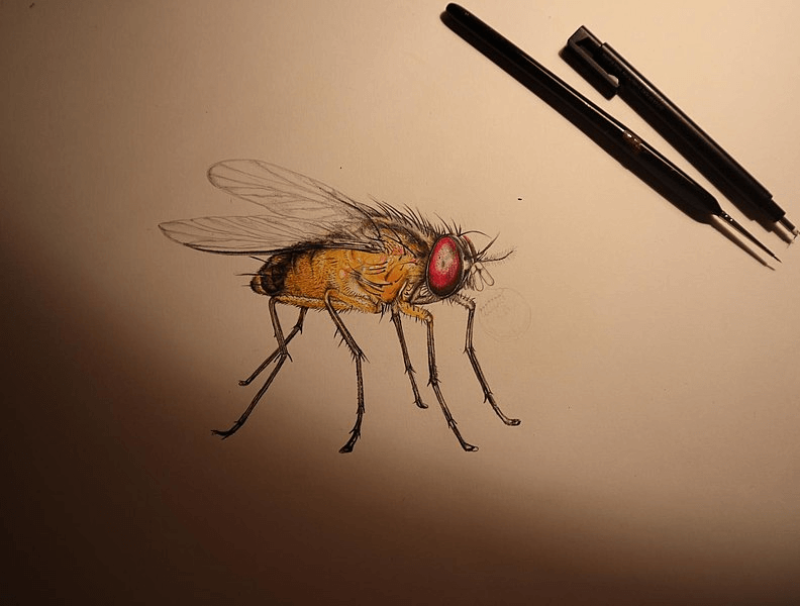
Still-unapproved CRISPR gene-drive could suppress fruit-killing vinegar flies

Credit: Camila Ortega via ERGo! and CC-BY-SA-4.0
Researchers have developed a “homing gene drive system” based on CRISPR/Cas9 that could be used to suppress populations of Drosophila suzukii vinegar flies—so-called “spotted-wing Drosophila” that devastate soft-skinned fruit in North America, Europe and parts of South America—according to new research from North Carolina State University.

The NC State researchers developed dual CRISPR gene drive systems that targeted a specific D. suzukii gene called doublesex, which is important for sexual development in the flies. CRISPR stands for “clustered regularly interspaced short palindromic repeats” and Cas9 is an enzyme that performs like molecular scissors to cut DNA. CRISPR systems are derived from bacterial immune systems that recognize and destroy viruses and other invaders, and are being developed as solutions to problems in human, plant and animal health, among other uses.

Targeting the doublesex gene resulted in female sterility in numerous experiments as females were unable to lay eggs, says Max Scott, an NC State entomologist who is the corresponding author of a paper in Proceedings of the National Academy of Sciences that describes the research.

“This is the first so-called homing gene drive in an agricultural pest that potentially could be used for suppression,” Scott said.

Gene drives can preferentially select, change or delete particular traits or characteristics and “drive” those edits through future generations, resulting in a sometimes far greater than 50% chance of passing those changes to progeny.

“Gene drive means biased inheritance,” Scott said.

Follow the latest news and policy debates on sustainable agriculture, biomedicine, and other ‘disruptive’ innovations. Subscribe to our newsletter.

Researchers used a fluorescent red protein to mark the presence of the CRISPR/Cas9 genetic change to the fly’s genetic blueprint, or genome. The gene drive systems transmitted that fluorescent protein to 94-99% of progeny, the paper reports.

The researchers also used mathematical modeling to predict how efficiently the gene drive system would suppress a given D. suzukii population in laboratory cages. The modeling showed that releasing just one modified fly for every four “wild” flies—those not genetically modified—could tank fly populations within approximately eight to 10 generations.

“Because doublesex is such a conserved gene required for female development in so many fly species, I think the homing gene drive strategy could be used for other pests,” Scott said.

Scott and collaborators previously showed success in suppressing D. suzukii populations using a strain that produces only males and also used a similar method to reduce lab populations of the New World screwworm fly.

Next steps include contained trial experiments in cages in an NC State greenhouse.

“We’re doing small population cage suppression experiments. We’re hoping to learn if repeated fly releases with a 1:4 ratio will suppress fly populations in a cage like the modeling suggests,” Scott said.


{{ reviewsTotal }}{{ options.labels.singularReviewCountLabel }}
{{ reviewsTotal }}{{ options.labels.pluralReviewCountLabel }}
{{ options.labels.noReviewsLabel }}
{{ options.labels.newReviewButton }}
{{ userData.canReview.message }}

Related Articles

Infographic: Global regulatory and health research agencies on whether glyphosate causes cancer

Infographic: Global regulatory and health research agencies on whether glyphosate causes cancer

Does glyphosate—the world's most heavily-used herbicide—pose serious harm to humans? Is it carcinogenic? Those issues are of both legal and ...

Most Popular

ChatGPT-Image-Jul-17-2026-12_42_10-PM
Viewpoint: RFK, Jr. is setting up a panel to compensate people who claim they were injured by a COVID vaccine–no proof needed 
Screenshot-2026-07-17-at-12.55.22-PM
Viewpoint: Is bagged salad a dangerous science experiment? Challenging an online misinformation campaign
ChatGPT-Image-Mar-10-2026-01_39_01-PM
Viewpoint—“Miracle molecule” debunked: Why acemannan supplements don’t work
ChatGPT-Image-Jul-6-2026-02_25_26-PM
40 million Americans take glucosamine. If you have memory loss, it could accelerate cognitive decline.
px-Minced-beef-meat-cow-cattle
Can we trust Trump’s USDA to accurately report farm data? Beef export numbers suggest ‘no’.
Screenshot 2026-07-11 094410
Growing animal muscle and fat cells inside rice grains and calling it beef: One of numerous genetically engineered products shaking up our ecosystem
ChatGPT-Image-Jul-9-2026-02_39_22-PM
Viewpoint: Polyphenols or NAD+ supplements to combat aging: No, Gwenyth Paltrow and followers, don’t waste your money.
ma art page image
‘It’s time to have a conversation’: Once adamantly opposed to human gene editing, UK’s The Guardian acknowledges likely benefits
afb-a-b
As the EU loosens restrictions on agricultural gene editing, it remains years behind the rest of the world on equally-safe GMO foods
file-f-d-d-
Facts & Fallacies Podcast: Europe's AC debacle underscores fatal flaw in green activism
Screenshot-2026-07-01-at-2.49.48-PM
Dr. TikTok and male fertility: Viral claims tout GLP-1 drugs as fertility boosters. What does the science say?
ChatGPT-Image-Jul-8-2026-12_32_48-PM
Viewpoint: SCOTUS strikes a blow against junk science in Bayer glyphosate case. Will it deter mass tort litigators?
ChatGPT-Image-Jun-17-2026-03_29_08-PM
Viewpoint: What’s the impact of the U.S. abandoning support for global health?
ChatGPT-Image-Jun-25-2026-12_23_17-PM
No, Bill Gates did not secretly engineer ticks to promote veganism
glp menu logo outlined

Get news on human & agricultural genetics and biotechnology delivered to your inbox.