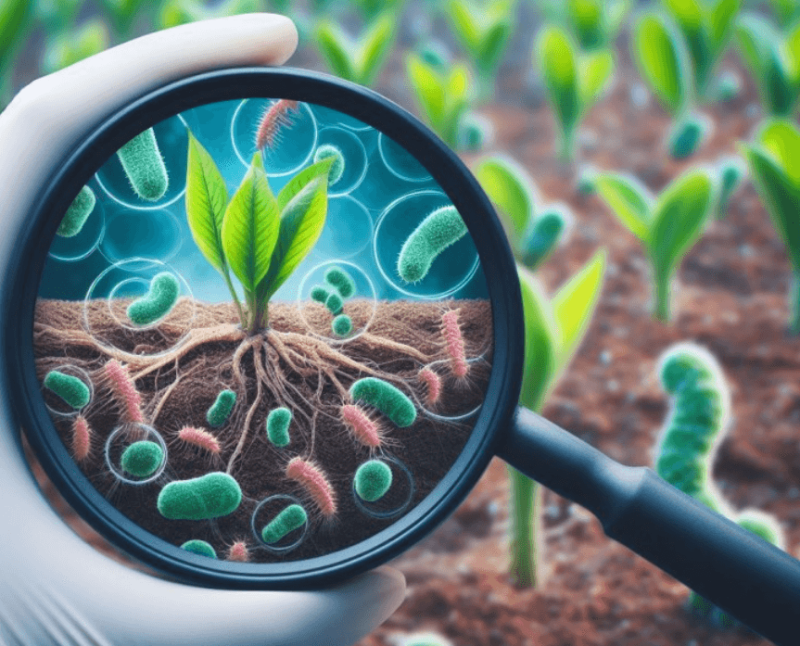
Boost to regenerative agriculture: Nanotechnology-enhanced bacterial fertilizer might could reduce farmers’ synthetic chemical dependency

screenshot pm
Credit: Yanki Turan/LinkedIn

Claims we may only have 60 harvests left appear to be hyperbole but the fact remains that our agricultural land is suffering due to micronutrient depletion.

Chemical fertilisers are unable to stem the tide, while microbial fertilisers, which replenish the nutrients removed as plants grow, bring with them their own hurdles.

Microbial fertilisers are mostly in use at large-scale commercial farms in Brazil, where farmers have seen equivalent or higher yields, as well as small “boutique” farms in the US. Costs can be prohibitive for many farmers though, with on-site fermenters and skilled staff needed to grow and disperse microbes.

Follow the latest news and policy debates on sustainable agriculture, biomedicine, and other ‘disruptive’ innovations. Subscribe to our newsletter.

However, Ariel Furst, based in the Department of Chemical Engineering at the Massachusetts Institute of Technology (MIT), US, believes access to microbial fertilisers can be improved through nanotechnology.


“Our goal is to enable everyone to have access to these microbial tools, without needing to actually grow the microbes on site,” she says. Using food-grade chemicals, Furst’s group has developed coatings that can protect the microbes until they are applied to the soil, while enabling transport in a dried form that prevents difficult and expensive liquid transport and avoids the need for cold chain. Comprising a metal and the organic compound polyphenol, the metal-phenol network coatings self-assemble under the right conditions.


This is an excerpt. Read the original post here

{{ reviewsTotal }}{{ options.labels.singularReviewCountLabel }}
{{ reviewsTotal }}{{ options.labels.pluralReviewCountLabel }}
{{ options.labels.newReviewButton }}
{{ userData.canReview.message }}

Related Articles

Infographic: Global regulatory and health research agencies on whether glyphosate causes cancer

Infographic: Global regulatory and health research agencies on whether glyphosate causes cancer

Does glyphosate—the world's most heavily-used herbicide—pose serious harm to humans? Is it carcinogenic? Those issues are of both legal and ...

Most Popular

newborn infant baby mother
Facts & Fallacies Podcast: The truth about vitamin K shots
Screenshot-2026-06-16-at-10.02.22-PM
Viewpoint: ‘Industrial food’ primer—Challenging the dangerous delusions of the alternative food movement
ChatGPT-Image-Jun-9-2026-01_11_37-PM
Turmeric supplements: More risks than benefits
ChatGPT-Image-Jun-16-2026-10_29_11-AM
What’s behind Anthropic’s warning about the accelerating development of AI
ChatGPT Image Jun 16, 2026, 12_03_37 PM
Kennedy accused of trying to ‘bully’ science journal that retracted study linking vaccines to infant deaths
ChatGPT-Image-Jun-16-2026-10_01_45-AM-2
Viewpoint—Recursive self-improvement: AI leader Anthropic calls for AI slowdown
ChatGPT-Image-Jun-3-2026-04_29_13-PM
Viewpoint: While unvaccinated children are dying overseas, Congress challenges Trump and Kennedy’s block on aid
Screen Shot at AM
Facts & Fallacies Podcast: Right-wing politics bad for your health? Separating speculation from science
Screenshot-2026-06-16-at-11.23.32-AM
In a rebuke to RFK, Jr.’s anti-vax crusade, journal retracts study claiming hepatitis B vaccine–autism link
ChatGPT-Image-Jun-15-2026-11_00_13-AM-2
Glucosamine alert: Alzheimer’s progresses faster among those taking the popular supplement
Screenshot-2026-06-14-at-9.53.54-AM
Is the World Cup a perfect storm for the spread of infectious diseases?
Screenshot-2026-06-05-at-2.12.30-PM
Some plants can poison you. So how did humans figure out what is safe to eat?
ChatGPT-Image-Mar-10-2026-01_39_01-PM
Viewpoint—“Miracle molecule” debunked: Why acemannan supplements don’t work
glp menu logo outlined

Get news on human & agricultural genetics and biotechnology delivered to your inbox.