Bioluminescent petunias: Light-up mushroom genes are secret ingredient in green glowing genetically modified plants — and they are now on sale

images fill size x v
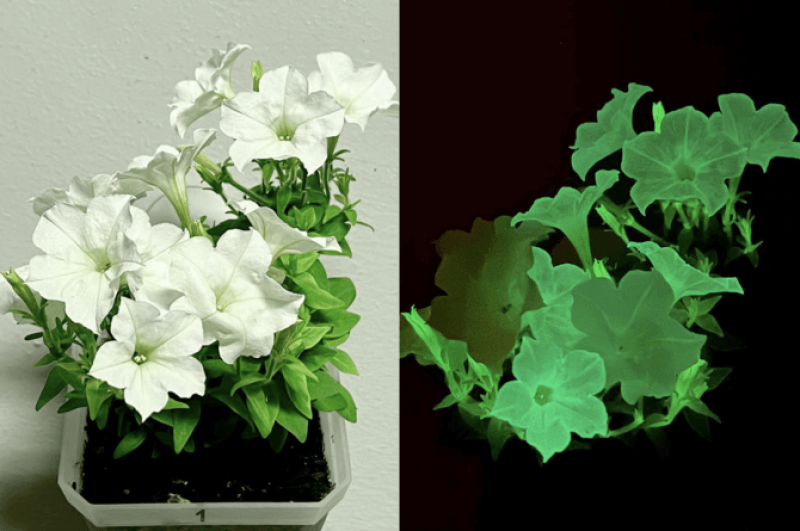
Left: Genetically-engineered petunias in natural light. Right: Genetically-engineered petunias in the dark. Credit: Light Bio

Consumers in the United States can now pre-order a genetically engineered plant for their home or garden that glows continuously. At a base cost of US$29.00, residents of the 48 contiguous states can get a petunia (Petunia hybrida) with flowers that look white during the day; but, in the dark, the plant glows a faint green. Biotechnology firm Light Bio in Sun Valley, Idaho, will begin shipping a batch of 50,000 firefly petunias in April.

Researchers contacted by Nature seem enamoured by them. This is a “groundbreaking event” — to have made a plant that can bioluminesce brightly enough to be seen with the naked eye and sold to plant lovers, says Diego Orzáez, a plant biologist at the Institute of Plant Molecular and Cellular Biology in Valencia, Spain. “Being a European, I have envy that consumers in the United States can have their hands on these plants.”

Follow the latest news and policy debates on sustainable agriculture, biomedicine, and other ‘disruptive’ innovations. Subscribe to our newsletter.

The firefly petunia glows brightly and doesn’t need special food thanks to a group of genes from the bioluminescent mushroom Neonothopanus nambi. The fungus feeds its light-emitting reaction with the molecule caffeic acid, which terrestrial plants also happen to make. By inserting the mushroom genes into the petunia, researchers made it possible for the plant to produce enzymes that can convert caffeic acid into the light-emitting molecule luciferin and then recycle it back into caffeic acid — enabling sustained bioluminescence.


This is an excerpt. Read the original post here

{{ reviewsTotal }}{{ options.labels.singularReviewCountLabel }}
{{ reviewsTotal }}{{ options.labels.pluralReviewCountLabel }}
{{ options.labels.newReviewButton }}
{{ userData.canReview.message }}

Related Articles

Infographic: Global regulatory and health research agencies on whether glyphosate causes cancer

Infographic: Global regulatory and health research agencies on whether glyphosate causes cancer

Does glyphosate—the world's most heavily-used herbicide—pose serious harm to humans? Is it carcinogenic? Those issues are of both legal and ...

Most Popular

Screenshot 2025-07-30 at 10.48
Can gene editing eliminate Down syndrome? Scientists have done it in lab-grown cells
ChatGPT-Image-Mar-10-2026-01_39_01-PM
Viewpoint—“Miracle molecule” debunked: Why acemannan supplements don’t work
ChatGPT-Image-May-26-2026-07_51_21-AM-2
Viewpoint: There are more than 1,000 chemicals in a cup of coffee—including many substances that can cause cancer. Why isn’t it banned?
Screenshot-2026-06-04-at-12.05.08-PM
Cases of brain inflammation surge as U.S. measles pandemic approaches 2000
Screenshot 2026-05-26 at 10.15
Viewpoint: Double standard—Why does the wellness industry get a free pass while Big Healthcare is treated as morally suspect?
Screenshot-2026-05-28-at-1.36.28-PM
Viewpoint: Can mRNA research survive the Trump administration?
Picture1
Sounds we can’t hear — the hidden planetary signals behind science, fear, and misinformation
downsyndrome_compilation_MID_1
CRISPR breakthrough that can remove the chromosome responsible for Down syndrome raises ethical questions
ChatGPT Image May 26, 2026, 08_42_17 AM (1)
Viewpoint: Greenpeace and poison: How environmental advocacy groups rely on compliant (and often ignorant) journalists to spread disinformation and spark litigation

Sorry. No data so far.

glp menu logo outlined

Get news on human & agricultural genetics and biotechnology delivered to your inbox.