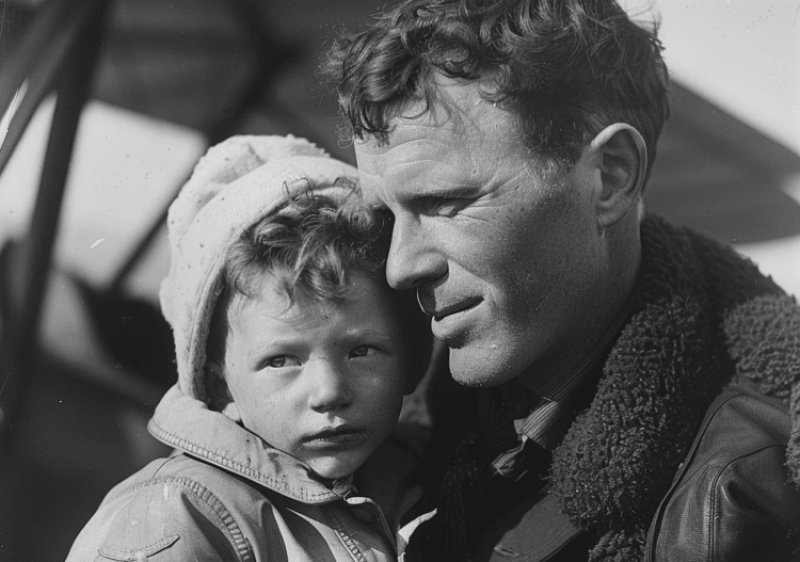
Did eugenicist Charles Lindbergh fake his disabled son’s ‘crime-of-the-century’ kidnapping to cover up experiments by Nazi-sympathizing scientists?

Did eugenicist Charles Lindbergh fake his disabled son’s ‘crime-of-the-century’ kidnapping to cover up experiments by Nazi-sympathizing scientists?
Credit: Midjourney/ Heenan

The 1932 kidnapping and murder of Charles Lindbergh’s 20-month-old son was called the “crime of the century” at the time, and has inspired more and less plausible theories about what really happened ever since. The San Francisco Chronicle has recently covered a new wave of interest in the case, based on retired judge Lise Pearlman’s 2020 book that builds on a theory that’s been around for decades: that the celebrity aviator himself was implicated, and the man executed for the crime was in fact innocent.

Follow the latest news and policy debates on sustainable agriculture, biomedicine, and other ‘disruptive’ innovations. Subscribe to our newsletter.

Pearlman proposes what the San Francisco Chronicle calls “a new, macabre theory about the case: that Lindbergh offered up his child as a subject for medical experiments and faked the kidnapping to cover up the child’s death.” Given evidence that the boy was “known to be sickly and to have an abnormally large head,” she argues that Charles Lindbergh allowed him to be used for medical experimentation by his close colleague, fellow eugenicist and Nobel Prize-winning French biologist Alexis Carrel. Lindbergh was working with Carrel in research on techniques for organ transplants (underlying this work was Carrel’s desire to preserve the “white race” from “less intelligent stock” – see Marcy Darnovsky’s 2010 post to go down Carrel’s rabbit hole).

So could a father have offered up his own son to be a medical guinea pig, resulting in the child’s death, and then staged an elaborate cover up? Absolutely.


This is an excerpt. Read the full article here

{{ reviewsTotal }}{{ options.labels.singularReviewCountLabel }}
{{ reviewsTotal }}{{ options.labels.pluralReviewCountLabel }}
{{ options.labels.newReviewButton }}
{{ userData.canReview.message }}

Related Articles

Infographic: Global regulatory and health research agencies on whether glyphosate causes cancer

Infographic: Global regulatory and health research agencies on whether glyphosate causes cancer

Does glyphosate—the world's most heavily-used herbicide—pose serious harm to humans? Is it carcinogenic? Those issues are of both legal and ...

Most Popular

ChatGPT-Image-May-7-2026-12_16_37-PM-2
Viewpoint: Are cancer rates ‘skyrocketing’ as RFK, Jr. and MAHA claim? The evidence says mostly the opposite
Screenshot-2026-04-13-at-1.39.26-PM
Viewpoint: ‘Safer for children?’ Stonyfield yogurt under fire for deceptive organic marketing
Screenshot-2026-04-22-at-10.46.29-AM
Viewpoint: How to counter science disinformation? Science journalist offers 12 practical tips
Picture1-14
When superbugs threaten vulnerable children: Can AI help solve antibiotic resistance?
Screenshot-2026-04-23-at-11.00.36-AM
Regulators' dilemma: Thalidomide, Metformin, and the cost of getting drug approvals wrong
Picture1-1
Cooling the planet with balloons: Could a geoengineering gamble slow global warming?
bigstock opioids on chalkboard with rol
GLP podcast: 'Safe injection sites': enabling drug addiction or saving lives?
ChatGPT-Image-May-12-2026-08_39_41-PM
GLP podcast: Big Pharma, Big Ag, Big Food—health harming industries or life-saving innovators?

Sorry. No data so far.

glp menu logo outlined

Get news on human & agricultural genetics and biotechnology delivered to your inbox.