It is therefore not surprising that this time period—the Middle to Upper Paleolithic transition—has been a focus of research for many archaeologists, physical anthropologists, and, more recently, geneticists.
Various scenarios have been explored over the years, from those positing tens of thousands of years of coexistence between the two groups of humans to those seeing a much more rapid replacement of Neanderthals by H. sapiens—whether through the active or coincidental displacement of our cousins or through outcompeting them for resources.
Both positions allow for the occasional interbreeding that has resulted in a little bit of Neanderthal being present in many of us, especially those of European and East Asian ancestry.
However, there are many challenges to exploring this distant time. Human skeletal remains are comparatively rare, with many of the best-known fossils having been excavated under less-than-ideal conditions in the 19th and early 20th centuries.
When skeletal remains are found, there are often questions over their precise relationship to other archaeological remains at the same site—such as stone and bone tools, animal remains, and other finds. Connections between a particular species of human and finds from an excavation have often been assumed but were later found to be spurious in a number of instances.
Major Revisions
The transition period of 50,000–40,000 years ago is within the lower limits of radiocarbon dating—a technique that only works on organic remains up to about 50,000 years old. This means the smallest amounts of more recent contamination from the burial environment, or from museum conservation materials, can make dating finds from these sites extremely challenging.
This has resulted in major revisions to the chronology of early human occupation over the past decade, shifting some dates on Neanderthal and modern human remains by many thousands of years.
This is obviously crucial to the debate since it is impossible to speak of overlap or replacement without a robust chronology. There is also the matter of spatial scale. Does the persistence of Neanderthals after 40,000 years ago in southern Iberia, for example, represent a lengthy period of overlap and coexistence, or a “last stand” at the margins of the continent, expressly avoiding contact with the newcomers?
The most recent entry into the fray comes from the cave of Ilsenhöhle in Ranis in east-central Germany, wonderfully situated at the base of a 16th-century Renaissance castle with earlier medieval origins.
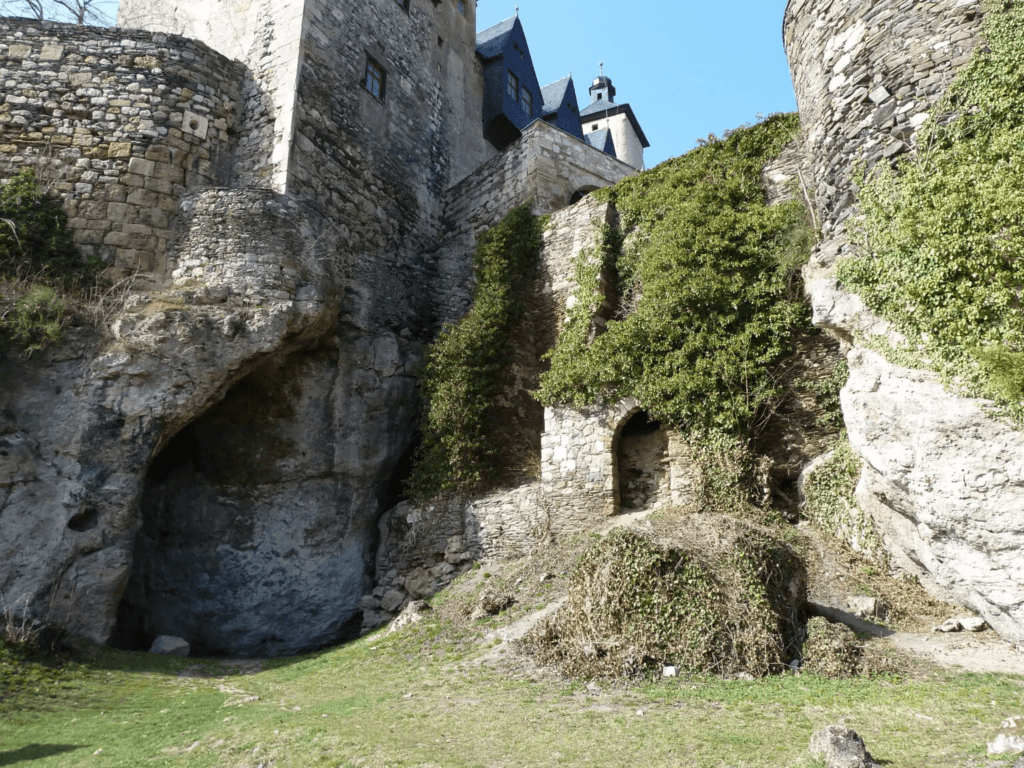
An international, multidisciplinary team has identified human (H. sapiens) remains from both early 20th-century and more recent excavations in the cave, dating them to around 45,000 years ago. The authors say that when combined with early dates of H. sapiens in France and a variety of dates for Neanderthals being present at 45,000 years around Europe, this allows a potential period of overlap between the two species lasting some 10,000 years.
In a companion paper, the researchers reported the results of their analysis of stable oxygen isotopes (different chemical forms of an element) that came from teeth belonging to mammals in the horse family (equids). These teeth came from the same sediment levels as the human remains. The results place the people in a particularly cold snap around 45,000–43,000 years ago.
The H. sapiens remains are associated with what was previously considered an ambiguous stone tool industry (a particular way of making tools) called the Lincombian-Ranisian-Jerzmanowician (LRJ). [However,] it has been unclear whether these were made by Neanderthals or modern humans.

Mystery Toolmakers
Other transitional Middle-Upper Paleolithic stone tool industries have a long history of the same problem—we’re not sure who made them. Most notable is the Châtelperronian of southern France and northern Spain: Do the Neanderthal remains accompanying some of these “modern-looking” tool industries mean they were the toolmakers, or is the association fortuitous?
This debate continues apace, with a possible H. sapiens newborn child’s ilium having recently been identified in a Châtelperronian assemblage at the Grotte du Renne in Arcy-sur-Cure in central France. At this site, only Neanderthal remains had previously been identified.
Most caves with Paleolithic deposits saw intermittent occupation, often by both Neanderthals and H. sapiens, over millennia. Materials can easily become mixed together and so, short of finding tools buried in a modern human grave, it is difficult to say who made them. Ranis does seem to have an advantage in this regard, though, as the levels containing the human remains and the LRJ tools were sealed together by a rockfall.
However, even here a cautionary note should be sounded. The dates for the levels under consideration still span several millennia, during which there may well have been short-term visits by both camps.
New Archaeological Techniques
The results from Ranis, as well as contributing important new data to our understanding of the Middle-Upper Paleolithic transition, highlight the contributions of recent developments in archaeological science.
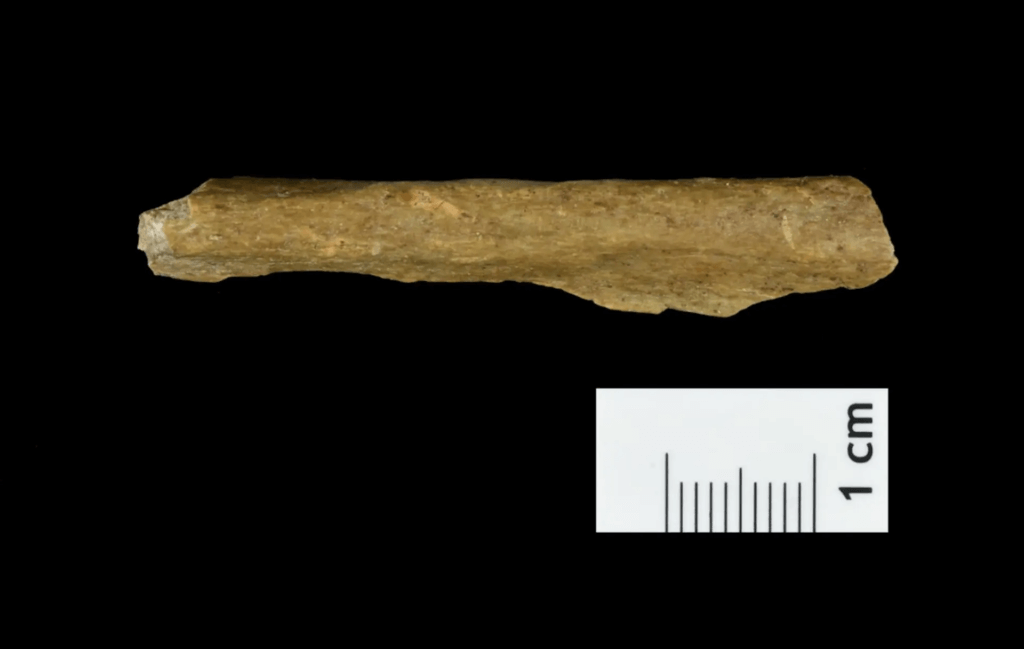
Far from unearthing a complete skeleton or skull that traditionally would have heralded an important new hominin fossil, Ranis yielded only a few small fragments of bone that were recognizable as human. Some other small bone fragments were identified as belonging to hominins (the wider human family) using a technique known as proteomics—the study of protein structures that are unique to genera and sometimes to species. This technique was also applied to the site’s fauna in another companion paper.
Then, relatively high-precision radiocarbon dates were obtained for both the sediment level and the human remains themselves. The precision of these dates was further improved through statistical modeling.
But most importantly for the question at hand, ancient DNA analysis—in this case, mitochondrial DNA (mtDNA)—confirmed the identification as H. sapiens. The mtDNA results link Ranis with other Initial Upper Paleolithic human remains at Zlatý kůň in the Czech Republic and the Grotta di Fumane in Italy.
As the authors of the Ranis study note, an intriguing twist to the tale is that recent genetic studies suggest the H. sapiens conducting these early forays into Europe appear to have themselves been replaced by other H. sapiens populations later in the Upper Paleolithic.
So, the focus on the Middle-Upper Paleolithic transition and its replacement of one hominin population by another may have to be extended to consider similar, subsequent events that have remained far less visible because they all involved H. sapiens.
Rick Schulting is a Professor of Scientific and Prehistoric Archaeology at the University of Oxford. Follow him on Twitter @rickschulting.
A version of this article was posted at Sapiens and is used here with permission. Check out Sapiens on Twitter @SAPIENS_org