I wish that I could stop reposting this essay – I do so whenever limitations on women’s reproductive rights become ever more egregious. And that certainly happened when the Supreme Court of Alabama ruled early last year that human embryos, even those in the suspended development of a deep freeze, are “children” under the state’s Wrongful Death of a Minor Act.I wrote this essay in 2013, in response to common confusion of “embryo” and “fetus” – never imagining the blurring would extend to “baby”. We scientists are sticklers for precision and accuracy. Even physicians oversimplify human prenatal development, counting the weeks of pregnancy from the last menstrual period, two weeks before fertilization. That error has legal repercussions in so-called “heartbeat” laws claiming a deadline of 6 weeks for termination that, biologically speaking, really means 4 weeks.
“17 Timepoints” in 2013 apparently hit some nerves, for it’s been quoted, cited, excerpted, complimented, criticized, and tweeted. Various right-to-lifers in particular have trashed me, taking exception to my litany of biological facts.
In 2017, I reposted the essay in response to a document from the Department of Health and Human Services citing its role of “serving and protecting Americans at every stage of life, beginning at conception.” Oops.
I posted again in 2022, in the wake of Justice Alito’s leaked 98-page draft abortion opinion that would doom Roe v. Wade. So now, in some states, a woman in the throes of a miscarriage can be refused care at a hospital, and when the fetus becomes a dead baby in her home, she’s accused of murder. That’s what happened to Ohio resident Brittany Watts in January.
And now, ARTs – assisted reproductive technologies – have joined the discussion. Three couples have sued The Center for Reproductive Medicine and Mobile Infirmary Medical Center in Alabama because one of them accidentally dropped a vial containing a frozen embryo in the “cryogenic nursery” in response to “freeze-burned” skin. The unfortunate fumble happened in 2020; the suit filed in 2023.
The language of the lawsuit is telling.
The three couples are “parents,” the offspring “deceased embryo/minor,” and one in particular, “Baby Aysenne.” The legalese deems the “parents” “next friends,” which means that they represent another who cannot comment, such as the ball of cells that is a human blastocyst residing in a freezer.
Because the embryos arose with the help of IVF, the immediate aftermath of the Alabama ruling was for some fertility clinics to halt the procedure, calling into question even the storing of frozen embryos. The rage has yet to subside.
But the meme equating an unfertilized chicken egg with a chicken suggests the need for another biology lesson. How many people are reposting variations on that theme without realizing the biological distinctions, and their relevance? So, here we go again, updated only slightly.
From October 3, 2013
A biologist’s view of conception and when human life ‘begins’
I’m the author of several college textbooks, on human genetics, human anatomy and physiology, and intro biology. Being a biologist, a textbook author, and a mother, I’ve thought a great deal about the question of when a human life begins. So here are my selections of times at which a biologist might argue a human organism is alive. I’ll save my opinion for the end.
- Life is a continuum. Gametes (sperm and oocyte) link generations.
- The germline. As oocytes and sperm form, their imprints – epigenetic changes from the parents’ genomes – are lifted.
- The fertilized ovum. Of the hundreds of sperm surviving the swim to the oocyte, one jettisons its tail and nuzzles inside the much larger cell, which becomes an ovum. A fertilized ovum = conception.
- Pronuclei. The DNA in these packets from each gamete replicate, and then the pronuclei meet and merge, within 12 hours. The intermingling chromosomes at this first mitotic division form a new human genome. Following that first division, some genes from the new genome are accessed to make proteins, but maternal genetic information, in the form of RNA transcripts, still guides development.
- Cleavage divisions ensue. The components of an 8-celled embryo (day 3) have not yet committed to becoming part of the embryo “proper” (one with layers) or the supportive membranes. A cell from a cleavage embryo can still develop on its own if teased apart from the whole, yielding identical multiples.
- The new genome takes over as maternal transcripts wane (day 5). Cells continue to divide, bending the structure into a hollow ball of cells. Then a smidgeon of cells, the inner cell mass (icm), separates and lodges on the interior surface. It will become the embryo proper, as the hollow ball contorts into the extra-embryonic membranes.
- End of the first week. The embryo implants in the uterine lining.
- Day 16. The gastrula. Tissue layers form, first the ectoderm and endoderm, then the sandwich filling, the mesoderm. Each layer gives rise to specific body parts.
- Day 14. The primitive streak forms, the first sign of a nervous system and when some nations ban experimenting on human embryos.
- Day 18. The heart beats.
- Day 28. A strip along the back of the embryo, the notochord, closes. Within it the neural tube forms, which gives rise to the spinal cord as the bulge at the top comes to contain the brain. If the tube doesn’t close completely, a neural tube defect (such as anencephaly or spina bifida) results.
- End of week 8. The embryo officially becomes a fetus, all structures present in rudimentary form.
- Week 14. “Quickening,” the flutter a woman feels in her abdomen that will progress to squirms and kicks from within.
- Week 21. A fetus has a (very slim) chance of becoming a premature baby if delivered.
- Birth.
- Puberty. Sexual maturity is the Darwinian definition of what matters to populations and species, when reproduction becomes possible.
- Social milestones. Acceptance into (a) preschool (b) college or (c) medical school; marriage; when grown offspring leave home.
My answer? #14.

The ability of a fetus to survive outside of a woman’s body sets a practical, if fluid, technological limit on defining when a sustainable human life begins.
Having an active genome, tissue layers, a notochord, a beating heart … none of these matter if the organism cannot survive where humans survive, untethered and breathing oxygen.

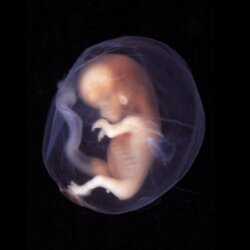



Technology has taken us to the ends of the prenatal spectrum, yet not provided too much for the middle, other than fetal surgeries for a handful of conditions. We can collect and select gametes, and even do the same for very early embryos, allowing those without specific diseases to continue development. At the other end, the gestational age at which a premature infant can survive hasn’t crept younger by much over the years.
So until an artificial uterus becomes a practical reality, technology defines, for me, when a human life begins: at viability outside a woman’s body.
This article first appeared on the GLP on April 7, 2024
Ricki Lewis has a PhD in genetics and is a science writer and author of several human genetics books. She is an adjunct professor for the Alden March Bioethics Institute at Albany Medical College. Follow her at her website or Twitter @rickilewis