Africa is the epicenter of Malaria. The World Health Organisation reports that the disease claims the lives of over 600,000 people annually, with 95 percent of deaths occurring in Africa, predominately among children. The disease spreads to humans through the bites of infected female Anopheles mosquitoes.
While traditional methods to control the disease such as insecticide-treated bed nets, indoor residual spraying, and antimalarial drugs have been invaluable, they have not been adequate to contain the disease.
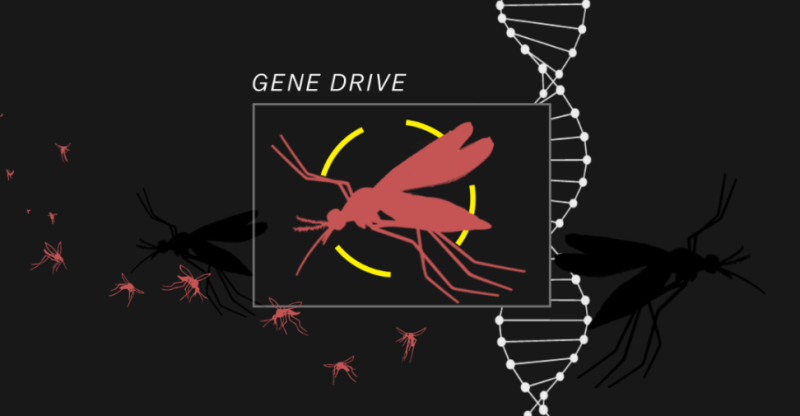
Although there is no silver bullet to control this horrific disease, or other insect and animal borne pests, health officials have an effective technological tool that could turn the tide worldwide—CRISPR gene edited gene drives.
Scientists believe this technology has the potential to wipe out malaria and save millions of lives.

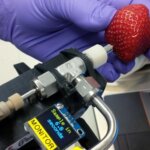
In recent years, researchers have developed gene drive systems to control agricultural pests such as the spotted-wing drosophila (Drosophila suzukii), an invasive fly that attacks soft-skinned fruits, posing a significant threat to agriculture.
Uruguay, among other South American countries, wants to deploy them to eradicate screwworms that are devastating cattle.
“With gene drives, we can control these pests in precise and effective ways,” says Alejo Menchaca, at the National Institute of Agricultural Research in Uruguay.

Case against gene drives
Scientists throughout the world are hopeful that gene drives will rid future generations of dreadful diseases that cause suffering, death, and deplete resources. However, because this technology, for which biochemists Jennifer Doudna and Emmanuelle Charpentier received the Nobel Prize in Chemistry in 2020, is the result of genetic engineering, environmental activists are actively working to prevent its development and future research.
African opponents fret that mosquitoes could be released into open fields in the near future, potentially putting people’s health and the region’s vast ecosystems at risk. But their larger beef is with all genetic innovation in agriculture, including GMOs and gene editing.
“They’re trying to use Africa as a big laboratory to test risky technologies,” said Nnimmo Bassey, director, Health of Mother Earth Foundation (HOMEF), an African-based ecological think tank headquartered in Nigeria that has campaigned against biotechnology.
Proponents of this fledgling revolutionary advance dispute the activists’ claims. They maintain that gene drives could be used in the sustainable control of plant and animal pests, in this case combating mosquito-borne infectious disease in Africa.

The proponents also note that anti-biotechnology activists are fear mongering, and in the long run African children will be the ones to suffer.
How gene drives work?
Gene drive technology exploits the natural process of genetic inheritance to spread specific genes rapidly through a species. The “drives” as they are called can ensure that nearly all offspring inherit the modified gene. Most gene drives in development use mechanisms like CRISPR-Cas9, which can cut and replace DNA at targeted sites. They are in development to target mosquito populations, specifically the Anopheles species, which are primary vectors of the disease in Africa.
In one notable study, researchers engineered Anopheles gambiae mosquitoes with a gene drive that caused female infertility, resulting in a dramatic reduction in mosquito populations within a few generations. Another study introduced a gene drive that made mosquitoes resistant to the Plasmodium parasite, significantly decreasing malaria transmission rates.
These early successes have not convinced activist groups that believe that genetic technologies will lead to western dominance of their already fragile cultures. The opposition crystalized in 2018 after the African Union Development Agency issued its summary report endorsing the development of gene drives to control malaria.
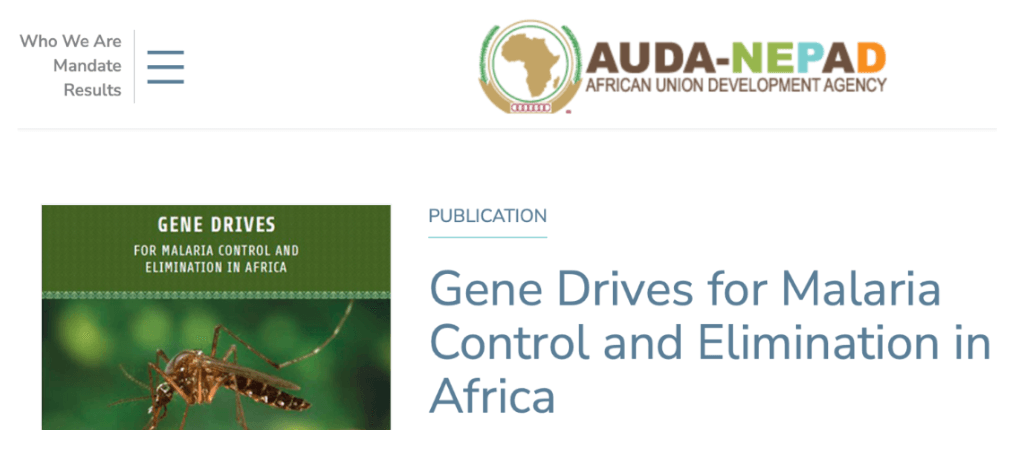
The anti-biotechnology response was quick and overwhelming. “Do not betray Africa,” wrote the Health for Mother Earth Foundation, an ecological think tank advocating for environmental NGO advocating for climate justice and food sovereignty in Nigeria and Africa at large.
Most countries in Africa are still grappling with the threats from basic genetic engineering and associated agro-toxics and do not even have experience or capacity for basic regulation of the risks for those first-generation genetic technologies, let alone synbio and GDOs [gene drives].
African activists believe that gene drives, specifically the manipulation of mosquitoes are a deliberate invasive technology designed to propagate genetic material across an entire population-potentially wiping out entire species.
HOMEF has played point in Africa for the global NGO community opposing gene drives. Africans, the coalition says, do not wish to be lab rats for gene drive experiments or guinea pigs for organizations they believe are bent on misguided disruption of the continent’s food systems and ecology.
The African Centre for Biodiversity (ACB) issued a scathing report of its own, claiming that gene drives would have a detrimental impact on human health and biodiversity.

ACB raised the specter of broader ecological, health, social, and negative economic impacts that it says could pose critical challenges to national sovereignty and biosafety risk assessment.
In some cases, these African organizations are shells, with an African leader but a staff and a budget supported almost entirely by well-funded activist groups in the United States and Europe that have led campaigns against genetic engineering for a quarter of a century.
ACB often partners with Friends of the Earth, Africa, a branch of the US-based FOE, and Canadian-based ETC Group, a technology rejectionist organization with a global presence. They claim multinational corporations in cahoots with foreign governments and the Bill and Melinda Gates Foundation are using Africans as “lab rats” and “guinea pigs.

African scientists opposed to gene drives make their case
The few independent scientists who support their cause are mostly foreign trained.
Barbara Ntambirweki, a Ugandan researcher and Stanford University Digital Practical Fellow is an ardent opponent of gene drives.
Sub-Saharan Africans should put plans to deploy genetically modified mosquito genomes on the back burner, she told the Genetic Literacy Project.
Why? Because there is no evidence or proof that genetically modified mosquitoes would/can contribute to tackling the current challenges in the fight against malaria in the sub-Saharan Africa region,” she said, adding that recent global gains suggest malaria reduction can be achieved without gene editing or GMO technologies.
Paraguay, Argentina, Algeria, Sri Lanka, China, and most recently Cape Verde have recently eradicated malaria through preventative, curative, surveillance, and control interventions, she contended. African nations can follow this path if we focus on alternative interventions for the benefit and sake of future generations. Africa is not a testing ground for untested technologies that have no claim to fame.
According to Ntambirweki, gene drives designed to suppress populations of mosquitoes may not perform as intended but instead result in unpredictable population dynamics where the temporary elimination is followed by resurgence of wild mosquitoes, or mixed populations of wild type and gene drive mosquitoes — a result gene drive supporters say could not happen if so-called ‘terminator technology’ is built into the gene drives.
“At issue, as well,” Ntambirweki says, is the potential risk of the technology to spread into non-target mosquito species that do not carry malaria but may other roles such as providing food sources for aquatic organisms.”
Some African activists take the side of mosquitoes, claiming killing them could be ecologically destructive.
Environmental conservationist Fred Wangota opposes the widespread extermination of wild mosquitos as ecologically risky.
Some are not human disease vectors, he says. Plans to replace wild populations with transgenic mosquitoes that are vectors of human disease could result in an ecological ‘butterfly effect’.
These could impact or eradicate other species, compromising biodiversity, and interfering with food chain cascades, altering pollinators, pests, crops, and interactions.
African scientists respond
Dr. Jonathan Kayondo, Principal Investigator for Target Malaria, Uganda, and the current acting Head of the Department of Entomology at the Uganda Virus Research Institute, believes those fears are misplaced. Target Malaria, one of the research projects working on leveraging gene drives, constantly reassesses the potential for its technology to harm the environment or human and animal health.
We want our new technology, which is self-sustaining and well suited to the widespread incidence of malaria and its prevalence in rural areas to be safe and effective.
Target Malaria published a paper in the Malaria Journal that simulated releases of gene drive mosquitoes in West Africa.
The exercise revealed that, in many cases, the more efficient a gene drive mosquito causes population reduction, the less likely potential harms are to occur. Many of the [potentially harmful] pathways identified here, although plausible, would not be expected to occur because the identification of potential harms allowed the project to be prepared to identify them during product testing and result in the strain being eliminated from further development.
Kayondo said the identified pathways will inform the next stages of an Environmental Risk Assessment on a population suppression gene drive, which will involve assessments of the likelihood and magnitude of identified potential harms.
“Before any novel control method can undergo regulatory review for consideration of field releases, potential harms to human health and the environment must first be identified and assessed,” he said.
Rita Muheto, a Tanzanian molecular geneticist agreed, maintaining that modified mosquito genomes would reduce the incidence of malaria in sub-Saharan Africa.
New gene editing tools, such as CRISPR-Cas9 and gene drives, will ensure that modified mosquito genomes are incapable of transmitting malaria parasites. With these technologies, our scientists will be able to genetically modify the little insects to produce sterile offspring that do not survive, as well as tweak their genes to prevent the birth of females, which seek out and bite humans and spread malaria.
Those claims are not reassurance, Wangota insists. “They have not been deployed yet for a reason.
49 African nations have ratified the Cartagena Protocol on Biosafety, which requires prior applications for the release of gene drive organisms to be submitted to a competent national authority. Africa must stick with its two proven malaria vector control strategies—indoor residual spraying and insecticide treated mosquitoes.
How might the public view gene drive deployment?
With respect to how the region’s publics are likely to respond to any future gene drive deployment, Ntambirweki pointed out that the status quo did not portend an optimistic outcome.
“Concerns will be raised about their deployment because they have been shrouded in secrecy and there is a lack of transparency in areas where research is going on. Communities in countries such as Burkina Faso, Mali, and Uganda have not been informed about their potential risks, but communities are required to give free prior informed consent, which has not been done.”
Ntambirweki stressed that gene drive developers should set up social contracts with communities, and that they should have to bear responsibility for any risks or unintended effects that might arise as result of gene drive deployment.
Free prior informed consent is a requirement that needs to embody these gene drive experiments. Currently, all these developments occur in a governance vacuum. The region still lacks a comprehensive law to regulate the development of this controversial technology.
Scientists behind gene drive development believe such social contracts, while attractive in theory, would likely be exploited by gene drive opponents, freezing deployment indefinitely.
At a societal level, a social contract is already in place, said Jude Thaddeus Bigirwenkya, Stakeholder Engagement Manager for Target Malaria Uganda. The contract is between the government and its people, and it recognizes Ugandan laws and regulations. Decisions on biosafety, including risk assessment and accountability, are made by the National Biosafety Committee on behalf of the Ugandan population.
In response to criticism that there hasn’t been enough community and decision-maker engagement in Burkina Faso, Mali, and Uganda—countries where mosquito gene drive are in development—Bigirwenkya said that the research consortium routinely seeks input with local communities.
The Target Malaria project has been engaging communities and countries where the research takes place for more than 10 years depending on the phase of the research.
Each of the African partner research teams has a dedicated stakeholder engagement team whose role is to reach out to local communities and other groups. We believe it is important to engage stakeholders on an ongoing basis on any potential applications, risks and benefits of gene drive technologies.
The project abides by its community agreement model to involve affected communities in the decision-making process and document local acceptance, he added.
He added that Target Malaria operates and works in accordance with biosafety decisions, including risk assessment and accountability considerations made by different countries’ Biosafety Committees and Authorities.
A potential gene drive release would only occur with national authorities’ approval and in compliance with international guidelines and national biosafety standards,” says entomologist Charles Mugoya, the Regulatory Affairs Manager for Africa at Target Malaria in response to concerns that gene drives would be deployed without considering risks to human health and biological diversity.
Those assurances will certainly not be enough for groups dedicated to blocking agricultural biotechnology innovation.
Richard Wetaya is an award-winning Ugandan science journalist who specializes in covering environmental issues, biotechnology, energy, health and climate change. Follow on LinkedIn Richard Wetaya and X @rwetaya