This article isn’t about whether you should take the stuff [1]. Instead, it raises some questions about what you think you’re taking vs. what you’re really taking.
If some of you find the following disquieting, I apologize in advance. But (A) it is all true; (B) it’s information your vitamin shops don’t want you to have; and (C) it will possibly screw with your head a little, in an ironic sort of way.
Did you ever wonder where your vitamin C comes from? Perhaps, on some level, you envision a bunch of flaxen-haired beauties with flowers in their hair, blithely frolicking through lush orange groves, lovingly selecting only the finest fruit, which will later be hand-squeezed to ensure that you will be getting nothing short of nature’s miracle itself?

You may need to adjust your expectations somewhat. Here is where your vitamin C really comes from.

But at least it looks idyllic inside:
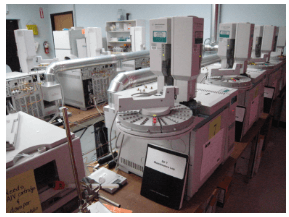
Ninety percent of the vitamin C that is consumed in the U.S. is manufactured in China. And it sure doesn’t come from oranges.
Two Choices: Both “Bad”
- Chemical synthesis
Vitamin C is synthesized in a multi-step sequence invented in 1933 (known as the Reichstein process), which starts with glucose as the raw material. Here are some of the chemicals used:
- Hydrogen gas and nickel metal under high-pressure
- Fermentation with oxygen and acetobacter bacteria
- Acetone (petrochemical), sulfuric acid (will dissolve your spleen, and everything else)
- Potassium permanganate (good for blowing stuff up)
- More sulfuric acid (in case it missed some of your spleen the first time)
If the scenario above doesn’t meet your lofty personal standards, there is good news. Sort of. The Reichstein process is mostly obsolete, because of economic and environmental factors. The chemical steps have been replaced by biosynthetic fermentation, carried out by genetically engineered microorganisms.
2. Fermentation process
While fermentation of glucose may sound more natural (hence better) than the Jersey Turnpike route, it brings along a healthy dose of ironic hilarity.




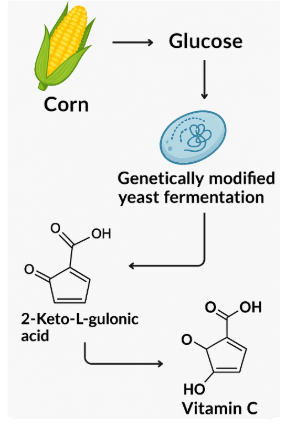
The one-pot fermentation method above shows the steps carried out by yeast. No problem, right Mr. Natural? Actually, there are several “problems,” or at the very least, a dent in your ideology:
- The corn used is genetically modified.
- It is then converted into corn starch. Sulfur dioxide, a preservative, is used in during process to inhibit bacterial growth.
- The corn starch is converted into glucose (sometimes referred to as “corn syrup”) using an enzyme called α-amylase.
- The α-amylase is made from genetically modified yeast and then lab-purified.
- The lab-produced glucose is converted into lab-based vitamin C using a fermentation process involving GM yeast strains, such as Ketogulonicigenium vulgare or Bacillus megaterium

So, there you go. If you’ve been taking vitamin C supplements, ~90 percent of the time you have been swallowing synthetic stuff that comes from a place as pastoral-looking as the New Jersey Turnpike near Exit 14A.
Or, you can swallow your pride, and embrace GM technology? What to do?
If all of a sudden, you find yourself facing a logical paradox, you are not the first. Gene Roddenberry beat you to it almost 60 years ago:
Star Trek Episode #37, November, 1967.
The “good” news? It doesn’t matter whether your vitamin C comes from flaxen-haired beauties or a place that looks like the Jersey Turnpike — it’s exactly the same. No matter the source, the vitamin C that you don’t need is chemically identical and indistinguishable.
NOTES:
[1] American Council advisor, Dr. David Seres, the director of nutritional medicine at Columbia Presbyterian Medical Center, has the following to say: “For most people, there is absolutely no role for a vitamin C supplementation. There is ample proof, from well designed studies, that vitamin C does not prevent even the common cold, let alone anything else.”
Josh Bloom is ACSH’s Director of Chemical and Pharmaceutical Science. Josh earned his Ph.D. in organic chemistry at the University of Virginia, followed by postdoctoral training at the University of Pennsylvania. Find Josh on X @JoshBloomACSH