
Brain dynamics and cognition share genetic roots. Criticality may guide future brain health research.
A recent study published on June 24 in PNAS presents strong evidence that brain criticality—the delicate balance between neural excitation and inhibition—is heavily influenced by genetic factors and closely linked to cognitive abilities.
The research, led by Prof. Ning Liu of the Institute of Biophysics at the Chinese Academy of Sciences (CAS) and Prof. Shan Yu of the Institute of Automation at CAS, utilized resting-state functional MRI (rs-fMRI) data from the Human Connectome Project S1200 release. This dataset included scans from 250 identical twins, 142 fraternal twins, and 437 individuals with no familial relation, allowing researchers to effectively assess the genetic contributions to brain criticality.
Sensory regions show strong heritability
The findings revealed that genetic factors play a significant role in shaping brain criticality, with more pronounced genetic influence detected in the primary sensory cortices than in higher-order association areas. This indicates that the brain’s ability to sustain near-critical dynamics—previously linked to efficient information processing and cognitive adaptability—is largely inherited.
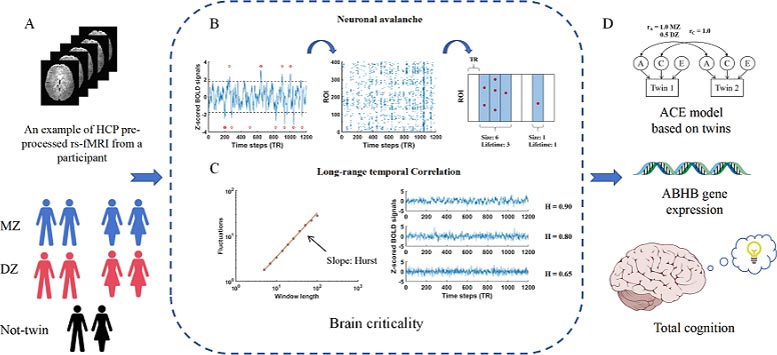
To further explore the underlying biology, the researchers combined the rs-fMRI data with gene expression maps from the Allen Human Brain Atlas. This analysis identified specific genetic expression patterns that correlate with regional brain criticality and are involved in biological processes associated with neurological disorders.




Importantly, the study also revealed that brain criticality and cognitive performance share a common genetic foundation, providing valuable insight into how inherited traits may support higher cognitive function.
Toward new understanding of brain health
“Maintaining criticality is essential for brain function,” said Prof. Liu. “Uncovering its genetic basis opens new directions for understanding cognition and neurological disease.”
This work lays the foundation for future research into the molecular mechanisms behind critical brain dynamics and their implications for brain health.
A version of this article was originally posted at SciTechDaily and is reposted here with permission. Any reposting should credit both the GLP and original article. Find SciTechDaily on X @SciTechDaily1