The Dunning-Kruger Effect is a cognitive bias where individuals with limited knowledge or skills in a specific area tend to overestimate their expertise. In simpler terms, the less you know, the more confident you may feel about your understanding. This phenomenon can lead to serious misunderstandings and the spread of misinformation, particularly in complex fields like agriculture.
In agriculture, the Dunning-Kruger Effect can pose unique challenges. When experts from unrelated fields engage in discussions about farming, plant genetics, food production, and more — without consulting actual subject matter experts — they risk making assumptions that perpetuate misinformation.
Ground Zero: The Lancet.
A prominent example of this is the 2015 IARC monograph published in The Lancet, which incorrectly classifies glyphosate as an organophosphate. Glyphosate is an an organophosphonate.
This distinction is not trivial; it is significant.
This mis-categorization highlights not just a lack of understanding about chemistries but also highlights how easily misinformation can spread when experts step outside their areas of expertise and how this can influence or shape public opinion. Was this “error” intentional or unintentional? We may never know. What we do know is that understanding the difference between these chemical classifications is crucial for assessing public health risks and in treating the patient.
Note: The Lancet is heavily referenced in medical circles. Yet, the mis-categorization in this monograph published in 2015 remains uncorrected. It continues to be cited (700+). It shapes public opinion and, of course, has spurred litigation.
Misinformation and the Medical Community.
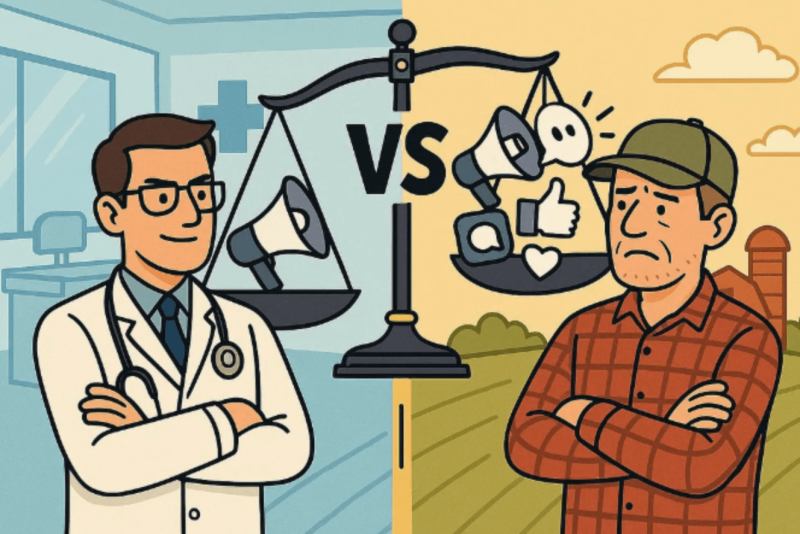
The Dunning-Kruger Effect often intersects with cognitive dissonance. This is the discomfort people feel when strongly held beliefs clash with new evidence. In this case, medical professionals might oversimplify agricultural practices due to limited understanding, leading them to draw flawed conclusions about pesticide safety or farming methods. I witnessed huge errors on platforms like TikTok. Medical experts work really hard on the platform to mitigate misinformation about vaccines, viruses, medical practices, etc in credible and creative ways. However, I have seen many lean into and misrepresent the science of agriculture. This may include sweeping statements about agricultural chemicals without recognizing that they just don’t have the knowledge and expertise to engage around complex topics like this.

So What?
The interplay of the Dunning-Kruger Effect and cognitive dissonance highlights the need for interdisciplinary collaboration in agriculture. To effectively combat misinformation, we must implement peer review processes in medical (and related) journals that include experts with a deep understanding of agricultural science. Bridging the divide between agriculture, medicine, environmental science, and social sciences is crucial for fostering accurate communication and science-based policy-making. This collaborative approach not only enhances the credibility of information but also equips us to address the multifaceted challenges of food security, food production, and environmental sustainability.
Tackling misinformation in agriculture means that we need to recognize our own knowledge limitations and collaborate with a diverse range of experts and stakeholders. By encouraging interdisciplinary discussions, we can better confront the pressing global challenges we face today.
References:
- Kruger, J., & Dunning, D. (1999). Unskilled and unaware of it: How difficulties in recognizing one’s own incompetence lead to inflated self-assessments. Journal of Personality and Social Psychology, 77(6), 1121–1134. doi:10.1037/0022–3514.77.6.1121
- Ryan, C. D., Schaul, A. J., Butner, R., & Swarthout, J. T. (2020). Monetizing disinformation in the attention economy: the case of genetically modified organisms (GMOs). European Management Journal, 38(1), 7–18.
Cami Ryan is a social & behavioral scientist working in agriculture. Follow Cami on X @CamiDRyan
A version of this article was originally posted at Medium and has been reposted here with permission. Any reposting should credit the original author and provide links to both the GLP and the original article. Find Medium on X @medium