Nearly 30 minutes. That’s the new world record for holding one’s breath under water. Here is how he did it

Screenshot 2025-10-03 at 12.58.34 PM

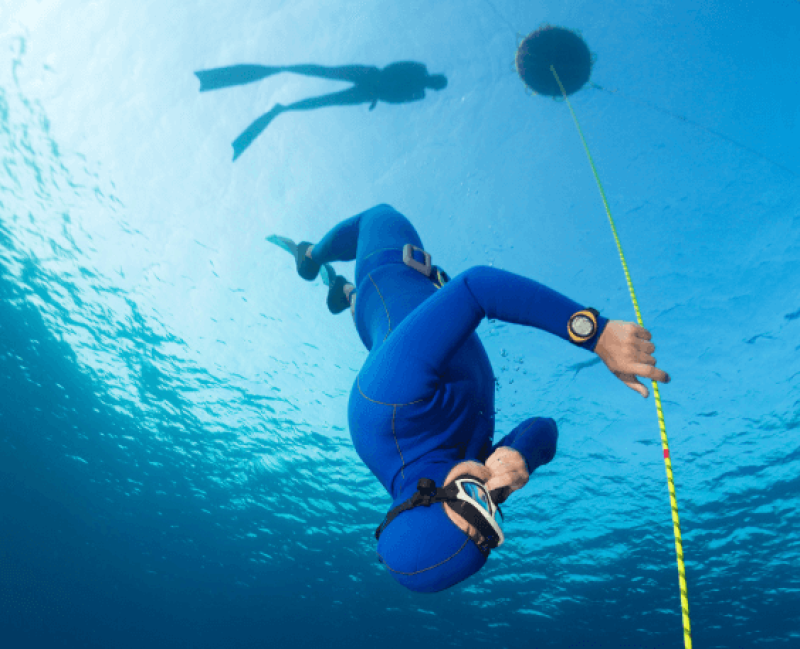
Vitomir Maričić is one of the world’s best freedivers.

And this summer he set a new world record:

He held his breath for 29 minutes and 3 seconds.

Ingrid Eftedal has researched freedivers.

These are people who dive underwater without a supply of air.

Eftedal finds the record is impressive. 

Most ordinary people can usually only hold their breath for about one minute.

Breathing works like a switch

The reason for this is our breathing reflex. It forces itself on like an automatic switch.

The reflex is triggered when carbon dioxide builds up in the blood, something that happens when we hold our breath.

“Freedivers train themselves to suppress that reflex,” she says.

Follow the latest news and policy debates on sustainable agriculture, biomedicine, and other ‘disruptive’ innovations. Subscribe to our newsletter.

Our body has an organ that can help us underwater: the spleen.

“Freedivers often call it an extra diving tank,” says Eftedal.

When you hold your breath, it can release red blood cells – and give the body extra oxygen.

“For some people, freediving is part of their everyday life,” says Eftedal.

This applies to the Bajau people in Indonesia.

“They have developed larger spleens,” she says.

This is an excerpt. Read the original post here

{{ reviewsTotal }}{{ options.labels.singularReviewCountLabel }}
{{ reviewsTotal }}{{ options.labels.pluralReviewCountLabel }}
{{ options.labels.newReviewButton }}
{{ userData.canReview.message }}

Related Articles

Infographic: Global regulatory and health research agencies on whether glyphosate causes cancer

Infographic: Global regulatory and health research agencies on whether glyphosate causes cancer

Does glyphosate—the world's most heavily-used herbicide—pose serious harm to humans? Is it carcinogenic? Those issues are of both legal and ...

Most Popular

Screenshot-2026-05-01-at-11.56.24-AM
‘Science moves forward when people are willing to think differently’: Memories of DNA maverick Craig Venter
Screenshot-2026-04-03-at-11.15.51-AM
Paraben panic: How a flawed study, media hype, and chemophobia convinced the public of the danger of one of the safest classes of preservatives
79d03212-2508-45d0-b427-8e9743ff6432
Viewpoint: The Casey Means hustle—Wellness woo opportunism dressed up as medical wisdom
ChatGPT-Image-Apr-30-2026-12_21_05-PM-2
The tech billionaires behind the immortality movement
Screenshot-PM-24
Viewpoint: The herbicide glyphosate isn’t perfect. Banning it would be far worse.
ChatGPT-Image-Mar-27-2026-11_27_05-AM
The myths of “process”: What science says about the “dangers’ of synthetic products and ultra-processed foods
ChatGPT-Image-Mar-10-2026-01_39_01-PM
Viewpoint—“Miracle molecule” debunked: Why acemannan supplements don’t work
Drinking lots of water can help reduce the effects of aging
Nanoplastics in drinking water: MAHA activists forge science-based bipartisan coalition 
ChatGPT-Image-May-1-2026-03_16_32-PM
Viewpoint: How ‘health care guru’ Joe Rogan circumvented the FDA’s skepticism on psychedelics
ChatGPT-Image-Mar-3-2026-01_17_14-PM
MAHA wellness influencers deride proven anxiety medications, tout lifestyle fixes
ChatGPT-Image-Apr-30-2026-05_00_48-PM
Wellness grifter physician turned wellness influencer out as surgeon general nominee
ChatGPT Image Apr 30, 2026, 01_11_41 PM
Trump’s America First health aid cuts: Retrenchment has already hit global malaria, HIV, TB, and polio programs
glp menu logo outlined

Get news on human & agricultural genetics and biotechnology delivered to your inbox.